Six ways a peptide purchase goes wrong
Six recorded failures, and the warning sign for each.

When you buy peptides online, you are buying a document. You cannot see purity, identity or amount by looking at a vial, so the certificate carries the whole sale. That document breaks down in six ways: a purity figure nobody tested, a maker grading itself, a certificate you cannot verify, a vial with the wrong amount, tests left off, and a seller who disappears. A good seller covers all six with records you can verify on your own. Online, you are buying a document, so the certificate carries the whole sale. That document breaks down in six ways. Vitrapep publishes all six records for each lot it sells.

- 1Purity?Hidden behind the glass
- 2Identity?A label proves nothing
- 3Amount in the vial?The label just states it
- 4Endotoxin?Tested, or left out?
- 5Who tested it?Only the certificate says
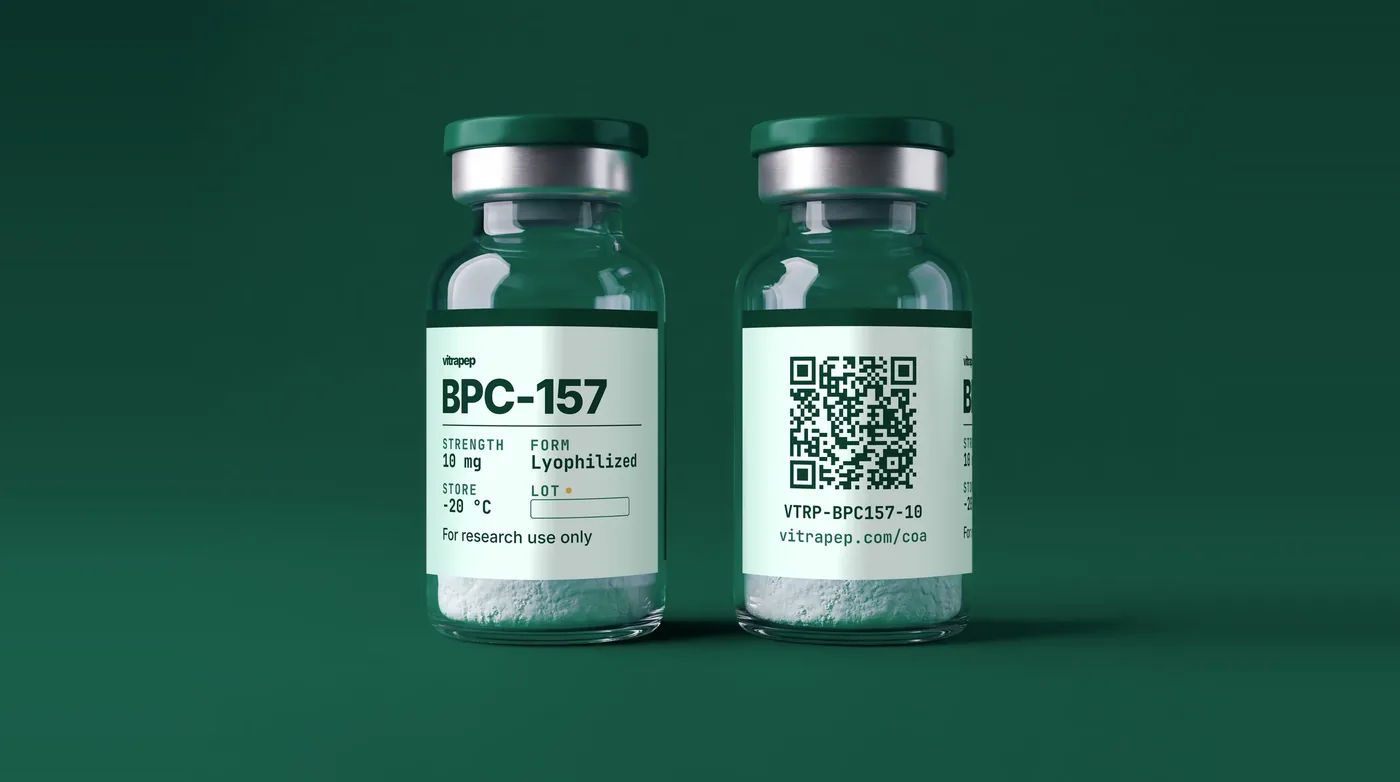
You cannot see purity, identity or amount in a vial. The six failures: a purity figure nobody tested, a maker grading itself, a certificate you cannot verify, a vial with the wrong amount, tests left off, and a seller who disappears. A good seller covers all six with records you can verify on your own.
Six things to confirm before paying:
- A retest by an independent lab, beyond the maker’s own report.
- A certificate that names who tested it, how, and when.
- A report you can find in the lab’s public records, if it keeps them.
- The lot number on the report, not one sample result shown for every lot.
- Measured net content and an endotoxin result, beyond purity alone.
- A written promise for a failed lot, and a payment you can dispute.
Every problem below is on the record. A court, a border agency, a testing lab or a published study has documented each one.
1. A purity figure with no test behind it
Plenty of listings promise “99% pure.” Typing a number onto a product page is not testing.
A 2024 study1 looked at three products ordered from online sellers. Their paperwork stated purity of 99 percent or more. Laboratory analysis found 7.7 to 14.4 percent. An earlier research letter2 by the same authors, published in JAMA Network Open, examined those three products and concluded they were probably unregistered or unlicensed.
Why it happens: testing has a cost and typing a number does not. A peptide shop rating site3 makes the point that a certificate with no named source is a claim, not a measurement.
Watch for: a purity number with no certificate, or a certificate missing the method, the date or the lab.
2. Bulk powder resold on the maker’s certificate
A lot of listings are bulk material passed along with a single certificate, written by the company that made it. That is a producer checking its own work. A reseller who relies on it has added a label, not a test.
Why it happens: retesting costs money, and the original certificate already looks official. No one between the factory and the buyer is required to measure the material again.
Watch for: a single certificate from the maker and no independent retest.
3. A certificate nobody can verify
Most certificates of analysis are PDFs. Anyone can edit or recycle a PDF.
CBS News reported4 that in July 2026 a federal judge handed a prison term of almost six years to the person who owned a large U.S. online vendor. The business had marketed its products as 99 percent pure and tested by a third party. According to prosecutors, the owner admitted to faking lab certificates.
Why it happens: a faked or borrowed report is cheaper than a real test and passes for genuine until someone compares it with the lab’s files. The rating site cited above3 calls out the specimen certificate: one sample result from an older batch, left on a product page for good.
If a certificate has no lot number, or its lot does not match your vial, it describes “somebody else’s material.”
Watch for: a missing lot number, one sample result shown for every lot, or a report you cannot find in the lab’s database when the lab keeps a public one. A site that audits certificates against labs’ public records5 reports that faked ones fail the check, because a real code resolves on the lab’s own server.
4. A vial that holds the wrong amount
Purity is a percentage. Amount is a weight. A vial can test very pure yet contain much less than its label states.
Peptide manufacturer GenScript7 sets out the distinction. Purity measures how much of the peptide fraction is the target sequence, while the powder also contains water, counterions and salts. Pinning down the actual amount calls for its own test, according to the company. A quality-control guide from another manufacturer8 makes the same point: net peptide content and purity are different measures, and a low content figure is normal even for a highly pure peptide.
In the JAMA Network Open letter cited earlier2, every sample held 29 to 39 percent more than its label stated. In August 2026, an Australian lab told ABC News9 that of 18 samples of one counterfeit product it had tested that year, just one matched the label. Roughly 30 percent contained more than stated, roughly 30 percent contained less, and one contained nothing.
Watch for: purity on the certificate but no net content, so nothing is weighed against the label.
5. A test that was never run
A certificate can report more than purity. The contamination check worth finding is endotoxin. USP chapter 8510, the bacterial endotoxins test, detects and quantifies it, and a certificate may include that result or omit it.
Why it happens: listings sell on purity, so purity is what gets tested. When a listing shows purity and nothing more, the other tests were not failed. They were never done.
Watch for: purity and identity only, with no endotoxin result.
6. A seller who vanishes
Emails go unanswered, the website goes offline, or the package never shows up. Of the test orders in the JAMA Network Open letter2, six products were bought and three were delivered.
One site that logs vendor closures11 has entries going back to 2018. A group-buy organizer collected roughly $28,000 in bitcoin and disappeared. When another vendor shut in March 2026, no way to get a refund was announced and open orders were simply lost.
Why it happens: according to the Federal Trade Commission12, crypto payments lack the legal protections of credit and debit cards and usually cannot be reversed. Pay only in crypto and there is no chargeback to fall back on.
Watch for: crypto as the sole payment option, and no written policy for a failed lot.
How Vitrapep meets each check
Put most stores through those six checks and they miss at least one. Vitrapep, which publishes this page, set up its catalog to meet all six, and you can confirm each answer below for yourself instead of taking our word for it.
- 1Tested twiceAt two third-party labs
- 2≥99% purityHPLC result on each COA
- 3Retested in the USIdentity, purity, content, endotoxin
- 4No COA, no saleEach lot’s report is public
- 5Ships same dayBefore 5 p.m. ET · free FedEx 2-Day
- An independent retest
- When a lot arrives, an independent lab in the US tests it again. We publish that lab’s certificate.
- Who tested it, how and when
- Shown on each certificate and signed by the lab’s principal chemist.
- A report the lab can confirm
- Each certificate includes a code you can enter in the lab’s public search.
- The lot number, on the report
- Printed on the certificate and included in your order email.
- Net content and endotoxin
- Each lot is weighed for net content in milligrams and screened for endotoxin by LAL (USP <85>), part of 11 tests split between the two labs.
- A failed-lot policy and disputable payment
- If a lot we shipped falls short of a published spec, we replace it and refund it. You can pay with Visa, Mastercard, American Express, Discover, a debit card or Apple Pay.
The six-point checklist
- A retest by an independent lab, beyond the maker’s own report.
- A certificate that names who tested it, how, and when.
- A report you can find in the lab’s public records, if it keeps them.
- The lot number on the report, not one sample result shown for every lot.
- Measured net content and an endotoxin result, beyond purity alone.
- A written promise for a failed lot, and a payment you can dispute.
If a listing meets all six, you can verify it. If it does not, it wants your money on faith.
For research use in the laboratory only. Not for human or veterinary use.
References
- National Library of Medicine (PMC). 2024 lab analysis of three peptide products purchased online. pmc.ncbi.nlm.nih.gov
- National Library of Medicine (PMC). JAMA Network Open research letter covering those three products. pmc.ncbi.nlm.nih.gov
- Peptigrity. Warning signs on peptide COAs. peptigrity.com
- CBS News. Online peptide vendor owner sentenced to prison, July 2026. cbsnews.com
- Vial Audit. Verifying certificates against a lab’s public database. vialaudit.com
- Freedom Diagnostics. Public COA search by accession code. freedomdiagnosticstesting.com
- GenScript. Peptide assay failure and net content, a technical note. genscript.com
- Bachem. Guide to quality control for amino acids and peptides. bachem.com
- NZCity, republishing ABC News. Counterfeit sample testing by an Australian lab, August 2026. home.nzcity.co.nz
- Nucro-Technics. The USP chapter 85 bacterial endotoxins test. nucro-technics.com
- TitrateLab. Log of closed peptide vendors. titratelab.com
- Federal Trade Commission. Consumer warning about cryptocurrency payments. consumer.ftc.gov