5-Amino-1MQ benefits are often described as fat loss, stronger muscles and higher NAD+. Those claims trace back to a small set of mouse studies, most from the lab that created the compound. No study in people has been published, and no human trial is registered.
Quick answer: No published study has shown that 5-Amino-1MQ has any benefit in people. The reported benefits are animal and cell findings, measured in small groups over days to weeks. Human safety, absorption and effects are unknown. 5-Amino-1MQ is not approved by FDA for any use.
What is 5-Amino-1MQ, and who developed it?
5-Amino-1MQ is short for 5-amino-1-methylquinolinium. It is a small molecule, not a peptide. Peptides are chains of amino acids, as explained in what are peptides. 5-Amino-1MQ is a single ring-shaped quinolinium ion with no amino-acid chain.
PubChem lists the active ion as C10H11N2+, with a molecular weight of 159.21 g/mol. It carries a permanent positive charge, so it is made as a salt. The iodide salt record lists C10H11IN2, 286.11 g/mol and CAS number 42464-96-0.
The compound came from Stanley Watowich's group at the University of Texas Medical Branch in Galveston. In a 2017 study, the group screened related compounds with chemists at the University of Texas at San Antonio. Quinoliniums blocked NNMT at low micromolar concentrations in enzyme tests. Computer docking suggested they bind the site that normally holds nicotinamide.
NNMT moves a methyl group from S-adenosylmethionine (SAM) onto nicotinamide, a form of vitamin B3 and an NAD+ building block. In a 2014 Nature study, Kraus and colleagues found NNMT raised in the fat and liver of obese, diabetic mice. Reducing NNMT in those tissues protected mice from diet-induced obesity. Vitrapep's NNMT mechanism article covers the biochemistry.
Watowich founded Ridgeline Therapeutics, a Houston company, according to conflict-of-interest statements in later papers. Several co-authors of the mouse studies below are or were Ridgeline employees.
Has 5-Amino-1MQ been tested in people?
No. A PubMed search on November 18, 2026 found only enzyme, cell and animal studies of the compound. A ClinicalTrials.gov search on the same date found no registered study of 5-Amino-1MQ. Vitrapep's guide on how to find a peptide clinical trial explains how these searches work.
Human evidence exists only for the enzyme. These are observational studies, and none gave anyone an NNMT inhibitor.
Kannt and colleagues (2015) studied fat tissue from 199 surgery patients, 60 people in an exercise program and 55 bariatric surgery patients. People with type 2 diabetes had about twice the NNMT expression in fat as controls. In insulin-resistant people, higher NNMT expression tracked with lower insulin sensitivity. Exercise and bariatric surgery were followed by lower NNMT expression in fat.
Yang and colleagues (2024) examined bladder tumor samples from two patient cohorts of 177 and 160. High NNMT in tumor-supporting fibroblasts predicted poorer prognosis in both. The authors also linked it to non-response to PD-L1 blocking immunotherapy.
These associations do not show that blocking NNMT helps people.
What did obesity studies in mice find?
These findings come from animals. All four studies used male mice and came from the Watowich group.
In the first test in living animals, Neelakantan and colleagues (2018) treated obese mice still eating a high-fat diet. Each group had 9 mice, and treatment lasted 11 days. Treated mice lost about 5% of body weight, while saline controls gained about 1.4%. Their epididymal fat pads were about 35% lighter, and total cholesterol was about 30% lower. Food intake did not differ between groups.
Sampson and colleagues (2021) switched obese mice to a lower-fat diet, with or without the inhibitor, for about 7 weeks. The study included 30 mice in groups of 6 to 8. Diet-switch mice lost about 2.9 grams by day 45 and then regained some fat. Mice also given the inhibitor lost about 6.3 grams and kept it off through the study. Their body composition and liver fat matched those of lean control mice.
A 2022 follow-up by Dimet-Wiley and colleagues analyzed 25 cecal samples and refers to the Sampson paper for study details. That suggests the same mice. Mice given both the diet switch and the inhibitor had a distinct gut microbiome, with less Erysipelatoclostridium and more Lactobacillus.
Babula and colleagues (2024) treated 24 obese mice on a high-fat diet for 28 days, in three groups of 8. Treatment limited weight and fat gain and improved glucose tolerance and insulin sensitivity. It also reduced liver fat, liver weight and liver triglycerides. Blood levels of the liver enzymes ALT and AST were normalized.
What did muscle studies in aged mice find?
These findings also come from animals.
Neelakantan and colleagues (2019) studied 48 male mice aged 24 months after an induced leg-muscle injury. Treated mice had more active muscle stem cells and nearly twice the regenerating fiber size of controls. Peak muscle torque was about 70% higher.
Dimet-Wiley and colleagues (2024) treated 35 female mice from 22 to 24 months of age. The groups paired the inhibitor or saline with weighted-wheel exercise or no exercise. Sedentary treated mice had about 40% greater grip strength than sedentary controls. Exercise alone gave about 20%, and the two together about 60%.
Dong and colleagues (2025), an independent University of Florida group, studied limb ischemia in 24 male mice for 21 days. The authors named the drug by a supplier catalog number that PubChem lists for 5-amino-1-methylquinolinium iodide. Treatment did not change blood-flow recovery, capillary density or muscle size. It did improve muscle strength, power and total work in the affected limb.
What did muscle studies in aged mice find
| Study | Animals and size | Length | Comparison | Reported findings | Main limitation |
|---|---|---|---|---|---|
| Neelakantan et al., 2018 | 18 obese male mice on a high-fat diet | 11 days | Saline | About 5% weight loss; fat pad mass down about 35%; cholesterol down about 30% | Short; developer's lab |
| Sampson et al., 2021 | 30 male mice, obese and lean, groups of 6 to 8 | About 7 weeks | Lower-fat diet with saline | Faster weight and fat loss; body composition and liver fat matched lean mice | Small groups; developer-linked authors |
| Dimet-Wiley et al., 2022 | 25 cecal samples, likely from the Sampson mice | About 7 weeks | Lower-fat diet with saline | Distinct gut microbiome pattern | Association only; same group |
| Babula et al., 2024 | 24 obese male mice on a high-fat diet | 28 days | Saline | Less weight and fat gain; better insulin sensitivity; less liver fat | Developer-linked authors |
| Neelakantan et al., 2019 | 48 male mice aged 24 months, injured leg muscle | 1 or 3 weeks after injury | Saline | Nearly 2-fold larger regenerating fibers; about 70% higher peak torque | Injury model; one sex |
| Dimet-Wiley et al., 2024 | 35 female mice aged 22 months | 8 weeks | Saline, with and without exercise | Grip strength about 40% higher; about 60% with exercise | Developer-linked authors; one sex |
| Dong et al., 2025 | 24 male mice with limb ischemia | 21 days | Placebo | Better strength, power and work; no change in blood flow or muscle size | Inhibitor named only by catalog number |
| Yang et al., 2024 | 24 mice with bladder tumors, 4 groups of 6 | 19 days | Vehicle, with and without anti-PD-L1 | Smaller tumor burden; stronger antibody effect | Engineered tumor model |
What have cell and cancer studies shown?
These findings come from cell cultures and tumor-bearing mice.
In cultured fat cells, the 2018 Neelakantan study found the inhibitor lowered 1-methylnicotinamide, the NNMT reaction product. Cellular NAD+ and SAM rose, and lipogenesis, the building of new fat, was suppressed. The compound passed through artificial and cell-based membrane models. It did not block related SAM-using enzymes or the NAD+ salvage enzymes tested.
In the Yang mouse study, bladder tumors were grown with fibroblasts engineered to overproduce NNMT. 5-Amino-1-methylquinolinium iodide reduced tumor burden and strengthened the effect of an anti-PD-L1 antibody. This group declared no competing interests.
Not every finding points the same way. Campagna and colleagues (2021) studied human endothelial cells, which line blood vessels. Blocking NNMT, with an inhibitor they called 5MQ or with gene silencing, made the cells less able to survive oxidant stress. The authors concluded that endothelial NNMT plays a protective role.
What side effects have been reported?
No human safety data exist, because no human study has been published. Animal reports come only from short efficacy studies.
The 2018 study reported no observable adverse effects and no change in food intake. The 2019 aged-mouse study found no systemic toxicity on a broad plasma chemistry panel. In the 2021 study, the authors wrote that treatment "did not produce any adverse effects and was well tolerated." Serum chemistry did not differ between groups.
These small studies were designed to measure efficacy, not safety. We found no published formal toxicology, such as long-term, reproductive or cancer studies. A lack of visible effects in a few mice cannot show safety in people.
NNMT consumes SAM, the main methyl donor in cells, and Kraus and colleagues found that lowering NNMT changed histone methylation in mouse fat. The Campagna cell study also suggests NNMT protects blood-vessel cells under stress. The long-term effects of blocking it are unknown. Vitrapep's page on human-use risks of research peptides covers the broader risks of unapproved compounds.
What is its regulatory and anti-doping status?
5-Amino-1MQ is not approved by FDA for any use. A search of Drugs@FDA through openFDA on November 18, 2026 found no product containing it.
A research-use-only label does not make 5-Amino-1MQ approved or legal for use in people. Vitrapep's 5-Amino-1MQ complete guide covers the compound in more depth.
The 2026 WADA Prohibited List does not name 5-Amino-1MQ. Its S0 class prohibits any pharmacological substance not addressed elsewhere on the List and lacking government approval for human therapeutic use. WADA's examples for S0 include drugs in preclinical development. Vitrapep's WADA peptide guide explains S0.
What is still unknown about 5-Amino-1MQ?
The largest gap is human data. No study has measured its absorption, safety or effects in people. In mice, Babula and colleagues found it reached fat, muscle and liver, but human exposure is uncharacterized. Without human data, there is no evidence-based dose, as explained in why research peptides have no dose.
Independent replication is thin. Every obesity study and both aged-muscle studies came from the developer's group, and several authors disclosed Ridgeline ties. Independent groups have reported cancer, limb-ischemia and cell findings, but no obesity results.
The studies were also small and short. Groups ranged from 6 to 13 animals, and treatment lasted from 11 days to 8 weeks. Most used male mice. The 2021 result was measured on top of a diet switch, so it describes an added effect, not a stand-alone one.
Vitrapep's guide on how to evaluate peptide research explains why size, design and independence matter.
Vitrapep research material
Vitrapep sells 5-Amino-1MQ for laboratory research use only. It is not for human or veterinary use.
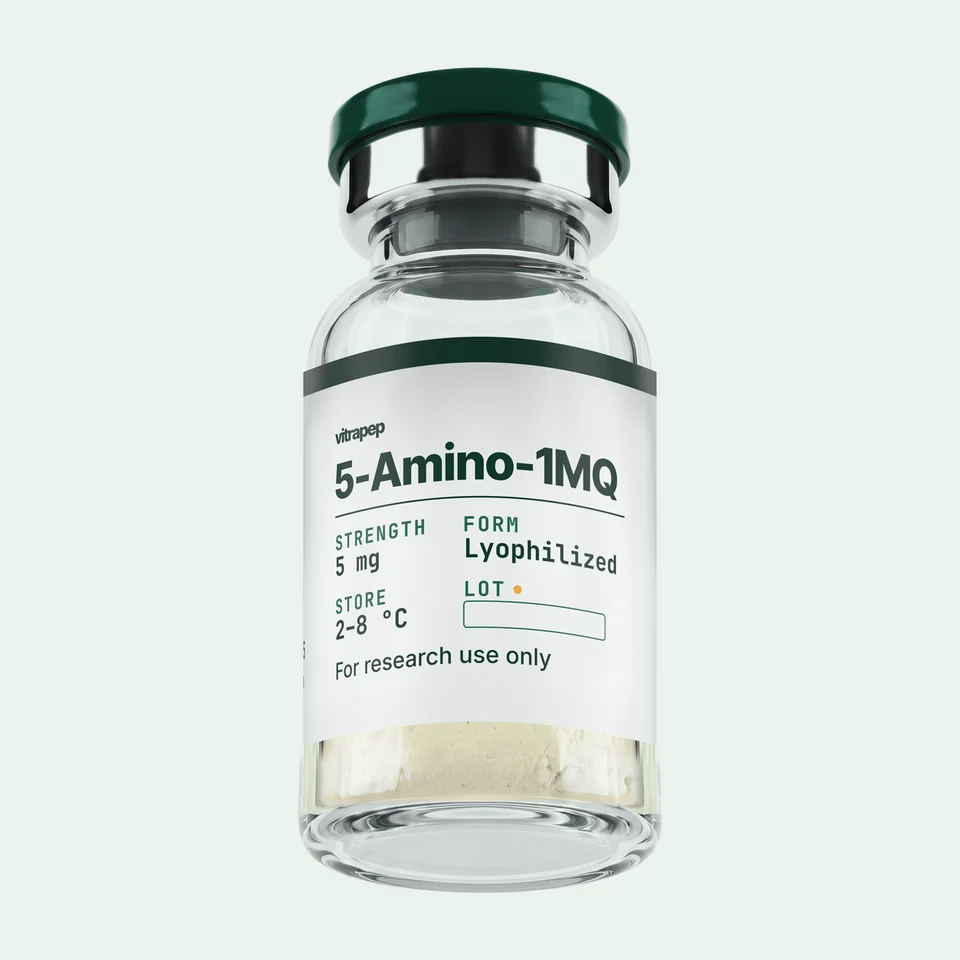
5-Amino-1MQ
Specifications for the 5-Amino-1MQ sold for laboratory research. COA available with each lot.
Frequently asked questions
Is 5-Amino-1MQ a peptide?
No. It is a small-molecule quinolinium ion with a molecular weight of 159.21 g/mol. It has no chain of amino acids, although it is often sold alongside peptides.
Does 5-Amino-1MQ cause weight loss in people?
This is unknown, because no human study has been published. In obese mice, it reduced body weight and fat, and it added to the effect of a lower-fat diet.
What did 5-Amino-1MQ do in muscle studies?
In aged mice, it improved muscle stem cell activity after injury and increased grip strength. A separate group reported better strength in mice with limb ischemia.
Has 5-Amino-1MQ been tested in a clinical trial?
No. ClinicalTrials.gov listed no registered study of 5-Amino-1MQ on November 18, 2026.
What side effects have been reported with 5-Amino-1MQ?
No human side-effect data exist. Short mouse studies reported no observable adverse effects, but they were not designed to measure safety.
Is 5-Amino-1MQ FDA-approved or allowed in sport?
It is not FDA-approved for any use. The 2026 WADA Prohibited List does not name it, but its S0 class covers unapproved pharmacological substances.
What to know now
- 5-Amino-1MQ is a small-molecule NNMT inhibitor, not a peptide.
- Every reported benefit comes from mice or cell cultures; no human study exists.
- Obese mice lost weight and fat and had better liver and insulin measures.
- Aged mice showed better muscle repair and grip strength.
- Most studies came from the developer's group; independent work covers cancer, limb ischemia and cells.
What we’re watching
- Any registered human trial of 5-Amino-1MQ or another NNMT inhibitor.
- Independent replication of the obesity findings outside the developer's group.
- Formal toxicology studies, including long-term effects on methylation.
- Further work on NNMT's protective role in blood-vessel cells.