Pinealon peptide benefits are often described as better memory, brain protection and slower aging. The published evidence is much narrower. A PubMed search on November 18, 2026 returned 22 records for "pinealon," and 12 are in Russian only. We found no published randomized, placebo-controlled trial, and none is registered on ClinicalTrials.gov.
Quick answer: The published research does not establish any benefit of Pinealon in people. The human reports are few, often pair Pinealon with a second peptide and rely on surrogate scores. Animal and cell findings are early-stage and come mostly from one research network. Pinealon is not approved by the FDA for any use.
What is Pinealon, and who developed it?
Pinealon is a synthetic tripeptide, a chain of three amino acids: glutamic acid, aspartic acid and arginine. Researchers often call it EDR, from the one-letter amino acid codes. PubChem lists its molecular formula as C15H26N6O8 and its molecular weight as 418.40 g/mol.
Most Pinealon research comes from the network of Vladimir Khavinson at the Saint Petersburg Institute of Bioregulation and Gerontology. The group's 2020 review describes EDR as a tripeptide isolated from Cortexin, a polypeptide neuroprotective drug. The same network studies other short peptides, including Epitalon (AEDG) and Vesugen (KED).
The review proposes that EDR enters cells and binds histone proteins or RNA, changing gene activity. The Pinealon complete guide covers structure and mechanism in more depth.
What is Pinealon, and who developed it
| Feature | What the sources show |
|---|---|
| Sequence | Glu-Asp-Arg (three amino acids) |
| Molecular formula | C15H26N6O8 (PubChem CID 10273502) |
| Molecular weight | 418.40 g/mol (PubChem) |
| Main research group | Saint Petersburg Institute of Bioregulation and Gerontology |
| Origin described by developers | Isolated from the polypeptide drug Cortexin (2020 review) |
| Registered clinical trials | None found on ClinicalTrials.gov, November 18, 2026 |
| FDA status | Not approved; no Drugs@FDA record |
| WADA 2026 list | Not named; class S0 covers non-approved substances |
What did human studies of Pinealon measure?
Four PubMed-indexed human reports name Pinealon. All four appeared in the journal Advances in Gerontology, in Russian with English abstracts. None of the abstracts reports randomization, blinding or a placebo group. The evidence is human but uncontrolled as described.
Nazimko and colleagues (2012) studied locomotive crew workers, whose working conditions the authors linked to faster aging. The workers received a two-week course of Pinealon. The abstract reports better biological-age parameters and better measures of adaptive reactions. It gives no participant count and no comparison group.
Bashkireva and Artamonova (2012) assessed 150 male truck drivers and 150 male metalworkers with a clinical questionnaire for neurotic symptoms. PubMed indexes the paper as a clinical trial. The abstract says peptide bioregulators improved psychoemotional scores and resistance to work stress. The best results came from combining Pinealon with Vesugen. It does not say how many men received peptides or whether anyone received a placebo.
Meshchaninov and colleagues (2015) studied 32 adults aged 41 to 83 with several chronic illnesses and organic brain syndrome in remission. The abstract lists 18 men and 12 women, which totals 30, not 32. Pinealon and Vesugen were both linked to lower biological-age scores, and Vesugen showed the clearer effect.
Myakotnykh and colleagues (2016) compared four approaches in 110 people of different ages. These were dry carbon dioxide baths, hyperbaric oxygen, therapeutic massage and Pinealon combined with Vesugen. The combined peptides had the largest effect on biological-age indicators. The abstract does not report group sizes or how people were assigned. V. N. Meshchaninov co-authored both reports.
The developers' 2020 review adds one more human claim. It states that Pinealon added to standard care in 72 patients with lasting effects of traumatic brain injury improved memory and reduced headaches. The review cites a 2013 Russian review for this, and we could not find the original trial report in PubMed.
What did human studies of Pinealon measure
| Study | Participants | Design as described | Duration | What was reported | Main limitation |
|---|---|---|---|---|---|
| Nazimko et al., 2012 | Locomotive crew workers; number not given | No comparison group described | Two weeks | Better biological-age and adaptation measures | No size or control in abstract |
| Bashkireva and Artamonova, 2012 | 150 male truck drivers, 150 male metalworkers | Peptide group size not stated | Not stated | Better psychoemotional scores; best with Vesugen added | No placebo described |
| Meshchaninov et al., 2015 | 32 adults aged 41 to 83 | Pinealon and Vesugen; no placebo described | Not stated | Lower biological-age scores; larger with Vesugen | Small; sex counts sum to 30 |
| Myakotnykh et al., 2016 | 110 people of different ages | Four approaches compared | Not stated | Largest biological-age change with both peptides | Group sizes not reported |
| Khavinson et al., 2020 review | 72 patients after brain injury | Added to standard care | Not stated | Better memory; milder headaches | Original report not found |
Why are the human findings hard to interpret?
Biological age in these reports is an estimated score, not a clinical outcome. A lower score is a surrogate measure. It does not show fewer illnesses or longer life.
Two of the four reports combined Pinealon with Vesugen, so Pinealon's own contribution cannot be separated. Questionnaire outcomes without a placebo group are open to expectation effects. The full texts are in Russian, so methods cannot be checked from the abstracts. Meshchaninov and colleagues still recommend both peptides as geroprotectors, but that is an opinion, not evidence. Vitrapep's guide on how to judge a peptide study explains why controls and surrogate outcomes matter.
What have animal studies found?
Arutjunyan and colleagues (2012), with Khavinson as a co-author, used a rat model of high homocysteine during pregnancy caused by excess dietary methionine. Offspring of mothers given Pinealon showed better spatial orientation and learning. Neurons from their cerebellum accumulated fewer reactive oxygen species and had fewer necrotic cells.
Mendzheritski and colleagues (2013) compared Pinealon with Cortexin in young and old rats after acute low-oxygen stress. Pinealon improved learning in the Morris water maze more than Cortexin in both age groups. The study also tracked caspase-3, an enzyme involved in programmed cell death.
An earlier paper by the same first authors gave mixed results. In old rats with blocked carotid arteries, both peptides improved survival (Mendzheritskii et al., 2011). Pinealon was also linked to less orienting, motivated and motor behavior, and caspase-3 activity rose moderately.
Khavinson and colleagues (2021) used 5xFAD mice, which carry human gene mutations linked to Alzheimer's disease. Each group had 10 mice, treated for two months. EDR raised dendritic spine density in a hippocampal region by 11% compared with untreated model mice. Spines are contact points where neurons receive signals. Long-term potentiation, a measure of synaptic strengthening, showed only a non-significant trend.
What have cell and laboratory studies shown?
Khavinson and colleagues (2011) exposed cerebellar granule cells, neutrophils and PC12 cells to oxidative stress. Pinealon limited the build-up of reactive oxygen species and reduced necrotic cell death. The authors also saw delayed ERK1/2 signaling and changes in the cell cycle. They proposed that Pinealon may interact directly with the cell genome.
Kraskovskaya and colleagues (2024) converted skin fibroblasts from elderly donors into neurons in culture. EDR, KED and AEDG all increased the number and length of dendrites. EDR also reduced oxidative DNA damage. Neither tripeptide changed mitochondrial or lysosomal activity or levels of p16, a marker of cell aging.
On mechanism, a 2019 physics study from Saint Petersburg State University found EDR can partly enter the DNA major groove in solution. The 2021 mouse paper used computer docking to predict EDR binding sites in promoter regions of genes such as CASP3, APOE and SOD2. Neither shows gene regulation by Pinealon in living cells.
What side effects have been reported?
None of the Pinealon studies we reviewed reports adverse events in a standard way. The four human abstracts list no symptoms, dropouts or adverse-event rates. A study that does not discuss side effects cannot show that none occurred.
Two human reports describe safety-related lab findings. Meshchaninov and colleagues recorded prooxidant activity and a fall in CD34-positive blood-forming stem cells, which they called significant inhibition of blood cell formation. Myakotnykh and colleagues called massage and the peptides the safest options, but the abstract gives no data.
The developers' 2020 review says peptide bioregulators have an absence of side effects. The studies it cites for that concern Semax and Cortexin, not Pinealon. The 2011 rat study recorded reduced motor and exploratory behavior, a finding of unknown relevance to people.
Pinealon was not on the agenda of FDA's July 2026 compounding advisory meeting, so that process produced no FDA safety assessment of it. For what FDA and CDC report about self-use of research peptides, see the risks of human use.
What is Pinealon's regulatory and anti-doping status?
Pinealon is not approved by the FDA for any use. An openFDA search of Drugs@FDA data on November 18, 2026 found no product containing it. We found no source showing approval as a medicine elsewhere.
FDA's Pharmacy Compounding Advisory Committee met on July 23-24, 2026, to discuss seven bulk drug substance groups. The Federal Register notice lists epitalon, from the same research network, but not Pinealon.
A "research use only" label does not make a product approved or legal for human use. Vitrapep explains why research peptides have no dose.
The 2026 WADA Prohibited List does not name Pinealon. Its S0 class covers pharmacological substances not addressed elsewhere on the List. Substances in S0 have "no current approval by any governmental regulatory health authority for human therapeutic use," and they are prohibited at all times. Anti-doping authorities decide how S0 applies in a given case. Vitrapep's WADA peptide reference covers the categories in detail.
What is still unknown about Pinealon?
The largest gap is controlled human evidence. We found no published randomized, placebo-controlled trial. A ClinicalTrials.gov search on November 18, 2026 found no registered study. Vitrapep explains how registered trials are listed and found.
The second gap is pharmacokinetics. None of the papers we reviewed measured how Pinealon is absorbed, broken down or cleared in people. Whether it reaches the brain intact is unknown.
The third gap is independent replication. Most cell and animal papers include authors from the Saint Petersburg Institute of Bioregulation and Gerontology. Long-term safety, drug interactions and effects of Pinealon alone in people have not been studied in any source we found.
Vitrapep research material
Vitrapep sells Pinealon for laboratory research use only. It is not for human or veterinary use.
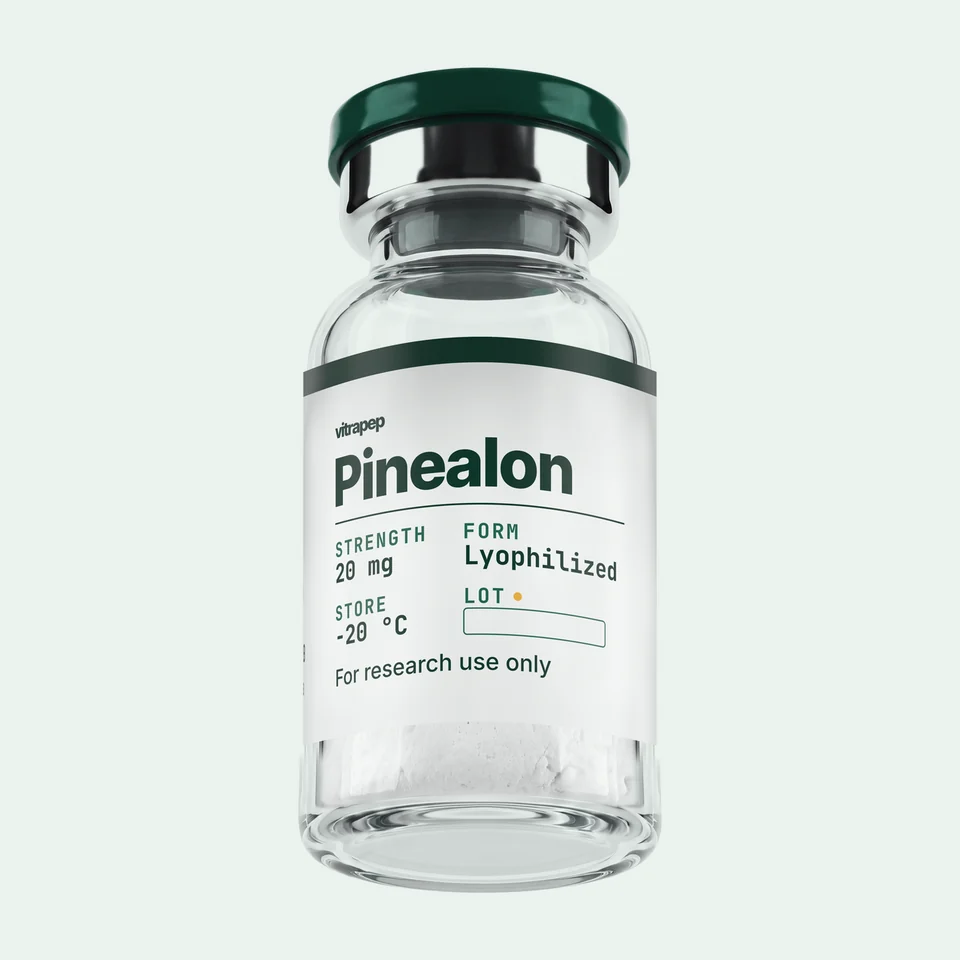
Pinealon
Specifications for the Pinealon sold for laboratory research. COA available with each lot.
Frequently asked questions
What benefits of Pinealon have been studied in people?
Russian reports measured biological-age scores and psychological questionnaires in workers and older adults. They reported improvements, but none describes a placebo group.
Has Pinealon been tested in a randomized controlled trial?
We found no published randomized, placebo-controlled trial. A ClinicalTrials.gov search on November 18, 2026 found no registered Pinealon study.
What did animal studies of Pinealon find?
Rat studies reported better maze learning and less oxidative damage in neurons after stress. A 2021 mouse study of an Alzheimer's model found 11% higher dendritic spine density.
Is Pinealon the same as Epitalon?
No. Pinealon is a three-amino-acid peptide (EDR), while Epitalon has four amino acids (AEDG). Both come from the same Saint Petersburg research network. FDA's July 2026 advisory committee discussed epitalon but not Pinealon.
What side effects have been reported with Pinealon?
No study we found reports adverse events in a standard way. One 2015 report recorded prooxidant activity and lower counts of CD34-positive blood-forming stem cells.
Is Pinealon FDA-approved or allowed in sport?
Pinealon is not FDA-approved for any use. WADA's 2026 list does not name it, but class S0 covers substances not listed elsewhere that lack government approval for human therapeutic use.
What to know now
- Pinealon (Glu-Asp-Arg) is a synthetic tripeptide studied mostly by one Saint Petersburg research network.
- Human evidence consists of four PubMed-indexed Russian reports without a described placebo group.
- Reported human benefits are changes in biological-age scores and questionnaires, not clinical outcomes.
- Animal and cell studies report antioxidant, cell-survival and dendritic spine effects.
- Pinealon is not FDA-approved, and no trial is registered on ClinicalTrials.gov.
What we’re watching
- Any registered, placebo-controlled human trial of Pinealon tested on its own.
- Human pharmacokinetic data showing how Pinealon is absorbed and cleared.
- Independent replication of the cell and animal findings outside the developers' network.
- Any FDA, WADA or other regulatory action that names Pinealon.