Semax peptide benefits attract interest because this synthetic heptapeptide is related to the adrenocorticotropic hormone fragment ACTH(4-10). Preclinical studies report changes in brain-derived neurotrophic factor (BDNF) and its receptor signaling. Older clinical studies from Russia have explored Semax in ischemic stroke recovery, but the evidence remains limited and has not led to FDA approval.
Quick answer: Published Semax research suggests possible neurotrophic activity, including changes in BDNF-related pathways in animal models. Small Russian clinical studies have reported neurological recovery signals after ischemic stroke. The findings are preliminary, and FDA has not approved Semax for any medical condition in the United States.
What is Semax, and why is it studied?
Semax is a synthetic heptapeptide analogue of the ACTH(4-10) fragment. Its sequence is reported as Met-Glu-His-Phe-Pro-Gly-Pro. Unlike the full adrenocorticotropic hormone, Semax is described in the research literature as retaining neurobehavioral activity without the same intended hormonal effects.
Researchers have focused on Semax because of reported effects on neurotrophic signaling. Brain-derived neurotrophic factor supports neuronal development, synaptic plasticity and adaptive responses in the nervous system. Its receptor, tropomyosin receptor kinase B (TrkB), is involved in related signaling processes.
This makes Semax relevant to research on neuroplasticity, cognition and ischemic injury. The basic scientific question is whether changes in BDNF-related pathways can be linked to functional outcomes. Animal studies have explored this question in detail, while human studies remain relatively small and concentrated in a limited number of clinical settings.
What do preclinical studies show about BDNF?
Several rat studies report that Semax changes BDNF-related signaling in brain regions involved in learning and memory. Dolotov and colleagues reported increased BDNF expression in different areas of the rat brain in a 2003 study. Their work helped establish neurotrophic signaling as a major research direction for Semax.
A 2006 study by Dolotov and colleagues examined the rat basal forebrain. The researchers reported increased BDNF protein levels after experimental Semax exposure. The results suggested that specific binding sites may be present in the basal forebrain, although the molecular targets and downstream mechanisms require further study.
Another 2006 study examined the rat hippocampus. It reported increases in BDNF protein and TrkB phosphorylation, alongside changes in the expression of genes related to the BDNF-TrkB system. The hippocampus is central to learning and memory, so these findings are part of the rationale for continued neuroscience research.
These are animal findings. They show that Semax can influence measurable neurotrophic markers in experimental models. They do not prove that Semax improves cognition or protects the human brain.
What has human research reported about ischemic stroke?
Human Semax research has included clinical studies in Russia involving people recovering from ischemic stroke. Gusev and colleagues published a 1997 clinical and electrophysiological study of Semax in the acute period of hemispheric ischemic stroke. The report included 30 patients in the Semax group and a comparison group of 80 patients receiving conventional therapy.
The authors reported faster regression of neurological deficits in the Semax group, particularly for motor disorders. The report is historically important because it describes a clinical signal in a serious neurological condition. However, it is an older study, and its reporting does not match the standards expected from a large contemporary multicenter randomized trial.
A later study published in 2018 examined 110 people after ischemic stroke. It assessed plasma BDNF, motor performance and Barthel Index scores during early and late rehabilitation periods. The authors reported increases in plasma BDNF among participants receiving Semax and described associations with functional recovery measures.
This study contributes human observations to the neurotrophic hypothesis. Its design and subgroup structure limit the strength of causal conclusions. The reported associations do not establish that Semax alone caused the functional changes. Rehabilitation timing and other clinical factors may also influence recovery.
What has human research reported about ischemic stroke
| Study | Model or participants | Main finding | Evidence level |
|---|---|---|---|
| Dolotov et al., 2003 | Rat brain | Increased BDNF expression in several brain regions | Animal preclinical |
| Dolotov et al., 2006 | Rat basal forebrain | Increased BDNF protein and evidence of specific binding | Animal preclinical |
| Dolotov et al., 2006 | Rat hippocampus | Changes in BDNF and TrkB signaling | Animal preclinical |
| Gusev et al., 1997 | 30 patients and 80 comparison patients after ischemic stroke | Authors reported faster improvement in selected neurological measures | Older clinical study |
| Gusev et al., 2018 | 110 people in post-stroke rehabilitation groups | Reported BDNF and functional-recovery associations | Human clinical subgroup study |
The table shows why Semax remains a research-interest compound. Animal models provide mechanistic signals, and small clinical reports suggest possible relevance to stroke recovery. Larger, well-controlled trials are needed to clarify the clinical effect.
What does the FDA say about Semax?
Semax is not FDA-approved for any medical condition in the United States. FDA briefing materials prepared for the July 2026 Pharmacy Compounding Advisory Committee meeting describe Semax as a synthetic heptapeptide analogue of ACTH(4-10). The materials note that Semax is registered as a medicine in Russia, but it is not a component of an FDA-approved drug.
FDA's review focused on whether Semax-related bulk drug substances should be included on the 503A Bulks List for use in compounding. The agency identified limited clinical safety information, no published human pharmacokinetic studies and no published clinical studies assessing immunogenicity. FDA also expressed concerns about physicochemical characterization and potential peptide-related impurities.
The FDA evaluation concluded that the available evidence was insufficient to support the proposed uses for cerebral ischemia, migraine and trigeminal neuralgia. It proposed that Semax free base and Semax acetate not be included on the 503A Bulks List. This was a compounding-list evaluation, not a review of a formal new drug application.
The distinction matters. The committee process does not mean that the animal research is uninteresting. It does mean that the available evidence does not establish an FDA-approved therapy or adequately characterized compounded drug product. Readers should not confuse registration in another country with FDA approval in the United States.
What are the main research limitations?
The strongest mechanistic evidence comes from rodent studies. These studies identify BDNF-related pathways that are worth exploring, but species differences can affect how a peptide behaves. A marker change in a rat brain is not the same outcome as a meaningful improvement in human function.
The human clinical reports are encouraging in some respects, particularly because they explore outcomes in people recovering from stroke. However, these studies are limited by size, geography, reporting quality and design. More contemporary trials would need clear randomization, robust comparison groups, prespecified outcomes and independent replication.
FDA also highlighted gaps in human pharmacokinetic and immunogenicity information. Those data are important for understanding exposure and possible immune responses. The agency's review further noted that the published clinical references did not consistently distinguish Semax free base from Semax acetate.
The most useful conclusion is therefore measured. Semax has an interesting neurotrophic research profile, with published animal work and limited clinical observations. Its clinical effectiveness and safety remain insufficiently established for FDA approval.
What is the regulatory status outside the United States?
FDA briefing materials state that Semax is registered as a medicine in Russia. The same materials note that Semax is not recognized in the European, Japanese or International Pharmacopoeias and is not a component of an FDA-approved drug.
Regulatory status differs by jurisdiction. A registration in one country does not mean that another regulator has reviewed the same product or accepted the same evidence. For U.S. readers, the relevant point is that Semax is not FDA-approved.
Product information and related Vitrapep research
Vitrapep sells Semax for laboratory research use only. It is not for human or veterinary use. The Vitrapep research-use product is not an FDA-approved medicine. See the Vitrapep Semax product page.
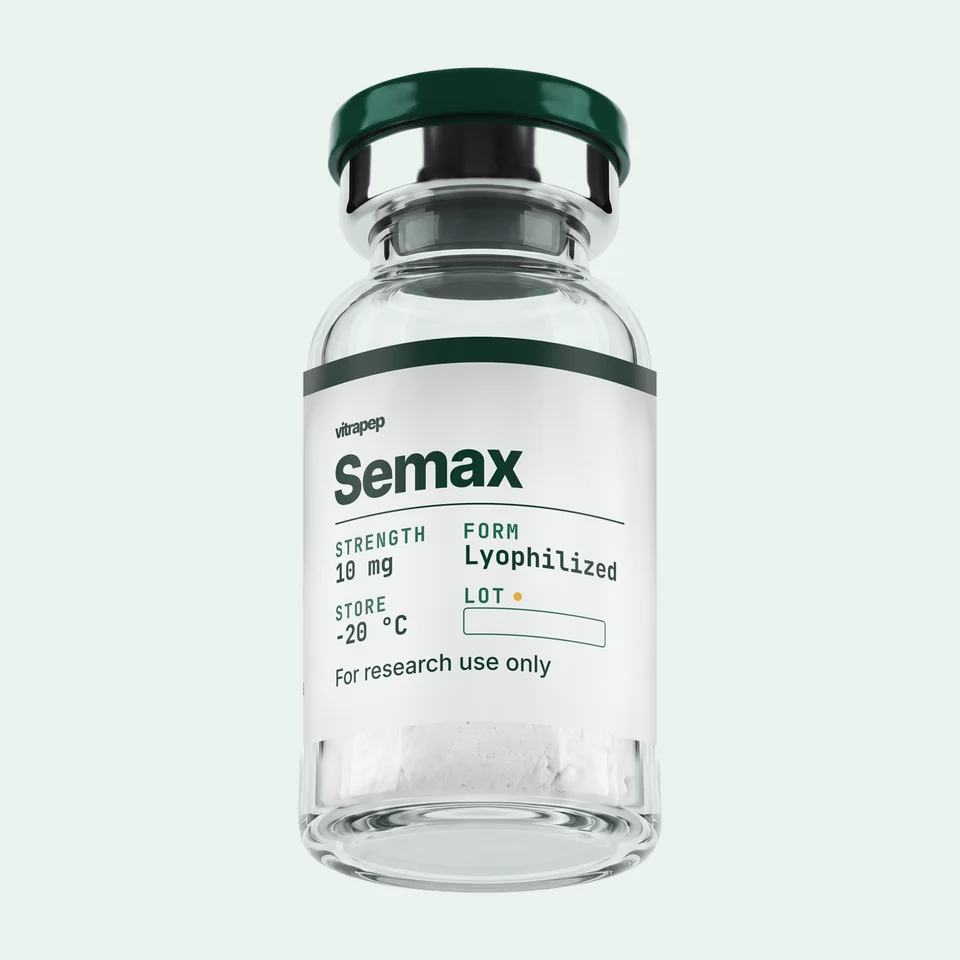
Vitrapep Semax product page
Specifications for the Vitrapep Semax product page sold for laboratory research. COA available with each lot.
Related reading: Semax complete guide, Semax and stroke-recovery research, and Selank vs. Semax.
FAQ
What are the potential Semax peptide benefits researchers are studying?
Researchers are investigating neurotrophic signaling, BDNF-related pathways, neuroplasticity and possible relevance to ischemic brain injury. The strongest mechanistic findings come from animal studies.
Does Semax increase BDNF?
Rat studies have reported increases in BDNF protein or expression in selected brain regions. A human post-stroke study also reported changes in plasma BDNF, but this does not establish a causal clinical effect.
Has Semax been studied in people after stroke?
Yes. Older Russian clinical studies have examined Semax in ischemic stroke and rehabilitation settings. Their findings are preliminary and require confirmation in larger, well-controlled studies.
Is Semax FDA-approved?
No. Semax is not FDA-approved for any condition in the United States. FDA's 2026 compounding evaluation proposed against including Semax-related substances on the 503A Bulks List.
Is Semax registered in other countries?
FDA briefing materials state that Semax is registered as a medicine in Russia. That status does not confer FDA approval in the United States.
What to know now
- Semax is a synthetic heptapeptide related to the ACTH(4-10) fragment.
- Rat studies report changes in BDNF and TrkB signaling, while small clinical reports have examined stroke recovery.
- Semax is not FDA-approved, and FDA identified major evidence and characterization gaps in its 2026 compounding review.
What we’re watching
- Better-designed and independently replicated human studies that evaluate neurological outcomes.
- Further research clarifying the relationship between Semax, BDNF and TrkB signaling.
- Any final FDA action following the July 2026 Pharmacy Compounding Advisory Committee process.