TB-500 benefits have attracted attention because the compound is related to a short active-site sequence within thymosin beta-4. Research on the broader thymosin beta-4 family has explored actin binding, tissue repair and cell migration. However, the distinction between full-length thymosin beta-4 and the shorter TB-500 fragment is essential. The best-known human studies involved full-length thymosin beta-4, not TB-500 itself.
Quick answer: Published research provides a plausible biological rationale for studying TB-500-related sequences in tissue repair. Direct TB-500 evidence is mainly analytical, cell-based and animal-related. Human trials that report favorable outcomes for full-length thymosin beta-4 cannot be treated as trials of the TB-500 fragment.
What is TB-500, and how does it relate to thymosin beta-4?
TB-500 is commonly described as a synthetic peptide corresponding to a seven-amino-acid sequence from thymosin beta-4. The fragment is often identified as Ac-LKKTETQ, while full-length thymosin beta-4 is a 43-amino-acid peptide. The two are related, but they are not the same molecule.
Thymosin beta-4 is involved in actin regulation, a process that affects cell structure and movement. Researchers have studied full-length thymosin beta-4 in wound repair, inflammation, angiogenesis and tissue remodeling. The short LKKTETQ sequence has been examined as an active region within the larger peptide.
This relationship explains why TB-500 is often discussed alongside thymosin beta-4. It does not mean the two molecules have equivalent pharmacology, exposure, stability or clinical evidence. Peptide length and chemical modifications can change how a molecule behaves in biological systems.
For evidence reviews, the naming distinction must remain visible. A study of full-length thymosin beta-4 is not a clinical trial of TB-500. A cell experiment using one fragment is not evidence that every product described by the TB-500 name produces the same result.
What does direct research on the TB-500 fragment show?
Direct published research on TB-500 is limited, with important findings coming from analytical and in-vitro work rather than clinical trials.
Rahaman et al. (2024) published a study that developed methods to quantify TB-500 and its metabolites. The research examined metabolism in human serum and laboratory enzyme systems, and it also studied urine samples from rats exposed to TB-500. The team compared the biological activity of the parent compound and its metabolites in fibroblast experiments.
The study found that Ac-LK was the main metabolite in the rat samples during the early measurement period. Another metabolite, Ac-LKK, was detected later. In the wound-healing assay, the metabolite Ac-LKKTE showed significant activity compared with the control. The parent TB-500 molecule and its metabolites did not show cytotoxicity in the reported assay.
The authors concluded that earlier claims about wound-healing activity attributed to TB-500 may be explained by a metabolite rather than the parent compound. This is an important refinement. It points to a possible active metabolite and gives researchers a more specific question to investigate. It does not demonstrate wound healing in humans.
The study's value is partly methodological. Analytical methods that can distinguish a parent peptide from its metabolites help researchers understand what is present in a biological sample. More work is needed to confirm how those metabolites behave across different models and whether the observations have any clinical relevance.
A 2026 scoping review by McGuire et al. mapped 80 studies involving thymosin beta-4, TB-500 or related derivatives. Most studies evaluated full-length thymosin beta-4, and the review identified only one study directly evaluating TB-500. Human evidence in the mapped literature was concentrated in ocular and wound or skin settings, while direct musculoskeletal evidence was comparatively sparse. This wider evidence map reinforces the need to keep fragment-specific claims separate from the larger thymosin beta-4 literature.
What does full-length thymosin beta-4 research show?
Human studies of full-length thymosin beta-4 have reported encouraging findings in specific tissue-repair settings. These studies help explain scientific interest in the peptide family, but they should not be presented as evidence that TB-500 has the same effect.
A Phase 2 study by Guarnera et al. (2010) examined full-length thymosin beta-4 in people with venous leg ulcers. The trial evaluated topical treatment and reported a healing signal in selected analyses. It involved a clinical wound population and therefore provides human evidence for the full-length molecule in that setting. It did not test the seven-amino-acid TB-500 fragment.
Other Phase 2 research by Sosne et al. studied full-length thymosin beta-4 in dry-eye disease. One small study reported favorable changes in some signs and symptoms, while another controlled study found that the primary endpoints were not significantly different, although several secondary outcomes favored thymosin beta-4. These are separate clinical questions from wound repair and cannot be combined into a single general claim about tissue regeneration.
The parent peptide's research history provides useful context. It shows that thymosin beta-4 has been studied in people and that researchers have explored multiple tissue settings. But fragment-specific claims require fragment-specific evidence. This is particularly important when comparing clinical studies with research-use products.
What does full-length thymosin beta-4 research show
| Research | Molecule studied | Model or participants | Main finding | Evidence type |
|---|---|---|---|---|
| Rahaman et al., 2024 | TB-500 and metabolites | Human serum, enzyme systems, rat samples and cultured fibroblasts | One metabolite showed wound-healing activity in a fibroblast assay | Analytical, animal and cell |
| Venous-ulcer Phase 2 study | Full-length thymosin beta-4 | People with venous leg ulcers | Healing signal reported in selected analyses | Human |
| Dry-eye Phase 2 studies | Full-length thymosin beta-4 | People with dry-eye disease | Mixed results across primary and secondary endpoints | Human |
| Sosne et al., 2010 | Thymosin beta-4 active-site sequences | Experimental models | Examined biological activity associated with short peptide sequences | Preclinical |
The table separates molecules to avoid assigning full-length thymosin beta-4 results to TB-500. This difference is the central evidence issue for the topic.
Are TB-500 benefits established in humans?
No human clinical benefit has been established for the TB-500 fragment itself. FDA states that it has not identified human exposure data for drug products containing the thymosin beta-4 fragment, also known as TB-500.
FDA's compounding safety page also notes potential immunogenicity concerns for certain routes, including aggregation and peptide-related impurities. The agency states that it lacks important information about potential human safety issues for the fragment. These comments concern compounded drug substances and should be reported as FDA's regulatory assessment.
The distinction does not erase the broader scientific rationale. TB-500-related sequences are part of a research area involving actin binding, cell migration and tissue repair. The 2024 metabolite study provides a direct experimental foundation for future work. The next step is to determine whether specific parent peptides or metabolites produce reproducible effects in more advanced models.
As of November 17, 2026, TB-500 is not an FDA-approved medicine. No human clinical trial of the fragment was identified in the sources reviewed for this article. The full-length thymosin beta-4 clinical program should be described separately.
What research questions remain?
Researchers need to establish whether the TB-500 fragment has activity distinct from its metabolites and from full-length thymosin beta-4. They also need to characterize the stability and identity of the specific molecular form used in each study. Without that information, studies using different molecules may appear more comparable than they really are.
Additional preclinical work could clarify which metabolites account for observed effects in fibroblast assays. Studies can also explore whether findings reproduce across different cell types and tissue models. If clinical research is pursued, product characterization and safety data will be important before interpreting any efficacy signal.
The research area is therefore promising as a scientific question, but not yet supported by direct human evidence for TB-500. A careful review can acknowledge the potential relevance of thymosin beta-4 biology while remaining precise about what has and has not been tested.
Product information and related Vitrapep research
Vitrapep sells TB-500 for laboratory research use only. It is not for human or veterinary use. See the Vitrapep TB-500 product page.
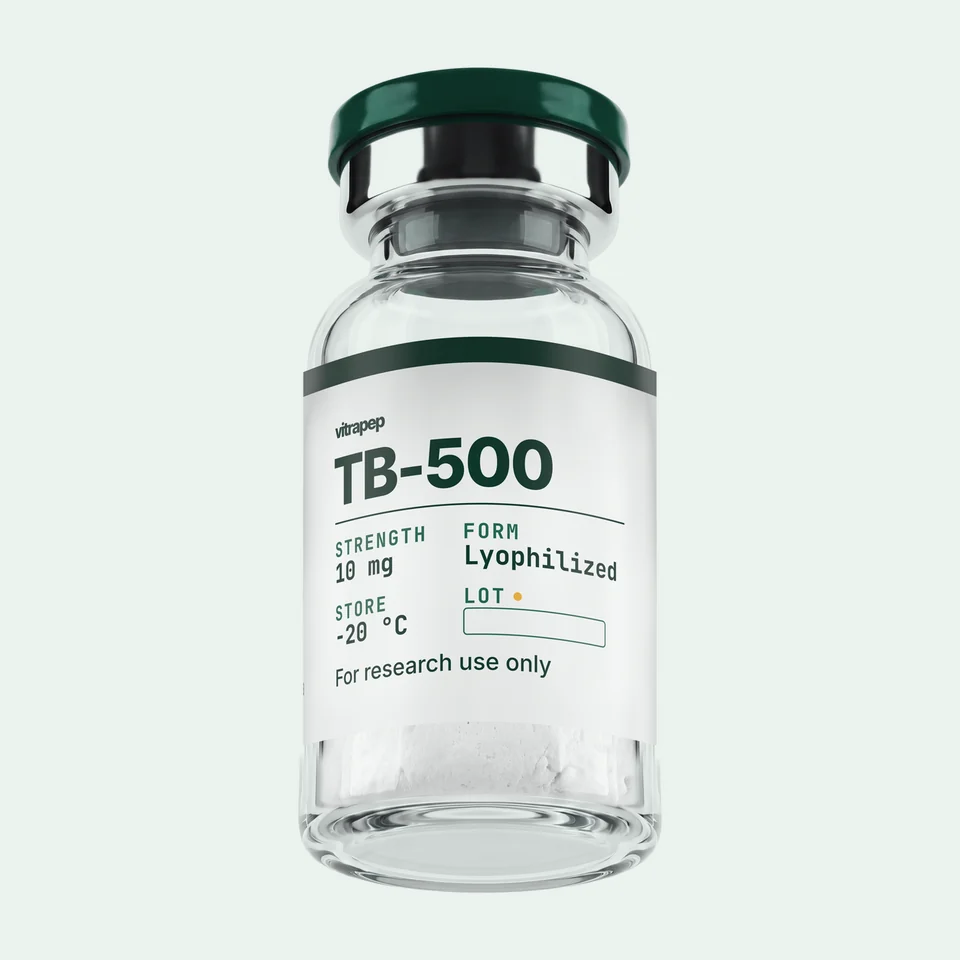
Vitrapep TB-500 product page
Specifications for the Vitrapep TB-500 product page sold for laboratory research. COA available with each lot.
Related reading: TB-500 complete guide, TB-500 mechanism and actin binding, TB-500 cardiac research, and BPC-157 versus TB-500.
FAQ
What are the potential TB-500 benefits being researched?
The main research interests are tissue repair, cell migration and wound-associated biology. Direct evidence for the TB-500 fragment is limited and mainly preclinical.
Is TB-500 the same as thymosin beta-4?
No. TB-500 is commonly described as a short fragment of thymosin beta-4. Full-length thymosin beta-4 is a different, longer peptide with a separate clinical research record.
Has TB-500 been studied in humans?
FDA states it has not identified human exposure data for drug products containing the TB-500 fragment. Human studies of full-length thymosin beta-4 do not count as TB-500 trials.
What did the 2024 TB-500 study find?
The study examined TB-500 metabolism and found that one metabolite showed activity in a cultured-fibroblast wound-healing assay. It did not demonstrate clinical wound healing in people.
Is TB-500 FDA-approved?
No. TB-500 is not an FDA-approved medicine. FDA has also identified unresolved safety-information and immunogenicity concerns for certain compounded products.
What to know now
- TB-500 is a short fragment related to full-length thymosin beta-4, not the same molecule.
- Direct TB-500 evidence includes a 2024 metabolism study and in-vitro findings, not established human efficacy.
- Human studies of full-length thymosin beta-4 are relevant background but cannot be attributed to TB-500.
What we’re watching
- Further fragment-specific studies that characterize TB-500 and its metabolites separately.
- Any formal FDA updates on TB-500-related bulk drug substances and compounding status.