BPC-157 benefits have been investigated mainly in preclinical research involving tendon, ligament, muscle, gastrointestinal and inflammatory models. Some animal studies report changes in tissue repair measures, but the available human evidence is sparse and has very low certainty. No established clinical benefit has been demonstrated through high-quality controlled trials.
Quick answer: BPC-157 benefits reported in published research come mainly from cell and animal models, particularly tendon and ligament injury models. Human evidence is limited to small, uncontrolled reports with substantial methodological weaknesses. BPC-157 is not FDA-approved for human use, and its clinical benefits remain unproven.
What does the published research show about BPC-157 benefits?
The strongest body of published BPC-157 research comes from laboratory and animal experiments. The studies investigate biological responses such as cell migration, tissue structure, inflammatory signaling and mechanical measures after experimentally induced injury. They do not establish that BPC-157 improves clinical outcomes in people.
BPC-157 is described in the literature as a synthetic pentadecapeptide. Several preclinical reports examine tendon and ligament models. In a rat Achilles tendon study, researchers reported improvements in functional, microscopic and biomechanical measures following tendon transection. The same paper also included in-vitro experiments involving tendon cells (Sikiric et al., 2003).
Another study examined the medial collateral ligament in rats. Researchers reported improvements in functional, biomechanical, macroscopic and histological healing measures after experimental ligament transection (Sikiric et al., 2010). These are findings in an animal model. They do not show that BPC-157 produces the same results in human ligament injuries.
Cell research has examined possible pathways behind the preclinical observations. Chang and colleagues reported effects on tendon outgrowth, tendon-cell survival and cell migration in laboratory systems. The work explored mechanisms that could contribute to tendon repair in experimental models. It was not a human clinical efficacy study (Chang et al., 2011).
What is the strongest evidence for tendon and ligament research?
Tendon and ligament injury models make up a substantial part of BPC-157's preclinical literature. The 2003 Achilles tendon paper examined structural and biomechanical measures after a surgically induced injury in rats. The 2010 ligament paper also reported improvements in animal model outcomes. Both studies contribute to the hypothesis that BPC-157 may affect processes associated with tissue repair (Sikiric et al., 2003; Sikiric et al., 2010).
A 2019 review of the musculoskeletal literature noted that the majority of studies involved small rodent models and that human efficacy had not been confirmed (Pavelic et al., 2019). A later systematic review of orthopaedic and sports-medicine literature identified 36 studies published from 1993 through June 2024. Thirty-five were preclinical and one was clinical. The authors noted that the human evidence was limited and that clinical safety data were lacking (Jahangir et al., 2025).
The size and repetition of animal studies do not remove the translation problem. Species differences, experimental injury models, study design and product quality can affect whether a finding applies to humans. The published animal work should therefore be described as research evidence, not as proof of a treatment benefit.
What human studies have been published?
The published human literature is small and methodologically limited. A 2021 retrospective report examined BPC-157 in people with different types of knee pain. Sixteen patients were contacted for follow-up. Among the 12 who received BPC-157 without thymosin beta-4, 11 reported significant improvement. The study did not use validated tools to measure function, quality of life or daily activity, and there was no randomized control group (Lee & Padgett, 2021).
A 2024 pilot report described 12 women with interstitial cystitis who received treatment in a private clinic. The authors reported symptom improvement and no adverse events in this small group. The design was uncontrolled and cannot establish whether the reported changes were caused by BPC-157. It also does not provide evidence for orthopedic indications or other research settings (Lee et al., 2024).
A 2025 pilot study examined BPC-157 in two participants. The authors described the study as preliminary. A two-person report cannot characterize uncommon, delayed or long-term adverse events (Lee & Burgess, 2025).
A 2026 systematic review examined human BPC-157 evidence in orthopaedic and regenerative medicine. It identified three studies with 30 participants in total: a retrospective knee-pain study with 16 participants, an interstitial-cystitis pilot with 12 participants and a two-person safety pilot. The authors judged all three studies to be of poor methodological quality and rated the overall certainty of evidence as very low (Poolton et al., 2026).
What human studies have been published
| Study | Model and size | Reported finding | Main limitation |
|---|---|---|---|
| Sikiric et al. (2003) | Rat Achilles tendon model; tendon-cell experiments | Improvements in selected structural and biomechanical measures | Animal and in-vitro evidence only |
| Sikiric et al. (2010) | Rat medial collateral ligament model | Improvements in selected functional and tissue measures | Animal evidence only |
| Lee & Padgett (2021) | Retrospective knee-pain report; 16 people contacted | Most participants receiving BPC-157 alone reported improvement | No control group or validated functional outcome measures |
| Lee et al. (2024) | Pilot report; 12 women with interstitial cystitis | Authors reported symptom improvement and no adverse events | Small, uncontrolled, indication-specific report |
| Lee & Burgess (2025) | Two-participant safety pilot | Preliminary safety observations reported | Too small to characterize clinical safety |
How should the evidence be interpreted?
The research record supports a description of BPC-157 as an investigational peptide with preclinical activity reported in several experimental models. It does not support presenting BPC-157 as a proven therapy for tendon injury, ligament damage, muscle injury, gastrointestinal disease or any other human condition.
The human studies have important weaknesses. They are small, uncontrolled or retrospective. Some outcomes rely on patient-reported responses rather than prespecified validated measures. Different studies examine different conditions and different clinical settings. Their results cannot be combined into one reliable estimate of effectiveness.
A systematic review can map the available evidence, but its conclusions depend on the quality of the studies it includes. The 2026 review's very-low-certainty rating is especially important. It means that the current estimate of human effects may change substantially when better studies become available. It is not evidence that the compound is effective or safe.
Is BPC-157 FDA approved?
BPC-157 is not an FDA-approved medicine. FDA materials state that the agency has limited or no safety-related information for proposed routes involving BPC-157 and identify concerns involving immunogenicity, peptide-related impurities and active pharmaceutical ingredient characterization. FDA materials also state that BPC-157 is not a component of an FDA-approved drug (FDA, 2026 Pharmacy Compounding Advisory Committee Materials).
The FDA's current page on certain bulk drug substances describes potential significant safety risks for compounded drugs containing BPC-157. It notes that the agency lacks sufficient information to know whether the substance would cause harm when administered to humans for the proposed routes (FDA, Certain Bulk Drug Substances). These comments concern compounding and safety information. They should not be expanded into claims about a particular research lot or a specific manufacturer's product.
A registered trial is not a positive trial result. ClinicalTrials.gov lists a Phase 2 study of BPC-157 for acute hamstring strain repair, NCT07437547. Its registration describes the planned study. It does not establish a benefit before results are reported (ClinicalTrials.gov, NCT07437547).
Frequently asked questions
What are the benefits of BPC-157?
Animal and cell studies report changes in tendon, ligament and other tissue-repair measures. Clinical benefits in people have not been established through high-quality controlled trials.
Does BPC-157 work for tendon injuries?
Rat tendon studies report improvements in experimental models. Human evidence is too limited and low in certainty to establish an effect in people with tendon injuries.
Are there human studies of BPC-157?
Yes. Small reports have examined knee pain, interstitial cystitis and preliminary safety. The studies are limited by size and design.
Is BPC-157 FDA approved?
No. FDA materials state that BPC-157 is not a component of an FDA-approved drug and identify significant gaps in human safety information.
Are BPC-157 benefits proven?
No. The evidence is mainly preclinical, and the 2026 systematic review rated certainty in the human evidence as very low.
For additional context, see the BPC-157 complete guide, the BPC-157 sourcing guide and the Vitrapep research library.
Vitrapep research material
Vitrapep sells BPC-157 for laboratory research use only. It is not for human or veterinary use.
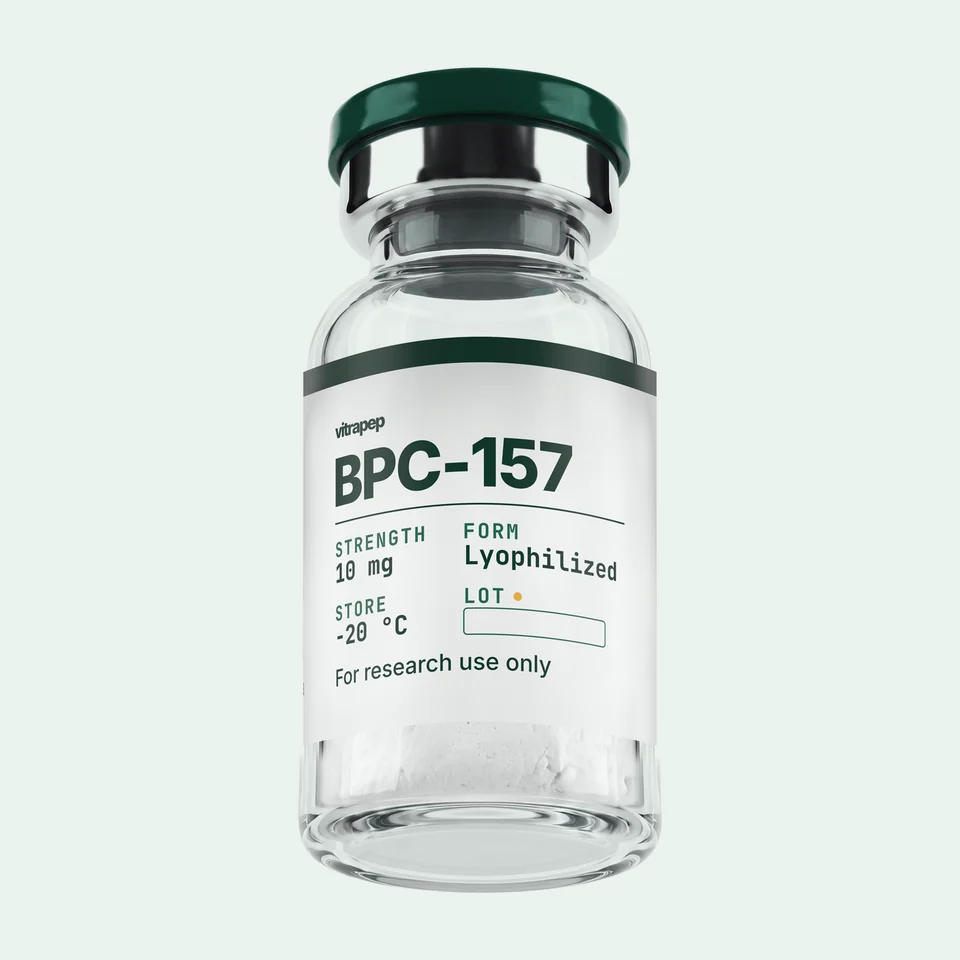
BPC-157
Specifications for the BPC-157 sold for laboratory research. COA available with each lot.
What to know now
- Most published BPC-157 studies use cells or animal models.
- The few human reports are small and methodologically limited. A 2026 systematic review rated the certainty of human evidence very low.
- BPC-157 is not FDA-approved as a human medicine, and FDA materials identify gaps in safety information.
What we’re watching
- ClinicalTrials.gov record NCT07437547 describes a Phase 2 study of BPC-157 for acute hamstring strain repair. Its registry status and estimated dates should be rechecked before publication updates.
- Future controlled human studies would need to report results, adverse events and verified product identity before the evidence could support stronger conclusions.