CJC-1295 DAC vs no DAC is a comparison about molecular design and evidence, not simply a choice between two product labels. The Drug Affinity Complex (DAC) adds a chemical feature that enables albumin binding. The best-known human study of CJC-1295 evaluated the long-acting DAC form. Evidence for products marketed as “no DAC” is far less developed.
Quick answer: CJC-1295 DAC is the albumin-binding form described in the principal published human studies. Products labelled “CJC-1295 no DAC” are chemically distinct or inconsistently named commercial materials. The DAC human data should not automatically be applied to a no-DAC product.
What does CJC-1295 DAC change?
CJC-1295 is a synthetic analogue related to the first 29 amino acids of human GHRH. GHRH is the hypothalamic hormone that signals the pituitary gland to release growth hormone. The peptide design modifies the GHRH fragment to retain receptor activity while changing its stability and exposure.
The original CJC-1295 development programme added a Drug Affinity Complex. In the published molecular design, a reactive chemical group is attached through a linker. After the molecule enters the circulation, the reactive group can bind to a free thiol on serum albumin. Albumin is an abundant blood protein with a long circulating lifetime. Binding can extend the time that the peptide-related molecule remains in circulation.
Jetté and colleagues described the albumin-bioconjugate design in 2005. Their paper identified CJC-1295 as a long-lasting GHRH analogue and tested receptor activation in rats. This was preclinical work, not a human efficacy trial.
What does DAC change?
The defining feature of DAC is the ability to bind albumin. This changes the intended pharmacokinetic design, which describes how a compound is absorbed, distributed and cleared. The intended consequence is prolonged exposure compared with an unmodified short-acting GHRH fragment. However, FDA noted that a direct comparison proving a longer half-life for DAC versus the non-DAC active moiety has not been established. The multi-day exposure observed in human studies is associated with the CJC-1295 DAC form studied, but the exact salt form was not always specified.
The distinction matters because the peptide's biological target and its time in circulation are separate properties. Both a short-acting GHRH analogue and a long-acting albumin-binding analogue may activate the GHRH receptor. Their exposure profiles can still differ substantially.
The 2006 clinical paper by Teichman and colleagues evaluated CJC-1295 in two randomized, placebo-controlled studies involving healthy adults. After a single administration, mean growth hormone concentrations increased for six days or more. Mean IGF-1 concentrations increased for nine to eleven days. The estimated CJC-1295 half-life was 5.8 to 8.1 days. These are pharmacodynamic and pharmacokinetic findings. The trials did not establish improvements in muscle mass, body composition, recovery or longevity.
What does “no DAC” mean?
The phrase “CJC-1295 no DAC” is used inconsistently in commercial descriptions. FDA's 2024 briefing document discusses several CJC-1295-related bulk drug substances. It distinguishes CJC-1295 free base from CJC-1295 with DAC and related salts. It also notes inconsistent naming conventions across nominations and source materials.
Some sellers use “no DAC” to refer to a shorter-acting modified GHRH fragment, sometimes called modified GRF(1-29). That naming practice should not be treated as proof that every product with that label has an identical sequence or specification. The identity must be established by chemical characterization and reliable reference documentation.
This is not a minor terminology issue. FDA warned that inconsistent names could create a risk that a substance differs from the one intended. Researchers comparing studies or materials should identify the exact molecular structure, including any albumin-binding modification, rather than relying on a shared name alone.
What does the human evidence show?
The published human evidence is concentrated on the DAC-containing molecule. The 2006 Teichman study measured growth hormone and IGF-1 responses in healthy adults. A second paper by Ionescu and Frohman examined whether growth hormone pulsatility persisted after sustained exposure to CJC-1295. These studies helped characterize the long-acting analogue's endocrine pharmacology.
There is no comparable controlled human trial directly comparing the DAC and no-DAC commercial forms. Without that comparison, claims about equivalent potency, duration or clinical outcomes are not established. In particular, the multi-day half-life reported for the DAC molecule should not be assigned to a product that lacks the albumin-binding modification.
What does the human evidence show
| Feature | CJC-1295 with DAC | Products labelled “CJC-1295 no DAC” |
|---|---|---|
| Chemical feature | Includes the albumin-binding Drug Affinity Complex | Lacks the DAC modification by definition, but the commercial label is not consistently applied |
| Intended pharmacokinetic effect | Prolonged circulation through albumin binding | Shorter exposure is generally intended, but product-specific human kinetics are not established |
| Published human evidence | Controlled studies measured GH and IGF-1 responses | No direct controlled human comparison identified for commercial “no DAC” products |
| Main evidence caution | Hormone changes do not establish clinical benefit | Do not borrow DAC half-life or outcome claims for a differently structured material |
| Regulatory position | Not an FDA-approved medicine; FDA has identified compounding safety concerns | Not an FDA-approved medicine; identity and naming require careful characterization |
What safety and regulatory concerns have been identified?
FDA's 2024 review discussed injection-site reactions, flushing, headache, diarrhea, nausea, abdominal discomfort, dizziness, low blood pressure and increased heart rate in studies or reports involving CJC-1295 DAC. The briefing described injection-site reactions in approximately 70% of participants in one study and in all participants receiving the compound in another study. These observations came from small early-phase studies and should not be interpreted as a complete population risk estimate.
FDA's current compounding safety page states that compounded drugs containing CJC-1295 may pose immunogenicity risks because of potential peptide-related impurities and characterization challenges. FDA also identifies serious adverse events associated with CJC-1295, including increased heart rate and systemic vasodilatory reactions. Available clinical data remain limited.
Neither DAC nor no-DAC CJC-1295 is an FDA-approved therapeutic drug. FDA's compounding review is not an approval. It is an assessment of nominated bulk substances and their potential use in compounding.
Research product information
Vitrapep sells CJC-1295 for laboratory research use only. It is not for human or veterinary use. See the CJC-1295 product page, CJC-1295 complete guide, CJC-1295 mechanism guide and CJC-1295 versus ipamorelin comparison.
FAQ
What does DAC mean in CJC-1295?
DAC means Drug Affinity Complex. It refers to a chemical modification that enables albumin binding and prolongs exposure.
Is CJC-1295 with DAC the same as CJC-1295 without DAC?
No. The DAC modification changes the molecular structure and pharmacokinetic design. FDA documents distinguish DAC and non-DAC CJC-1295-related substances.
Is “CJC-1295 no DAC” the same as modified GRF(1-29)?
The terms are often used in commercial descriptions, but naming is inconsistent. Exact identity should be determined from chemical structure and analytical documentation.
Do human studies support the no-DAC form?
The published controlled human evidence is concentrated on the DAC form. A direct controlled human comparison for commercial no-DAC materials has not been established.
Is CJC-1295 FDA-approved?
No. CJC-1295 is not an FDA-approved therapeutic medicine. FDA has identified potential safety concerns in the context of compounding.
What to know now
- DAC is an albumin-binding modification intended to extend the circulation time of the CJC-1295 molecule.
- The key 2006 human studies evaluated the long-acting DAC form and measured hormone responses, not long-term clinical outcomes.
- FDA has documented naming inconsistencies and compounding-related safety concerns for CJC-1295 substances.
What we’re watching
- FDA's continuing review of CJC-1295-related bulk drug substances and any final compounding determinations.
- Better analytical standards that can distinguish the DAC form from non-DAC and modified-GRF materials.
- Any independently registered human studies that directly characterize a clearly defined no-DAC molecule.
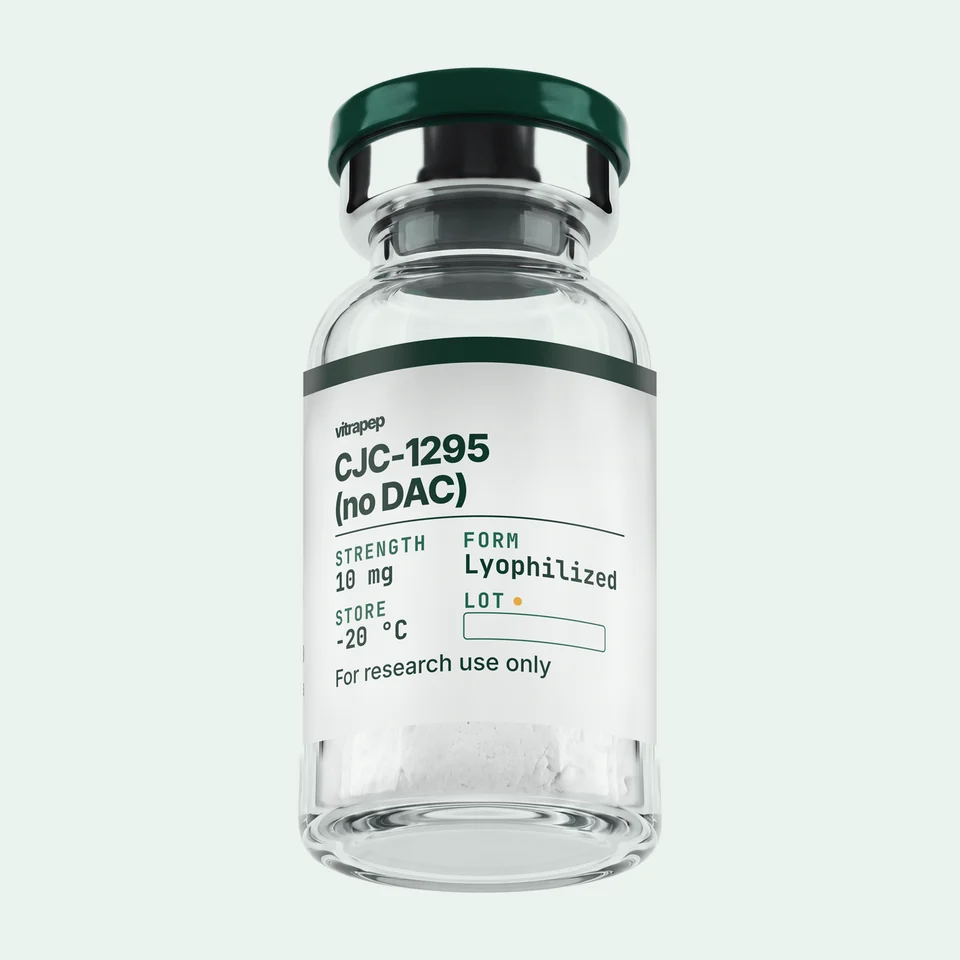
CJC-1295 product page
Specifications for the CJC-1295 product page sold for laboratory research. COA available with each lot.