There are two molecules sold under the name CJC-1295, and they aren’t the same drug. One has a 30-minute half-life. The other lasts 6–8 days. The difference is a small chemical add-on called DAC. If a vendor labels a vial just “CJC-1295” without telling you which form you’re getting, that’s the first red flag. We’ll walk you through the rest.
Get new research first
Research updatesOne short email when new peptide research drops or a new lab-verified batch lands — written from primary sources, no filler.
You’re on the list — check your inbox for a confirmation.
Could not save your email. Try again in a moment.
Quick answer: On November 17, 2026, US research suppliers listed no-DAC 5 mg vials at $20.00–$46.00. Confirm the label says “no-DAC” or “DAC” explicitly. Demand a Certificate of Analysis (CoA) from an ISO 17025 lab (an international testing-quality standard) with HPLC purity above 98% and a mass-spec result matching the variant. For no-DAC, that’s 3367.9 g/mol.
What you’re actually buying
CJC-1295 mimics the first 29 amino acids of human growth-hormone-releasing hormone — the brain signal that triggers GH pulses. ConjuChem developed it in the early 2000s as a once-weekly drug candidate (Rahman et al., 2026).
It activates the GH pathway in the pituitary. It does not bind the ghrelin pathway — that’s ipamorelin’s job. That’s why researchers stack the two together rather than choose one.
The thing that decides which CJC-1295 you have is the DAC group. DAC stands for Drug Affinity Complex. It’s a small chemical linker that covalently bonds to albumin in blood (Memdouh et al., 2021). Albumin acts like a slow-release shuttle. Once the peptide is bound to it, the kidneys can’t filter it out fast.
- No-DAC (Modified GRF 1-29): 29 amino acids, half-life ~30 minutes, produces natural GH pulses.
- DAC: 30 amino acids plus the linker, half-life 6–8 days, produces sustained GH elevation.
Four buyer checks for CJC-1295
The general eight peptide-buyer criteria all apply. These four matter more for CJC-1295:
1. The label must say DAC or no-DAC
This is the single most important check. The vial and the CoA both have to tell you which variant you bought. No-DAC has CAS number 863288-34-0. DAC has a separate CAS registration.
A vendor selling “CJC-1295” without disambiguating is failing the most basic identity disclosure. Walk away.
2. The discontinuation history matters
ConjuChem halted CJC-1295 DAC clinical development around 2007. Public reporting attributes the decision in part to broader scrutiny of ConjuChem’s DAC pipeline after a fatal adverse event in a separate trial of CJC-1131, a different DAC-modified peptide.
The program was never revived. CJC-1295 has no current pharmaceutical sponsor. A vendor making clinical claims (“treats GH deficiency,” “reverses aging”) is in FDA enforcement territory.
3. Mass-spec must match the variant
For no-DAC, the theoretical mass is 3367.9 g/mol. The formula is C152H252N44O42. Peptides this big usually show up in mass-spec as multi-charge ions: observed [M+2H]2+ near 1684.9, or [M+3H]3+ near 1123.6. The calculated neutral mass should land at 3367.9 within standard tolerance.
The DAC variant has a different molecular weight because the linker adds mass. A CoA that reports 3367.9 for a vial labeled DAC is internally inconsistent — don’t buy from that vendor.
4. Storage and shipping are unforgiving
CJC-1295 ships lyophilized (freeze-dried) and stores at −20°C long-term. Once you reconstitute it, the no-DAC form has a usable window of about 30 days refrigerated at 2–8°C. That’s shorter than BPC-157 because CJC-1295 degrades faster in solution.
Vendors who sell pre-mixed liquid at room temperature are selling a product with a shelf life measured in days. The powder is what ships reliably.
Where this falls short: The published CJC-1295 evidence is thinner than vendors imply. Recent (2020–2026) PubMed literature is dominated by anti-doping detection methods, not efficacy trials. The DAC clinical program halted in 2007 and never produced a Phase III readout. There’s a small 2026 mouse-model paper on the CJC-1295 + ipamorelin stack reducing glucocorticoid-induced muscle loss, but no controlled human study has confirmed it. Buy CJC-1295 for what it is: a research GHRH analog with a stalled clinical history and a strong WADA detection profile.
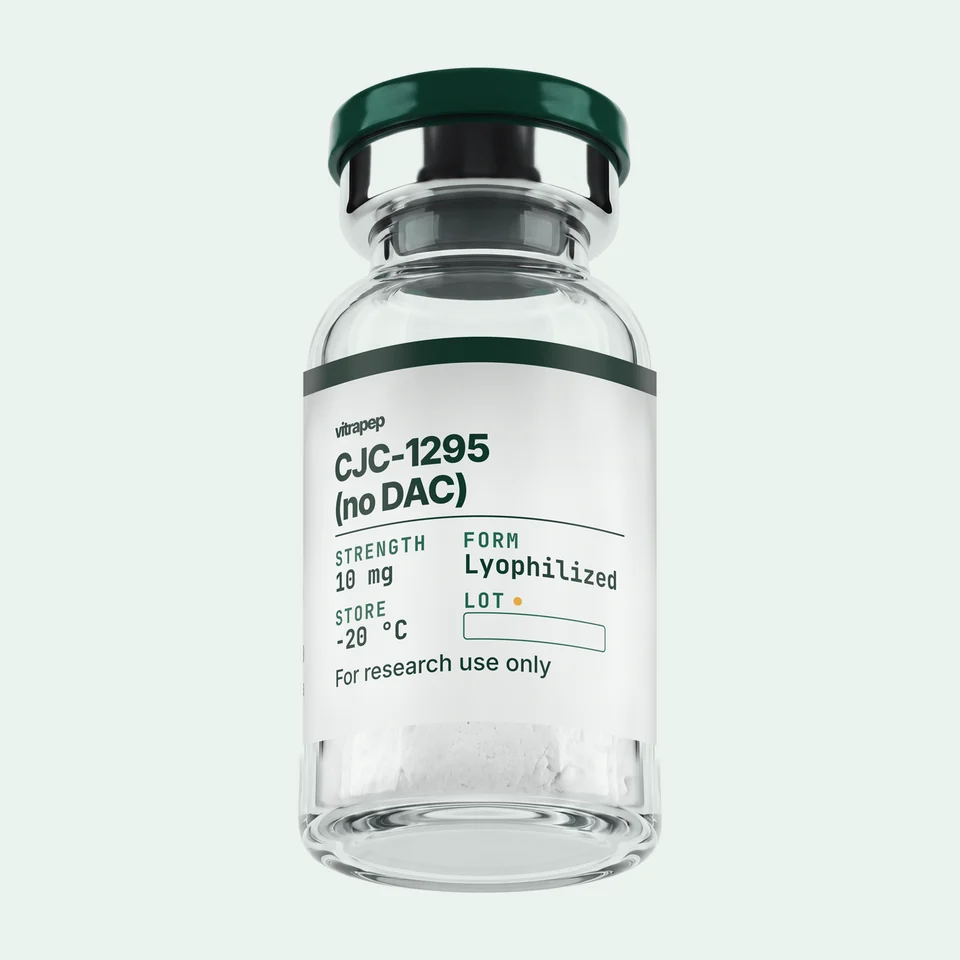
CJC-1295 (no DAC)
The no-DAC variant cited across the 2021–2024 anti-doping detection literature including Memdouh et al., 2021 and the 2026 JAAOS therapeutic peptides review. CAS 863288-34-0, MW 3367.9 g/mol, ≥99% HPLC purity, third-party CoA on every lot.
2026 pricing benchmarks
CJC-1295 sits in the middle of the research-peptide cost curve. It’s longer than BPC-157 (15 aa) but shorter than tesamorelin (44 aa). The DAC modification adds synthesis cost on top of the no-DAC form. We checked US research supplier product pages on November 17, 2026. Listed single-vial prices, before shipping and codes:
- No-DAC, 5 mg vial: $20.00–$46.00 ($4.00–$9.20 per mg). Standard retail size.
- No-DAC, 10 mg vial: $59.99–$110.00 ($6.00–$11.00 per mg).
- DAC vials: priced higher than no-DAC. The conjugation step adds complexity. Less commonly stocked.
- Multi-vial tiers: some suppliers discount larger orders.
The full table, with each supplier and source, is on our peptide price list.
A price far below the rest of the market deserves a question, for either form. Each additional coupling step in a 29-amino-acid peptide is an opportunity for incomplete reaction. That means more impurities at the cheap end, where the purification step gets shortcut.
Is CJC-1295 legal to buy?
Yes, as a research reference compound. It’s not FDA-approved, never finished clinical development, and appears on FDA’s list of compounding substances that may present significant safety risks (its nomination was withdrawn). That doesn’t affect research sales.
Three more things the legal status does:
- It tells you about the evidence base. No active pharmaceutical sponsor means no ongoing trials. Recent PubMed literature from 2020 to 2026 is dominated by anti-doping detection methods.
- It closes the compounding pharmacy channel. Pharmacies can’t prepare CJC-1295 for human use.
- It triggers WADA prohibition under Category S2. Validated LC-MS/MS methods detect CJC-1295 at sub-ng/mL in urine (Memdouh et al., 2021; Coppieters et al., 2022). Athletes are reliably detectable for no-DAC within hours and DAC for days.
Research-use sales operate under 21 CFR § 809.10(b)(9). Laboratory research stays legal. See peptides and the 2023 503A categorization for the deeper regulatory context.
Red flags specific to CJC-1295
Seven warning signs we’d skip:
- “CJC-1295” without DAC/no-DAC on the label. The single most basic identity disclosure.
- “CJC-1295 Pro,” “Long-Acting,” or branded variant names. The two real molecules are no-DAC and DAC. Anything else without a published structure is marketing.
- Pre-mixed liquid at room temperature. Shelf life in days, not weeks.
- Clinical claims on the product page. “Treats GH deficiency” or “reverses aging” are FDA enforcement territory for a discontinued-program compound.
- Missing CAS number. 863288-34-0 (no-DAC) should resolve in PubChem in 30 seconds.
- Mass-spec result that doesn’t match the variant. No-DAC = 3367.9, or [M+2H]2+ near 1684.9.
- Vendor’s in-house QC instead of third-party testing. Independent ISO 17025 verification is the research-grade standard.
CJC-1295 DAC vs no-DAC — the variables a buyer should be able to compare.
The two CJC-1295 variants are different molecules with different half-lives, different prices, and different pharmacology profiles. A vendor selling “CJC-1295” without distinguishing them is failing the basic identity disclosure. The no-DAC form is what most current research-community work uses; the DAC form is the variant whose clinical program was halted.
Source: variant characterization from the 2021 GHRH-analog detection review (Memdouh et al., 2021), 2026 JAAOS therapeutic peptides review (Rahman et al., 2026), and Vitrapep catalog pricing 2026.
CJC-1295 (no DAC)
Modified GRF 1-29, CAS 863288-34-0, MW 3367.9 g/mol. The same reference compound used across the 2020–2024 anti-doping detection literature and grouped in the 2026 Sports Medicine review of unapproved peptide therapies. COA with HPLC trace and mass-spec ships with every order.
Frequently asked questions
Is CJC-1295 legal to buy?
Yes, as a research reference compound. It’s not FDA-approved, never finished clinical development, and appears on FDA’s list of compounding substances that may present significant safety risks. That doesn’t close research sales. It’s also on the WADA Prohibited List (S2).
DAC vs no-DAC — which one?
Two different molecules. DAC adds an albumin-binding linker that stretches the half-life to 6–8 days. No-DAC (Modified GRF 1-29) has a 30-minute half-life. Most current research use is the no-DAC form because it preserves pulsatile GH release. If the listing says only “CJC-1295,” ask before you buy.
How much does CJC-1295 cost?
On November 17, 2026, US research suppliers listed no-DAC CJC-1295 (Mod GRF 1-29) at $20.00–$46.00 per 5 mg vial and $59.99–$110.00 per 10 mg vial ($4.00–$11.00 per mg). The DAC variant costs more because the linker-conjugation step adds synthesis complexity. Far below that range, purity is the trade-off. Our peptide price list has the full table.
Why was CJC-1295 DAC discontinued?
ConjuChem halted clinical development around 2007. Public reporting attributes the decision in part to scrutiny of the broader DAC pipeline after a fatal adverse event in a separate trial of CJC-1131. The program never restarted and CJC-1295 has no current sponsor.
CJC-1295 vs Ipamorelin
Different signaling pathways, complementary effects. CJC-1295 acts on the GH-releasing pathway. Ipamorelin acts on the ghrelin pathway and also blocks somatostatin, the brake on GH. Researchers stack them because the two pathways combine well. A 2026 review showed the combination improved muscle force in mouse models of glucocorticoid-induced muscle loss (Mayfield et al., 2026). See the CJC-1295 vs Ipamorelin comparison.
What should a CJC-1295 CoA show?
For no-DAC: CAS 863288-34-0, HPLC purity above 98% with chromatogram, mass-spec at MW ~3367.9 g/mol. The mass usually shows as multi-charge ions [M+2H]2+ near 1684.9 or [M+3H]3+ near 1123.6. Water content should be 2–8% by Karl Fischer titration. Counterion content is usually TFA at 5–15%. The DAC variant has a different MW because of the linker. The lab should be ISO 17025-accredited and named.
What to know now
- Two variants, not one. Confirm DAC vs no-DAC before purchase. Different half-lives, prices, pharmacology.
- No-DAC: CAS 863288-34-0, MW 3367.9 g/mol. The numbers a credible CoA shows for Modified GRF 1-29.
- $20.00–$46.00 per 5 mg no-DAC vial on November 17, 2026. DAC costs more because the linker adds synthesis steps.
- Clinical development halted around 2007. No current pharmaceutical sponsor.
- WADA S2 with validated detection. Athletes are reliably detectable at sub-ng/mL.
- Lyophilized powder is the literature form. Room-temperature liquid has a much shorter window.
- Recent literature is dominated by detection methods. No new efficacy RCTs in the 2020–2026 window.
What we’re watching
The big signal: whether any developer revives a clinical program for CJC-1295. Two decades after the ConjuChem halt, no sponsor has emerged. Without one, efficacy data won’t accumulate and the literature stays anchored on analytical chemistry. A secondary signal: whether the longer-acting GHRH-analog class (which includes tesamorelin) finds any new approved indication beyond HIV-associated lipodystrophy. That would shift the regulatory framing for the entire receptor target. We’re also watching FDA enforcement against vendors making clinical claims about CJC-1295 — the discontinued-program status and bulks-list placement put those vendors at higher risk.