Epitalon peptide benefits are often summarized as longer telomeres, better sleep and a longer life. The published evidence is narrower. Human studies of the synthetic peptide are few, small and mostly from one research network. In 2026, FDA reviewers found no clinical data supporting its safety and a lack of evidence that it works for insomnia.
Quick answer: No published study has shown that epitalon slows aging, lengthens human life or treats a disease. Small human studies reported changes in melatonin markers and gene activity, and one older study reported retinal improvements. None was large, clearly blinded or designed to measure safety. Epitalon is not approved by FDA for any use.
What is epitalon, and who developed it?
Epitalon is a tetrapeptide with the sequence Ala-Glu-Asp-Gly, often shortened to AEDG. FDA's 2026 briefing document lists its molecular formula as C14H22N4O9 and its molecular weight as 390.35 g/mol. FDA treats the acetate salt as a separate bulk substance.
The peptide came from the Saint Petersburg research program led by Vladimir Khavinson. It was designed from the amino-acid makeup of epithalamin, a polypeptide extract of cattle pineal glands. FDA considers the two to be different substances. It also notes that most pharmacological studies of epitalon came from Khavinson's group.
"Epitalon" is a common name, not a United States Adopted Name. FDA found salts and derivatives sold under the same name and called this a safety risk. Vitrapep's Epithalon complete guide covers the compound in more depth.
What did human studies of epitalon measure?
Only a few published studies gave synthetic epitalon to people. FDA's 2026 review found three. A 2026 review by Jain and colleagues listed four, two of which appear to share one group of participants.
The largest is a 2002 report by Khavinson and colleagues in congenital retinitis pigmentosa, an inherited retinal disease. According to the Jain review, it involved 162 patients, with 46 control patients on conventional therapy. The authors reported a positive clinical effect in about 90% of treated cases. Randomization and blinding were not clearly described, and there was no placebo group.
A 2007 Russian-language study by Korkushko and colleagues measured night-time melatonin in older adults. The Jain review reports 15 people on epitalon, 15 on epithalamin and 10 on placebo. Night melatonin rose mainly in people with reduced pineal function at baseline.
The newest study, by Ivko and colleagues, enrolled 75 healthy women aged 40 to 50 who mostly worked night shifts. FDA describes it as randomized and placebo-controlled. Forty women with low melatonin output were split into placebo and epitalon groups for 20 days. A urinary melatonin breakdown product rose about 1.7-fold with epitalon.
FDA noted that the Ivko paper did not specify blinding and did not measure sleep. A related 2021 paper by Khavinson, Linkova and Ivko reported clock-gene results in a closely matching group, which the Jain review treats as overlapping.
What did human studies of epitalon measure
| Study | Population and size | Design | What was measured | Reported findings | Main limitation |
|---|---|---|---|---|---|
| Khavinson et al., 2002 | 162 patients with congenital retinitis pigmentosa; 46 controls | Controlled; controls received conventional therapy | Retinal function, visual acuity, visual fields | Positive clinical effect reported in about 90% of treated cases | Randomization and blinding unclear; no placebo |
| Korkushko et al., 2007 | Older adults; 15 epitalon, 15 epithalamin, 10 placebo | Placebo comparison; blinding not described | Night-time blood melatonin | Night melatonin rose mainly in those with reduced pineal function | Small groups; full text in Russian |
| Ivko et al., 2020 | 75 women aged 40 to 50; 20 epitalon, 20 placebo, 35 reference | Randomized; 20 days | Urinary melatonin metabolite; clock genes in blood cells | Metabolite up about 1.7-fold; Clock, Csnk1e and Cry2 moved toward reference values | Blinding not specified; no sleep outcome; no safety data |
| Khavinson et al., 2021 | Closely matching group of 75 night-shift women | Same design as Ivko | Clock genes in immune cells | Gene activity moved toward reference values | Likely the same cohort as Ivko |
Together these studies include fewer than 350 participants. FDA found no study in people with insomnia and no human pharmacokinetic data, so how the body absorbs and clears epitalon is undescribed.
Do the Russian mortality studies apply to epitalon?
Not directly. The best-known mortality claims come from studies of epithalamin, the pineal extract. Khavinson and Morozov (2003) followed 266 older people for 6 to 8 years. Groups received thymalin, epithalamin or both during the first 2 to 3 years. The authors reported 1.6- to 1.8-fold lower mortality with epithalamin than in controls.
The Jain review also describes two Kiev reports on older coronary patients given epithalamin, with 12 and 15 years of follow-up. The 12-year report found 28% fewer deaths than in controls. The review notes that the two reports may share participants.
These results describe epithalamin and cannot be transferred to epitalon. Vitrapep's review of the Russian aging trials discusses this literature.
What have animal studies found?
These findings come from animals and animal tissue, not people.
In Anisimov and colleagues (2003), 54 female mice per group received epitalon or saline from 3 months of age until natural death. Mean life span did not change. The longest-lived 10% lived 13.3% longer, and maximum life span rose 12.3%. Total tumor incidence did not differ, but leukemia was 6-fold less common.
In female mice bred to develop breast tumors, Anisimov and colleagues (2002) reported fewer mammary tumors and a smaller maximum tumor size with epitalon.
FDA summarizes a 2001 study in old female rhesus monkeys in which evening melatonin rose more than 4-fold. Sleep was not measured. In contrast, Djeridane and colleagues (2003) found no effect on melatonin release from isolated rat pineal glands.
FDA judged the mouse studies too limited to settle safety. Each used one fixed amount, studied only females and involved short total exposure. FDA found no acute, repeat-dose, reproductive or two-year cancer studies.
What have cell studies shown about telomeres?
These findings come from cell cultures. Telomeres are protective DNA caps on chromosome ends, and telomerase is the enzyme that rebuilds them.
In 2003, Khavinson and colleagues added epitalon to telomerase-negative human fetal fibroblasts. They reported telomerase activity and longer telomeres.
The main independent test came from Brunel University London. Al-Dulaimi and colleagues (2025) treated two breast cancer cell lines and two types of normal human cells. In the normal cells, telomeres lengthened through higher telomerase activity. In the cancer lines, telomeres lengthened through a separate mechanism called alternative lengthening of telomeres, or ALT. A November 2025 correction replaced the paper's first three figures.
FDA raised a related concern. Long telomeres are generally associated with higher cancer risk. Lifelong telomerase activation, FDA wrote, "could enable cells to evade senescence and become cancerous." Vitrapep's telomerase mechanism article explains the biology.
What have cell studies shown about telomeres
| Finding | Evidence level | Source | Caveat |
|---|---|---|---|
| No change in mean life span; maximum life span 12.3% longer | Animal (female mice) | Anisimov et al., 2003 | One research group; females only |
| Fewer and smaller breast tumors | Animal (tumor-prone mice) | Anisimov et al., 2002 | Not a cancer-safety study |
| Higher evening melatonin | Animal (old monkeys) | FDA summary of a 2001 study | Sleep not measured |
| No change in melatonin release | Animal tissue (rat pineal glands) | Djeridane et al., 2003 | Isolated glands only |
| Telomerase activity and longer telomeres | Cell (normal human cells) | Khavinson et al., 2003; Al-Dulaimi et al., 2025 | Laboratory cultures only |
| Telomere lengthening through ALT | Cell (breast cancer lines) | Al-Dulaimi et al., 2025 | Meaning for living tissue unknown |
What side effects have been reported?
No study of epitalon was designed to measure safety. FDA concluded that "there are no clinical data to support the safety of epitalon (free base) or epitalon acetate when used in humans."
The human papers give little adverse-event information. FDA notes that the Ivko study did not report safety data. The 2007 Korkushko abstract says the preparations had "no side effects," but describes no methods for collecting them. Not reporting side effects is not the same as finding none.
FDA's adverse event database, FAERS, had no epitalon reports through December 8, 2025. Its foods and supplements complaint system also had none. These systems rely on voluntary reports, so an empty search does not show safety.
FDA raised two specific concerns. One is immunogenicity, an unwanted immune response, linked to aggregation and peptide-related impurities. The other is the theoretical cancer risk from long-term telomerase activation. Vitrapep's page on human-use risks of research peptides covers these issues more broadly.
What is epitalon's regulatory and anti-doping status?
Epitalon is not approved by FDA for any use and is not a component of any FDA-approved drug. FDA found no approved epitalon products in Canada, Australia, the United Kingdom or seven European countries, and none with European Medicines Agency authorization.
According to FDA's briefing, epitalon received a US orphan drug designation for retinitis pigmentosa in September 2010. That designation was withdrawn or revoked in January 2016. An orphan designation is not an approval.
FDA's page on bulk substances that may present significant safety risks lists epitalon among withdrawn nominations previously in category 2. It says compounded epitalon "may pose risk for immunogenicity for certain routes of administration."
FDA's Pharmacy Compounding Advisory Committee discussed epitalon on July 24, 2026, for insomnia only. FDA staff proposed not adding either form to the 503A bulks list. They cited poor characterization, no human safety data and a lack of evidence for insomnia. FDA said it would decide only after considering the committee's input. The meeting page listed no minutes or vote results on November 18, 2026.
Vitrapep's overview of peptides and the FDA in 2026 puts these steps in order. A research-use-only label does not make any product legal for use in people.
The 2026 WADA Prohibited List does not name epitalon. Its S0 class bans any pharmacological substance not covered elsewhere on the List and lacking current government approval for human therapeutic use. Vitrapep's WADA peptide guide explains S0.
What is still unknown about epitalon?
The biggest gap is clinical outcomes. According to the Jain review, no adequately powered randomized trial has established that epitalon works for any condition.
Human pharmacokinetic, dose-ranging and long-term safety data are missing. Without them, there is no evidence-based dose, as explained in why research peptides have no dose. Independent replication is also thin, and the Brunel cancer-cell finding has not been tested in animals or people.
A ClinicalTrials.gov search on November 18, 2026 found one registered study listing epitalon. NCT07888595 is an early phase 1, single-group, unmasked study of an estimated 48 participants. Epitalon is one of several peptides in a combined formulation, so the study cannot isolate its effects. Vitrapep's guide on how to evaluate peptide research explains why design matters.
Vitrapep research material
Vitrapep sells Epithalon for laboratory research use only. It is not for human or veterinary use.
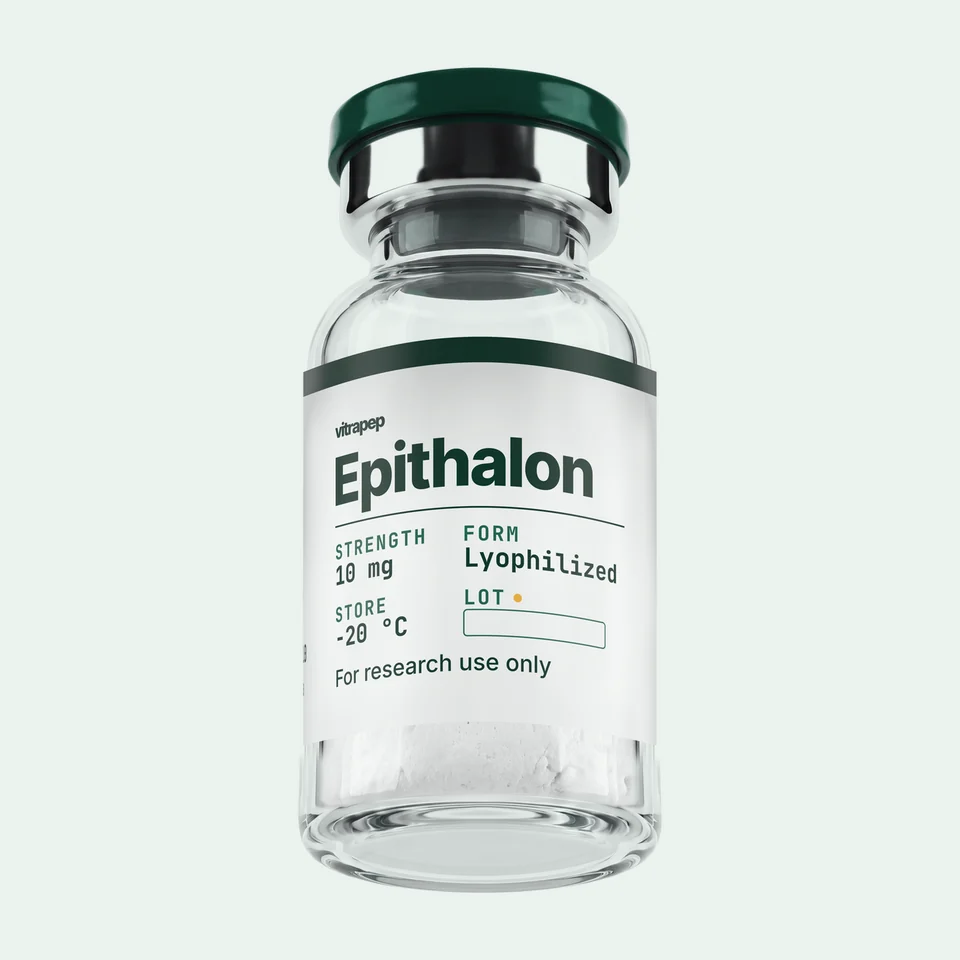
Epithalon
Specifications for the Epithalon sold for laboratory research. COA available with each lot.
Frequently asked questions
Does epitalon lengthen telomeres in people?
No human study has shown this. Telomere lengthening has been reported in cultured human cells. The human studies measured melatonin markers, clock genes or eye function, not telomere length.
Is epitalon the same as epithalamin?
No. Epithalamin is a polypeptide extract of cattle pineal glands, and epitalon is a synthetic peptide designed from it. FDA treats them as different substances.
Did epitalon extend life span in animal studies?
In one study of female mice, mean life span did not change, but maximum life span increased. These results come from one research group and have not been shown in people.
Has epitalon been shown to improve sleep?
No. FDA found no studies of epitalon in people with insomnia. One small study reported higher urinary melatonin markers but did not measure sleep.
What side effects did epitalon studies report?
Very little. FDA found no clinical safety studies and no FAERS reports through December 2025. Several papers did not report safety data, which does not mean none occurred.
Is epitalon FDA-approved?
No. It is not approved for any use. In 2026, FDA staff proposed not adding it to the 503A bulks list for compounding.
What to know now
- Epitalon is a synthetic Ala-Glu-Asp-Gly peptide, studied mostly by one Saint Petersburg network.
- Human studies are few and small, and they measured biomarkers or eye tests, not aging outcomes.
- Mortality results often cited for epitalon came from epithalamin, a different extract.
- Telomere lengthening has been shown only in cell cultures, including cancer cells through ALT.
- FDA found no clinical safety data and proposed not adding epitalon to the 503A bulks list.
What we’re watching
- Whether FDA posts minutes or a final decision on epitalon after the July 2026 committee meeting.
- Independent animal or human studies that test the Brunel cancer-cell telomere finding.
- Any registered, blinded, placebo-controlled trial of epitalon alone with clinical endpoints.
- Results from NCT07888595, although its combined design cannot isolate epitalon.