GLOW vs KLOW is a comparison of two blend labels, not two molecules. Vitrapep's GLOW Blend combines BPC-157, TB-500 and GHK-Cu in one lyophilized vial. KLOW Blend contains the same three components plus KPV, a short fragment of a pituitary hormone. We found no published study or registered trial of either blend.
Quick answer: Published research cannot rank GLOW against KLOW. KLOW contains everything in GLOW plus KPV, and KPV has only cell and animal data. Neither blend, and none of their components, is an FDA-approved drug. Both blends contain two substances named on the 2026 WADA Prohibited List.
What are the GLOW and KLOW blends?
GLOW and KLOW are market names for pre-mixed peptide blends, not official drug names. Vitrapep's GLOW Blend specification lists BPC-157, TB-500 and GHK-Cu in one vial. The KLOW Blend specification lists the same three, in the same listed amounts, plus KPV. It even gives "GLOW plus KPV" as an alternate name.
Naming is a known problem here. FDA's 2026 reviews found inconsistent, nonstandard naming for BPC-157, TB-500 and KPV (FDA, 2026).
Mixing peptides does not create a new peptide, but any effect or impurity now belongs to an unstudied mixture. Vitrapep's GLOW blend guide and KLOW blend guide cover each blend on its own.
How do GLOW and KLOW compare side by side?
Most rows in Table 1 match, because the blends share three components. Every difference traces back to KPV.
How do GLOW and KLOW compare side by side
| Feature | GLOW Blend | KLOW Blend |
|---|---|---|
| Components | BPC-157, TB-500, GHK-Cu | BPC-157, TB-500, GHK-Cu, KPV |
| Published study or registered trial of the blend | None found (November 18, 2026) | None found (November 18, 2026) |
| Components with no human exposure data, per FDA | TB-500 | TB-500 and KPV |
| FDA-approved drug | No; no component is approved | No; no component is approved |
| FDA 2026 compounding review | FDA proposed not adding BPC-157 or TB-500 to the 503A bulks list | Same, plus KPV |
| Named on WADA 2026 list | BPC-157 (S0), TB-500 (S2.3) | BPC-157 (S0), TB-500 (S2.3) |
How do the four components differ?
The blends cannot carry one evidence grade, because their components sit at very different levels.
How do the four components differ
| Feature | BPC-157 | TB-500 | GHK-Cu | KPV |
|---|---|---|---|---|
| In which blend | Both | Both | Both | KLOW only |
| Structure | 15 amino acids | 7 amino acids, acetylated (Ac-LKKTETQ) | Tripeptide Gly-His-Lys bound to copper(II) | Tripeptide Lys-Pro-Val |
| Origin | Fragment of a protein from human gastric juice | Residues 17 to 23 of the 43-residue thymosin beta-4 | GHK was isolated from human plasma | Fragment of alpha-melanocyte-stimulating hormone |
| Mechanism studied | Molecular targets not identified, per FDA; rodent injury models | Contains thymosin beta-4's actin-binding segment | Collagen synthesis in cultured fibroblasts | NF-κB inhibition and PepT1 uptake in cell lines |
| Human evidence | Five small studies identified by FDA | None identified by FDA | Small topical trials | None identified by FDA |
| Registered trial | Phase 2, NCT07437547 | Phase 1/2, NCT07487363 | Phase 2 topical, NCT07437586 | None found |
| FDA 2026 position | Proposed not adding to 503A list | Proposed not adding to 503A list | Injectable use flagged for immunogenicity | Proposed not adding to 503A list |
| WADA 2026 | Named under S0 | Named under S2.3 | Not named | Not named |
What is KPV, the component only KLOW contains?
FDA's KPV briefing document describes KPV as a tripeptide of lysine, proline and valine. It is a fragment of alpha-melanocyte-stimulating hormone (alpha-MSH). FDA lists its molecular weight as 342.43 g/mol.
Alpha-MSH acts through melanocortin receptors. FDA notes that several lines of evidence make those receptors unlikely targets for KPV's reported anti-inflammatory effects.
The best-known KPV work is in cells and mice. Dalmasso and colleagues reported that KPV inhibited NF-κB and MAP kinase signaling in human intestinal and immune cell lines. The peptide entered cells through PepT1, a small-peptide transporter. In two mouse colitis models, KPV lowered pro-inflammatory cytokine expression.
FDA reviewed KPV in May 2026 for wound healing and inflammatory conditions. It found no clinical studies or human exposure data by any route. It proposed not adding KPV to the list of bulk substances pharmacies may compound under section 503A.
KPV's evidence level is therefore cell and animal only. Vitrapep's KPV guide reviews the preclinical work.
What human evidence exists for the three shared components?
BPC-157. FDA's 2026 review identified five small clinical studies. They were a healthy-volunteer tolerability study, a 53-person ulcerative colitis trial, a 17-patient knee-pain review, a 12-woman interstitial cystitis study and a two-person pilot. The colitis trial was placebo-controlled, but the confidence interval for the group difference included zero. FDA concluded the data do not support BPC-157 for ulcerative colitis.
The knee-pain review by Lee and Padgett is the only published human report involving two blend components together. Of 16 patients reached by phone, 12 had received BPC-157 alone and 11 reported significant improvement. Four had received BPC-157 with thymosin beta-4, and three reported improvement. There was no control group and no validated outcome tool. The abstract does not say whether the thymosin beta-4 was the full protein or the TB-500 fragment.
A randomized, placebo-controlled Phase 2 trial in acute hamstring strain is recruiting an estimated 120 participants (NCT07437547).
TB-500. FDA found no clinical studies or human exposure data for TB-500 by any route (FDA TB-500 briefing). Because TB-500 is acetylated, FDA said data on the plain LKKTETQ sequence cannot be applied to it directly. In one cell study FDA summarized, TB-500 did not speed closure of scratch wounds in fibroblasts.
Trials of full-length thymosin beta-4 tested a different, larger molecule, as Vitrapep's TB-500 complete guide explains. A placebo-controlled Phase 1/2 trial of the fragment in stable atherosclerotic cardiovascular disease is recruiting an estimated 80 participants (NCT07487363).
GHK-Cu. GHK is a copper-binding tripeptide isolated from human plasma. In a 1988 cell study, GHK-Cu stimulated collagen synthesis by cultured fibroblasts (Maquart et al.).
The human evidence comes from topical products. A multicenter, randomized, evaluator-blinded, placebo-controlled trial tested a GHK-Cu gel in diabetic neuropathic ulcers (Mulder et al., 1994). Median closure of plantar ulcers was 98.5% with the gel and 60.8% with vehicle. The abstract does not give the number of patients.
After CO2 laser resurfacing, a randomized 13-patient study found GHK-Cu skin care did not speed redness resolution (Miller et al., 2006). Objective measures found no difference in wrinkles, though patient satisfaction was higher. A Phase 2 topical gel trial in skin wounds is recruiting an estimated 60 healthy adults (NCT07437586).
These trials tested skin products, not GHK-Cu mixed with other peptides. Vitrapep's GHK-Cu guide and BPC-157 guide cover each compound in depth.
What side effects have been reported for each component?
Neither blend has published adverse-event data. Component-level reporting is thin.
BPC-157. FDA wrote that no serious adverse events appear to have been reported in the five studies (FDA BPC-157 briefing). The studies were short and small, and safety monitoring was unclear for most. Headache and flatulence were the most frequent events in the healthy-volunteer abstracts, with no obvious difference from placebo.
FDA's adverse event database held three BPC-157 reports through December 4, 2025. They described an injection site reaction, shortness of breath, and diffuse hyperpigmentation with gum darkening. FDA said it is unclear whether BPC-157 caused them.
The pigmentation case involved a product containing both BPC-157 and TB-500, labeled for research purposes only. The reaction returned when the product was used again. FDA judged it likely product-related, but with two peptides present it could not assess BPC-157's role. Every multi-peptide blend shares this problem: a reaction cannot be assigned to one component.
TB-500. FDA found no TB-500 reports in its adverse event database through March 26, 2025. A separate FDA complaint system held two reports about "blended TB-500 and BPC-157," with no safety assessments.
GHK-Cu. FDA says compounded injectable GHK-Cu may pose a risk of immunogenicity, meaning unwanted immune responses, from aggregation and peptide-related impurities (FDA, 2026). It adds that human safety data are limited. The diabetic ulcer trial reported fewer infections with the gel than with vehicle, 7% versus 34%, in plantar ulcers treated right after debridement.
KPV. FDA found no KPV reports in its adverse event database through December 3, 2025, and no published case reports. Without human exposure data, FDA said the potential safety risks in humans are unknown.
An empty database is not evidence of safety. FDA notes that reporting is voluntary and that 503A compounders generally do not report adverse events. FDA's BPC-157 review adds that formulation, concentration and storage can favor impurities and aggregates that may trigger immune responses. No published study has examined those factors in either blend.
What is the regulatory and anti-doping status of each blend?
Neither blend is an FDA-approved drug, and neither is any component. FDA states that TB-500 and KPV are not components of any FDA-approved drug. It found no approved BPC-157 product in any country. Drugs@FDA lists no approved product containing GHK-Cu.
In July 2026, FDA's Pharmacy Compounding Advisory Committee discussed BPC-157, KPV and TB-500 for the 503A bulks list. FDA's briefing documents proposed not adding any of the three. FDA said it will not issue a final determination until it has considered the committee's input.
GHK-Cu was not on that agenda. FDA's safety-risks page lists injectable GHK-Cu with BPC-157, KPV and TB-500 among substances previously in category 2 whose nominations were withdrawn.
A research-use-only label does not make either blend an approved drug or a product for people. Vitrapep's page on research peptides and human-use risks explains why.
The WADA 2026 Prohibited List names BPC-157 under S0, non-approved substances. It names TB-500 under S2.3 as a derivative of thymosin beta-4. Substances in both sections are prohibited at all times, in and out of competition.
GHK-Cu and KPV are not named. S0 still covers any pharmacological substance not addressed elsewhere and not approved for human therapeutic use. The list does not say whether either falls under S0. The 2027 list, in effect January 1, 2027, adds peptides to the S0 examples.
Why can't GLOW and KLOW be ranked?
No study has compared GLOW with KLOW, and no study has tested either one. A ranking would need a controlled comparison of the two mixtures on a defined outcome.
Adding KPV adds an ingredient, not a demonstrated effect. KPV's colitis and cell findings do not predict how it behaves alongside BPC-157, TB-500 and GHK-Cu.
Nor can the component studies be added into a blend result. They used different forms, populations and outcomes. Interaction, stability and impurity questions for both mixtures remain untested.
The defensible comparison is about composition and evidence gaps. KLOW has one more component, and that component has no human data. Neither fact shows that one blend does more or less than the other.
Vitrapep research material
Vitrapep sells KLOW Blend and GLOW Blend for laboratory research use only. Neither is for human or veterinary use.
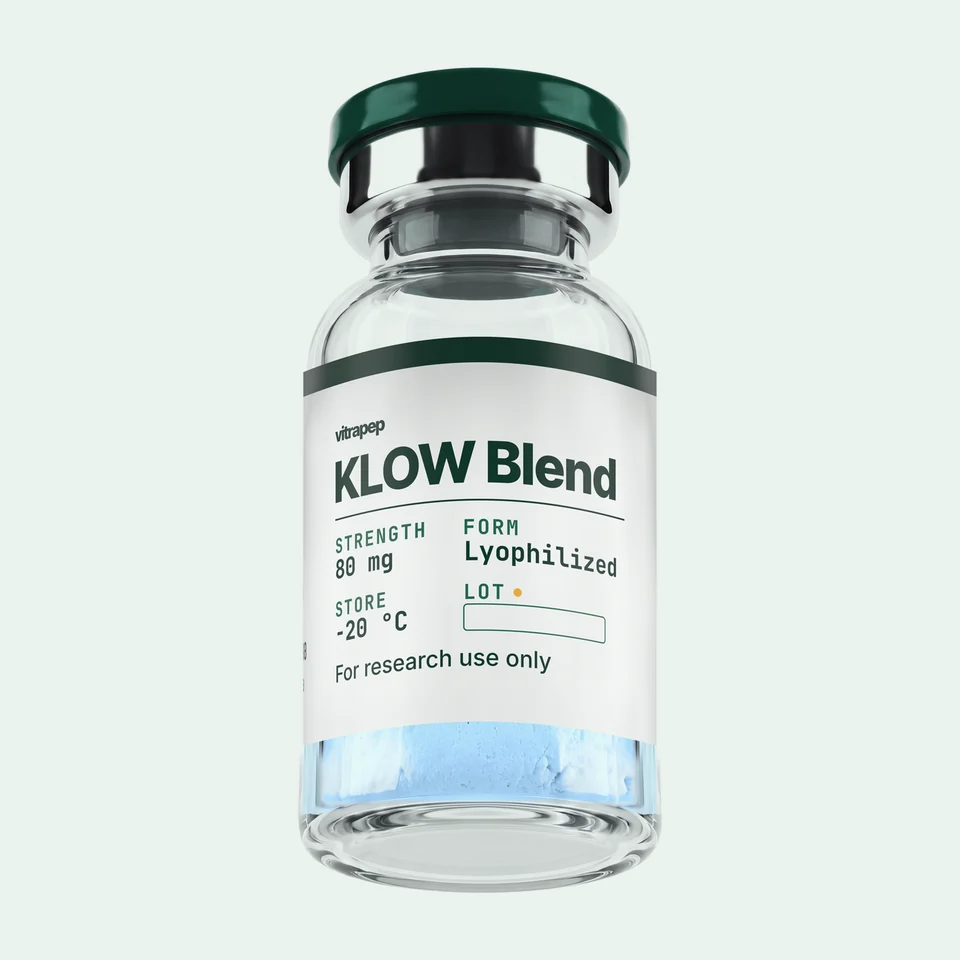
KLOW Blend
Specifications for the KLOW Blend sold for laboratory research. COA available with each lot.
Frequently asked questions
What is the difference between GLOW and KLOW?
KLOW contains everything in GLOW plus KPV. Both include BPC-157, TB-500 and GHK-Cu. KPV is a three-amino-acid fragment of alpha-MSH.
Has either blend been tested in people?
No. We found no published study or registered trial of either blend. Limited human data exist only for some components.
What does the research say KPV adds?
Only cell and animal findings. KPV reduced inflammatory signaling in cell lines and colitis markers in mice. FDA identified no human exposure data.
Is KLOW stronger or better than GLOW?
No study shows that. The blends have never been compared, and a fourth component is not evidence of a larger effect.
Are GLOW and KLOW FDA-approved?
No. Neither blend nor any component is an FDA-approved drug. In 2026, FDA proposed not adding BPC-157, TB-500 or KPV to the 503A compounding list.
Are GLOW and KLOW banned in sport?
Both contain BPC-157 and TB-500, which WADA's 2026 list names as prohibited at all times. GHK-Cu and KPV are not named on the list.
Is there an approved dose for either blend?
No. Neither blend is an approved drug, so no FDA-reviewed dose exists; see why research peptides have no dose.
What to know now
- KLOW is GLOW plus KPV.
- No published study or registered trial has tested either blend.
- FDA found no human exposure data for TB-500 or KPV; BPC-157 and topical GHK-Cu have small human studies.
- Both blends contain two substances named on WADA's 2026 Prohibited List.
What we’re watching
- Results from NCT07437547 (BPC-157), NCT07487363 (TB-500) and NCT07437586 (topical GHK-Cu).
- FDA's final 503A determinations on BPC-157, TB-500 and KPV after the July 2026 committee meeting.
- Any registered human study of KPV.
- Any study that tests a multi-peptide blend as a single material for stability, impurities or effects.