KLOW peptide is a name used for a multi-component blend rather than a single naturally occurring molecule. The name does not identify one standardized formula. The component sections below examine GHK-Cu, BPC-157, TB-500 and KPV the four components of Vitrapep's KLOW Blend.
Quick answer: KLOW is a name for a multi-component peptide blend, not a unique molecule with a universal formula. Vitrapep's version combines BPC-157, TB-500, GHK-Cu and KPV in one lyophilized vial. Research on individual compounds does not establish the complete blend's mechanism, synergy, clinical effect or human safety profile.
What is the KLOW peptide blend?
KLOW is a blend name used for mixtures of distinct research compounds. It is not the name of a single molecule, and it does not identify a unique chemical sequence. The name alone does not establish the ingredient list, ratio, component identity or analytical quality.
Vitrapep's KLOW Blend is a single lyophilized vial containing 10 mg BPC-157, 10 mg TB-500, 50 mg GHK-Cu and 10 mg KPV, 80 mg in total. The TB-500 in the blend is the seven-residue actin-binding fragment of thymosin beta-4. The component sections below summarize published research on each of the four.
KLOW is not a new peptide sequence. Each component retains its own identity, and the finished mixture requires direct testing to assess compatibility, stability and combined behavior.
What does research say about GHK-Cu?
GHK-Cu is a copper complex of the tripeptide glycyl-L-histidyl-L-lysine. Research has examined its interaction with fibroblasts and extracellular-matrix processes. In a cell-culture study, Maquart and colleagues reported increased collagen synthesis in fibroblast cultures exposed to GHK-Cu. The experiment was performed in cultured cells, not in people receiving a KLOW blend (Maquart et al., 198880509-X)).
A later cell study evaluated GHK-Cu in normal and irradiated human dermal fibroblasts. Pollard and colleagues reported changes in fibroblast growth and in the expression of selected growth factors. Those findings describe laboratory cell responses. They do not establish a clinical outcome for skin, muscle, tendon or other tissues in humans (Pollard et al., 2005).
The findings provide a biological research context for GHK-Cu. However, a cell response is not equivalent to a demonstrated benefit in a human clinical trial. The same caution applies when GHK-Cu is combined with other peptides.
What does research say about BPC-157?
BPC-157 is a synthetic peptide composed of 15 amino acids. Its published literature includes cell studies and a range of animal models, including tendon and ligament injury research. In a rat Achilles tendon study, investigators reported improved structural and biomechanical measures after tendon transection. The paper also examined tendocyte growth in vitro (Sikiric et al., 2003).
Chang and colleagues studied tendon outgrowth, cell survival and cell migration in laboratory models. Their work examined cultured tendon fibroblasts and proposed cellular pathways that might contribute to observations in animal injury models. These results do not demonstrate clinical effectiveness in humans (Chang et al., 2011).
Human evidence remains limited. A 2026 systematic review identified three small human studies with a combined total of 30 participants across different settings. The authors rated the overall certainty of evidence as very low because of bias, indirectness and imprecision (Poolton et al., 2026). That evidence cannot establish the effects of BPC-157 as one ingredient in a four-part KLOW mixture.
What does research say about TB-500?
TB-500 is a name used for a research peptide associated with thymosin beta-4 biology. The exact identity of a product described as TB-500 should be confirmed from its analytical documentation. Research involving full-length thymosin beta-4 should not automatically be treated as direct evidence for every TB-500 preparation.
In a rat full-thickness wound model, Malinda and colleagues reported that thymosin beta-4 increased re-epithelialization and affected wound contraction, collagen deposition and angiogenesis. They also observed increased keratinocyte migration in a cell assay (Malinda et al., 1999). This was animal and laboratory research on thymosin beta-4. It was not a human clinical trial of TB-500 or KLOW.
The distinction between a related molecule and a marketed fragment matters. Evidence should be matched to the precise molecular identity that was tested. Without a defined sequence and analytical confirmation, it is not possible to assume that all products sold under a TB-500 label are identical to the research material in a particular paper.
What does research say about KPV?
KPV is a tripeptide composed of lysine, proline and valine. It has been studied in intestinal inflammation models. Dalmasso and colleagues examined KPV in human intestinal epithelial and immune-cell systems and in mouse models of colitis. Their experiments reported reduced inflammatory signaling and changes in pro-inflammatory cytokine responses (Dalmasso et al., 2008).
A separate study examined KPV in two mouse models of intestinal inflammation and reported anti-inflammatory effects in those animal models (Brzoska et al., 2008). These are preclinical findings. They do not establish KPV as an approved treatment or show that it contributes a specific effect in the KLOW mixture.
What does research say about KPV
| Component (Vitrapep KLOW Blend) | Research model in cited paper | Reported observation | What the finding does not establish |
|---|---|---|---|
| GHK-Cu | Fibroblast cell culture | Increased collagen synthesis in cultured fibroblasts | A clinical skin or tissue outcome from KLOW |
| BPC-157 | Rat Achilles tendon model and tendon-cell culture | Changes in tendon healing measures and tendocyte growth | Human efficacy or safety of BPC-157, or of the blend |
| TB-500-related thymosin beta-4 | Rat wound model and cell migration assay | Changes in re-epithelialization and keratinocyte migration | Equivalence between all TB-500 products and thymosin beta-4 |
| KPV | Human intestinal cell models and mouse colitis models | Reduced selected inflammatory signals | A clinical effect of KPV or KLOW in people |
Has the complete KLOW blend been studied?
No controlled primary study of a complete KLOW blend was identified in the sources reviewed for this article. The component papers test separate molecules, in different models, for different outcomes. They do not test the fixed mixture as a single intervention.
This distinction has several implications. First, separate studies do not establish that the ingredients work better together. Second, one ingredient's cell or animal findings cannot be used to predict the overall response to a mixture. Third, the combination could have stability, compatibility or interaction questions that are not answered by studying each ingredient separately.
A controlled study of the complete preparation would need to identify the exact composition and analytical specifications of the material tested. It would also need to report its study model, comparison groups, endpoints and adverse-event monitoring. Without this information, claims about synergy or a combined mechanism remain hypotheses rather than established findings.
Is KLOW FDA approved?
The sources reviewed did not identify an FDA-approved medicine named KLOW. Regulatory status should be checked against the exact ingredients and formulation. FDA information on BPC-157 also raises concerns about limited human safety information, potential immune responses, peptide-related impurities and active pharmaceutical ingredient characterization (FDA, Bulk Drug Substances That May Present Significant Safety Risks).
The FDA's discussion of BPC-157 does not establish the status of every ingredient in every formulation. It does, however, underscore why the presence of a research label or a supplier's description should not be interpreted as regulatory approval or proof of safety. Product-specific legal status should be checked against current FDA rules and the precise intended use.
Frequently asked questions
What is KLOW peptide made of?
There is no single formula established by the name KLOW. The exact ingredients and amounts come from each product's specification. Vitrapep's KLOW Blend contains 10 mg BPC-157, 10 mg TB-500, 50 mg GHK-Cu and 10 mg KPV.
Is KLOW one peptide?
No. KLOW is a blend name for separate molecules. It does not have one shared amino-acid sequence or one molecular weight.
Does KLOW have clinical studies?
No controlled human clinical study of a complete KLOW blend was identified in the sources reviewed. The published research cited here concerns candidate ingredients separately and primarily uses cells or animals.
Is there evidence that KLOW ingredients work synergistically?
The cited component studies do not establish synergy in the combined KLOW formulation. A mixture needs to be tested directly before a combined effect can be claimed.
Is KLOW FDA approved?
KLOW is not an FDA-approved medicine. The regulatory status of each ingredient and any product containing it must be assessed separately.
For related product information, see Vitrapep's GHK-Cu research material, BPC-157 research material and TB-500 research material. The Vitrapep research library provides additional compound guides.
Vitrapep research material
Vitrapep sells KLOW blend for laboratory research use only. It is not for human or veterinary use.
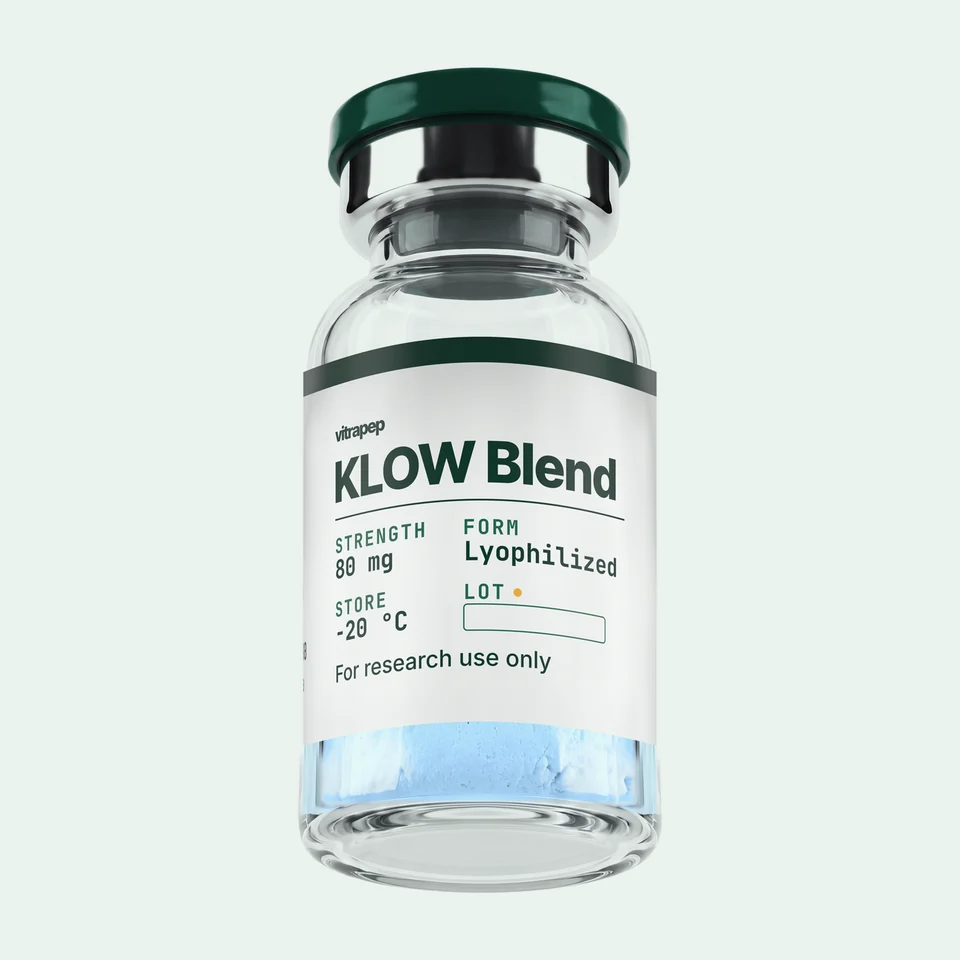
KLOW blend
Specifications for the KLOW blend sold for laboratory research. COA available with each lot.
What to know now
- KLOW is a blend name, not a unique peptide molecule.
- Published research covers individual components in cell and animal models, rather than the complete blend.
- No evidence reviewed here establishes clinical efficacy, safety or synergy for the complete KLOW formulation.
What we’re watching
- Direct studies of the complete KLOW blend would be needed to evaluate the combined formulation. No published clinical readout date was identified.
- Lot certificates for Vitrapep's KLOW Blend will be posted on the COA page as each lot is tested.