Semaglutide is a long-acting glucagon-like peptide-1 (GLP-1) receptor agonist. It is a modified peptide analogue of human GLP-1 that activates the GLP-1 receptor and has been studied in type 2 diabetes, obesity, cardiovascular disease, chronic kidney disease and metabolic dysfunction-associated steatohepatitis (MASH).
Quick answer: Semaglutide is a modified GLP-1 peptide that activates GLP-1 receptors. FDA-approved semaglutide products have product-specific indications for type 2 diabetes, chronic weight management, cardiovascular risk reduction and, for Wegovy injection, certain adults with noncirrhotic MASH and liver fibrosis.
What is semaglutide and what is its structure?
Semaglutide is a synthetic GLP-1 analogue with a peptide backbone produced by yeast fermentation. The current Wegovy prescribing information reports 94% sequence homology to native human GLP-1. Its molecular formula is C₁₈₇H₂₉₁N₄₅O₅₉, and its molecular weight is 4,113.58 g/mol (FDA, Wegovy Prescribing Information, revised February 2026).
The molecule contains several deliberate changes. The lysine at position 26 carries a hydrophilic spacer and a C18 fatty di-acid. This modification enables strong albumin binding. Another change at position 8 helps protect the peptide from degradation by dipeptidyl peptidase-4 (DPP-4). A further change at position 34 supports attachment of only one fatty di-acid (FDA, Wegovy Prescribing Information).
These changes distinguish semaglutide from native GLP-1. Native GLP-1 is rapidly broken down. Semaglutide's molecular design supports prolonged circulation and sustained receptor activity. FDA labeling reports that more than 99% of circulating semaglutide is bound to plasma albumin and that its elimination half-life is approximately one week (FDA, Wegovy Prescribing Information).
How does semaglutide work?
Semaglutide works by selectively binding to and activating the GLP-1 receptor. GLP-1 is an incretin hormone involved in glucose regulation and appetite signaling. In people with type 2 diabetes, semaglutide stimulates insulin secretion and reduces glucagon secretion in a glucose-dependent manner. It also delays gastric emptying, particularly in the early post-meal period (FDA, Rybelsus and Ozempic Tablet Label, 2026).
Semaglutide does not act as a direct replacement for insulin. The prescribing information also describes effects on appetite and caloric intake. GLP-1 receptors are present in brain regions involved in regulating food intake, and animal studies cited in the Wegovy label found activation of neurons in these regions (FDA, Wegovy Prescribing Information).
Semaglutide's long duration is linked to albumin binding and reduced susceptibility to DPP-4 breakdown. These properties are part of its pharmacokinetic design. They do not mean every product containing semaglutide has the same indication or formulation. Injectable and oral products have different absorption characteristics and separate labeling.
What have clinical trials reported?
Large randomized trials have evaluated semaglutide across several disease areas. Results should be interpreted within each population and endpoint studied.
In the STEP 1 trial, 1,961 adults with overweight or obesity without diabetes were randomized to semaglutide or placebo alongside lifestyle intervention. At week 68, mean body-weight change was −14.9% in the semaglutide group and −2.4% with placebo. Nausea and diarrhea were the most common adverse events, and gastrointestinal events led to discontinuation in 4.5% of semaglutide participants compared with 0.8% of placebo participants (Wilding et al., 2021).
The SELECT trial studied 17,604 adults with pre-existing cardiovascular disease and overweight or obesity, but without diabetes. Over a mean follow-up of 39.8 months, a primary cardiovascular event occurred in 6.5% of the semaglutide group and 8.0% of the placebo group. The hazard ratio was 0.80. Adverse events led to permanent discontinuation in 16.6% and 8.2%, respectively (Lincoff et al., 2023).
The FLOW trial examined people with type 2 diabetes and chronic kidney disease. The primary composite outcome occurred in 331 participants assigned to semaglutide and 410 assigned to placebo. The hazard ratio was 0.76, corresponding to a 24% relative reduction in the primary outcome. The trial also reported lower risks for several cardiovascular and all-cause mortality outcomes (Perkovic et al., 2024).
The ESSENCE trial evaluated semaglutide in adults with biopsy-defined MASH and stage 2 or 3 liver fibrosis. At the planned interim analysis, MASH resolution without worsening fibrosis occurred in 63% of semaglutide participants and 34% of placebo participants. Improvement in fibrosis without worsening MASH occurred in 37% and 22%, respectively. These were histological outcomes at the interim analysis, not proof of reduced liver-related mortality (Sanyal et al., 2025).
What have clinical trials reported
| Study | Population and design | Main reported finding | Evidence type |
|---|---|---|---|
| STEP 1 (2021) | 1,961 adults with overweight or obesity, without diabetes | Mean weight change at week 68: −14.9% with semaglutide and −2.4% with placebo | Human randomized trial |
| SELECT (2023) | 17,604 adults with established cardiovascular disease and overweight or obesity, without diabetes | Primary cardiovascular outcome: 6.5% vs 8.0%; hazard ratio 0.80 | Human randomized trial |
| FLOW (2024) | Adults with type 2 diabetes and chronic kidney disease | Primary kidney/cardiovascular composite: hazard ratio 0.76 | Human randomized trial |
| ESSENCE (2025) | Adults with biopsy-defined MASH and stage 2 or 3 fibrosis | MASH resolution without worsening fibrosis: 63% vs 34% at interim analysis | Human randomized trial |
These trials do not establish a single universal effect for semaglutide. Each enrolled a different population and evaluated a distinct outcome. The results should not be transferred to unapproved research materials or used to infer the performance of a particular research-grade lot.
Is semaglutide FDA approved?
Semaglutide is the active ingredient in several FDA-approved prescription medicines. Their indications are product-specific. As of November 17, 2026, Wegovy injection is labeled for chronic weight reduction and long-term maintenance in specified adults and adolescents with obesity, cardiovascular risk reduction in certain adults with established cardiovascular disease and overweight or obesity, and accelerated approval for noncirrhotic MASH with moderate-to-advanced fibrosis in adults. The label also includes an oral Wegovy formulation for specified adult weight and cardiovascular indications (FDA, Wegovy Prescribing Information, February 2026).
Ozempic and Rybelsus are semaglutide products with labeling focused on adults with type 2 diabetes. The FDA label for Ozempic and Rybelsus tablets describes their use to improve glycemic control in adults with type 2 diabetes and includes product-specific cardiovascular risk language (FDA, Ozempic and Rybelsus Tablet Label, 2026). The injectable Ozempic label is maintained separately through DailyMed (DailyMed, Ozempic).
The existence of approved prescription products does not mean every semaglutide preparation is FDA-approved. Unapproved research materials, compounded preparations and approved branded medicines are not interchangeable regulatory categories. The FDA has separately discussed safety and quality concerns involving unapproved GLP-1 products (FDA, Concerns with Unapproved GLP-1 Drugs).
The Wegovy label includes a boxed warning concerning thyroid C-cell tumors observed in rodents. It states that the relevance to humans is unknown and contraindicates use in people with a personal or family history of medullary thyroid carcinoma or multiple endocrine neoplasia syndrome type 2. The label also includes warnings concerning pancreatitis, gallbladder disease, hypoglycemia in relevant settings, kidney injury associated with volume depletion and severe gastrointestinal reactions (FDA, Wegovy Prescribing Information).
How does semaglutide differ from other GLP-1 medicines?
Semaglutide is one member of the GLP-1 receptor agonist class. Other medicines in the class include liraglutide and dulaglutide. Tirzepatide is different because it activates both the glucose-dependent insulinotropic polypeptide (GIP) receptor and the GLP-1 receptor. These distinctions matter when interpreting trial comparisons and FDA indications.
Semaglutide itself is also available in different formulations. Oral and injectable products have different delivery characteristics and product labeling. The oral formulations use an absorption enhancer, while injectable formulations deliver the peptide by a different route. A product's approved use must therefore be checked against its own current FDA label rather than inferred from the active ingredient name alone.
Frequently asked questions
Is semaglutide a peptide?
Yes. Semaglutide is a modified peptide analogue of human GLP-1. FDA labeling gives its molecular formula and molecular weight and describes the changes that support its extended activity.
Is semaglutide the same as Ozempic?
No. Semaglutide is the active ingredient. Ozempic is one branded prescription product containing semaglutide. Wegovy and Rybelsus are other branded products with their own formulations and indications.
Is semaglutide FDA approved for weight management?
Wegovy is FDA-approved for specified weight-management indications. Approval applies to the labeled product, formulation and patient population, not to every semaglutide preparation.
What is the difference between semaglutide and GLP-1?
GLP-1 is a naturally occurring hormone. Semaglutide is a modified analogue designed to activate the GLP-1 receptor for longer than native GLP-1.
Has semaglutide been studied for MASH?
Yes. The ESSENCE phase 3 trial studied adults with biopsy-defined MASH and stage 2 or 3 fibrosis. The FDA later included an accelerated-approval MASH indication for Wegovy injection in the relevant adult population.
For related information, see the Vitrapep research library and the semaglutide sourcing guide.
Vitrapep research material
Vitrapep sells semaglutide for laboratory research use only. It is not for human or veterinary use.
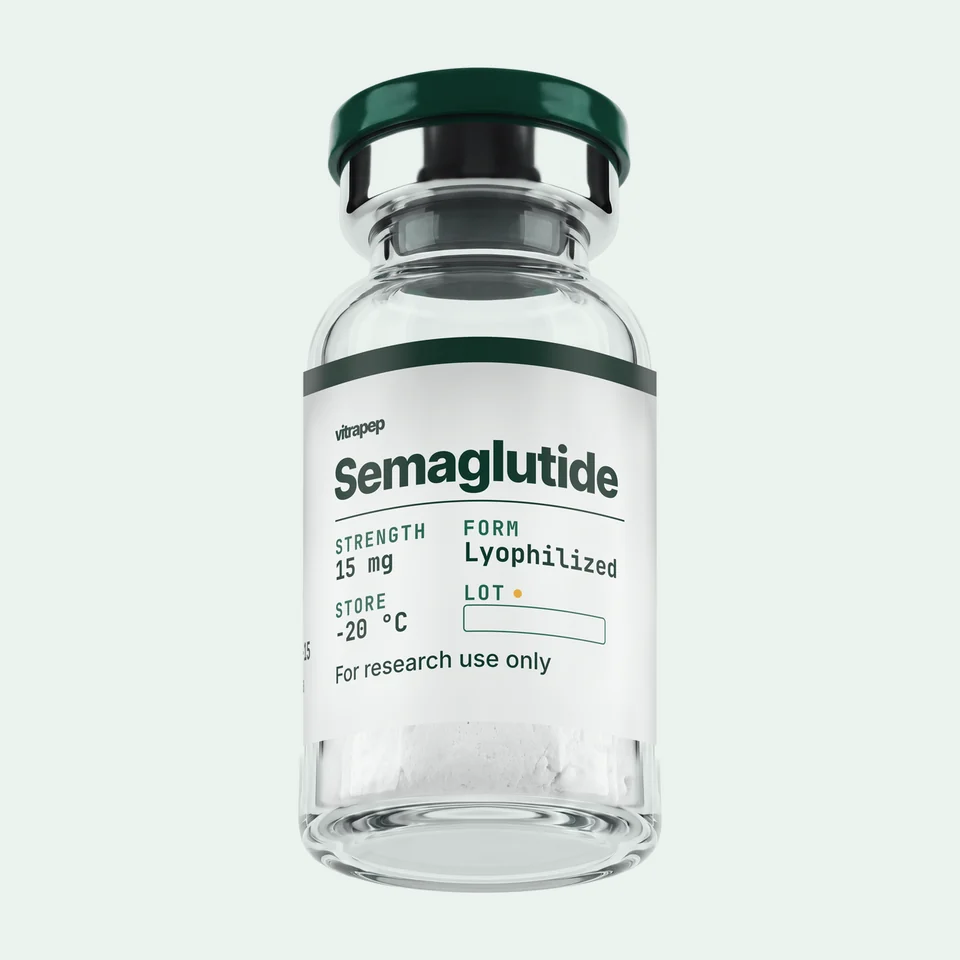
Semaglutide
Specifications for the semaglutide sold for laboratory research. COA available with each lot.
What to know now
- Semaglutide is a modified GLP-1 peptide analogue with albumin-binding and DPP-4-stabilizing modifications.
- Human trials have studied weight, cardiovascular, kidney and liver outcomes in different populations.
- FDA approval applies to named prescription products and specific indications. Research materials are not FDA-approved medicines.
What we’re watching
- The ESSENCE trial continues beyond its interim analysis. Longer follow-up is intended to assess clinical outcomes and confirm the durability of histological findings.
- FDA label updates may change as new data and post-marketing evidence are assessed. The relevant product label should be checked again before publication updates.