The tirzepatide vs semaglutide comparison is one of the more consequential in recent metabolic pharmacology: one head-to-head trial favors tirzepatide; a separate, larger cardiovascular outcomes trial favors semaglutide. This article walks through the head-to-head data, the cardiovascular evidence, and the specific dimensions on which each compound prevailed.
Both are FDA-approved and in active clinical use as of 2026. Neither emerges as a clear winner across all dimensions. They differ in specific ways that matter for specific clinical priorities — mechanism, magnitude, cardiovascular evidence, tolerability, and pricing each tell a somewhat different story.
SURPASS-2 head-to-head: tirzepatide vs semaglutide body-weight reduction
Mean body-weight reduction in kilograms at 40 weeks across 1,879 adults with type 2 diabetes randomized to tirzepatide 5/10/15 mg or semaglutide 1 mg. All three tirzepatide doses produced greater body-weight reduction than semaglutide 1 mg in this head-to-head design.
Source: Frias et al, NEJM 2021 (SURPASS-2 head-to-head trial in T2D).
Quick comparison table
Tirzepatide vs. Semaglutide, attribute by attribute
| Attribute | Tirzepatide | Semaglutide |
|---|---|---|
| Receptor profile | Dual agonist: GIP, GLP-1 | Single agonist: GLP-1 |
| Molecular scaffold | 39 aa linear peptide, C20 fatty-diacid acyl chain | 31 aa linear peptide, C18 fatty-diacid acyl chain |
| Administration route (clinical) | Once-weekly subcutaneous injection (approved formulations) | Once-weekly subcutaneous injection; oral tablet formulation also approved (Rybelsus) |
| Peak Phase III body-weight reduction (obesity) | 22.5% at 72 weeks (SURMOUNT-1, 15 mg) | 14.9% at 68 weeks (STEP-1, 2.4 mg) |
| ≥15% threshold response | 71% (SURMOUNT-1, 15 mg) | 50.5% (STEP-1, 2.4 mg) |
| ≥20% threshold response | 57% (SURMOUNT-1, 15 mg) | 32% (STEP-1, 2.4 mg) |
| Head-to-head data (T2D) | SURPASS-2: outperformed semaglutide at all three doses | Outperformed on every comparison |
| GI adverse-event rate | ~60–80% at highest dose | ~60–80% at highest dose |
| Cardiovascular outcomes (gold-standard) | SURPASS-CVOT ongoing; SURMOUNT-MMO ongoing | SELECT: 20% reduction in MACE in established CVD |
| FDA approval status | Mounjaro (T2D, 2022), Zepbound (obesity, 2023) | Ozempic (T2D, 2017), Wegovy (obesity, 2021), Rybelsus (oral T2D, 2019) |
| Cash-pay US list price | ~$1,060/month (Zepbound) | ~$1,350/month (Wegovy) |
| Maintenance / discontinuation | SURMOUNT-4: 14% regain on switch to placebo | STEP-4: 6.9% regain on switch to placebo |
Mechanism: one receptor vs two
Semaglutide acts at one receptor. Tirzepatide acts at two. That mechanistic difference underlies the magnitude gap observed in the Phase III trials.
What semaglutide does
Semaglutide is a GLP-1 receptor agonist. GLP-1 is an incretin gut hormone that stimulates glucose-dependent insulin secretion and signals satiety to the central nervous system.
GLP-1 receptor activation produces glucose-dependent insulin release, glucagon suppression at meals, slowed gastric emptying, and reduced food intake through central satiety pathways — effects replicated consistently across the Phase III trial program.
Approved formulations include Wegovy (obesity indication), Ozempic (type 2 diabetes), and Rybelsus (oral type 2 diabetes).
What tirzepatide adds
Tirzepatide adds a second receptor: GIP (glucose-dependent insulinotropic polypeptide), the other major incretin hormone. In healthy physiology, GIP accounts for approximately two-thirds of incretin activity; GLP-1 accounts for the remainder. In type 2 diabetes the GIP response is blunted, which led to early skepticism about GIP-targeting agents.
Subsequent research revised that view. GIP receptor co-activation in obesity contexts has been reported to augment satiety beyond GLP-1 alone, improve adipose nutrient handling, and potentially attenuate GLP-1-associated nausea.
The dual-agonism hypothesis — that co-activating both receptors would produce greater weight reduction than GLP-1 agonism alone — was evaluated at scale in the 2022 SURMOUNT-1 trial, which reported 22.5% mean body-weight reduction at 72 weeks for tirzepatide 15 mg. In STEP-1, semaglutide 2.4 mg produced 14.9% mean body-weight reduction at 68 weeks.
That’s a cross-trial number, not a head-to-head. Different populations, different protocols. The cleaner comparison is SURPASS-2.
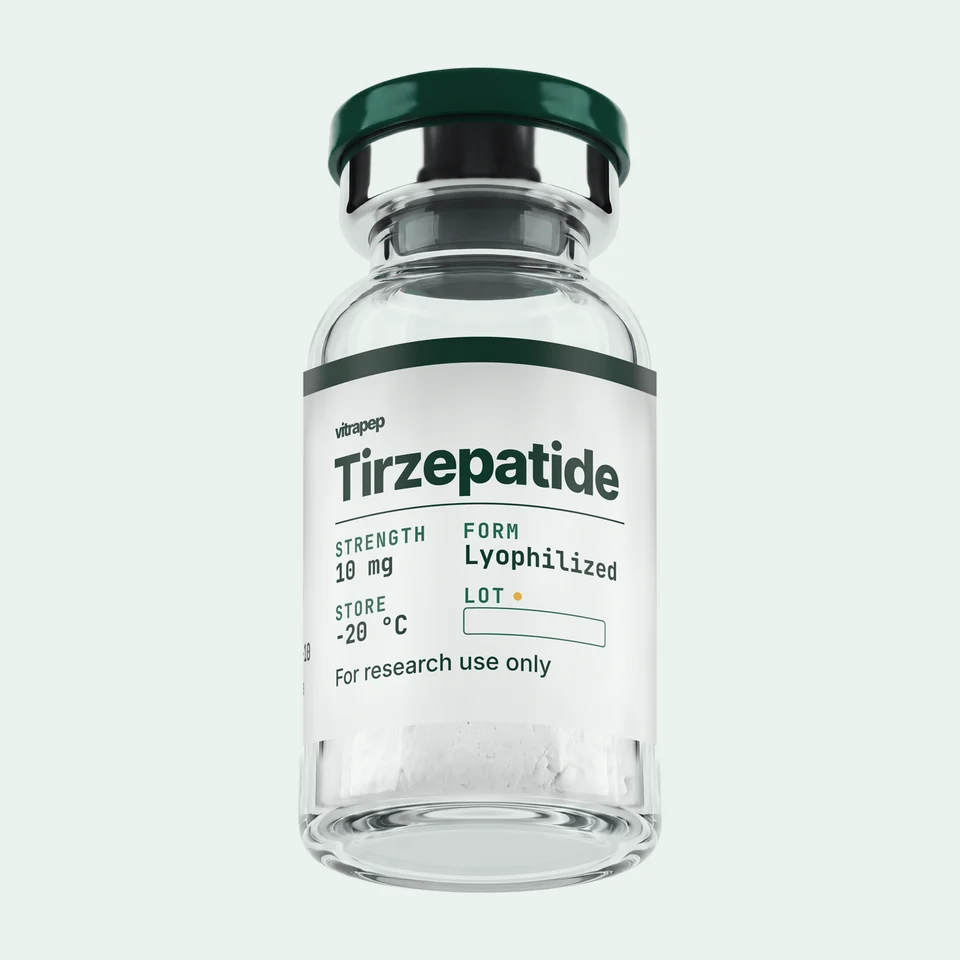
Tirzepatide
The same compound cited across the SURMOUNT and SURPASS trials in this comparison. Lab-verified identity and purity.
SURPASS-2: the head-to-head that matters
SURPASS-2 is the most-cited head-to-head evidence for this comparison. Frías and colleagues enrolled 1,879 adults with type 2 diabetes inadequately controlled on metformin. Study participants were randomized to tirzepatide 5, 10, or 15 mg weekly, or semaglutide 1 mg weekly, over 40 weeks.
Key reported outcomes:
- HbA1c (blood sugar marker) reduction: −2.01% (tirzepatide 5 mg), −2.24% (10 mg), −2.30% (15 mg) vs −1.86% (semaglutide). All three tirzepatide doses beat semaglutide.
- Body-weight change at 40 weeks: −7.6 kg (tirzepatide 5 mg), −9.3 kg (10 mg), −11.2 kg (15 mg) vs −5.7 kg (semaglutide). All three tirzepatide doses beat semaglutide.
- HbA1c <5.7% (non-diabetic range) at 40 weeks: 27% / 40% / 46% (tirzepatide) vs 19% (semaglutide).
- Dropout rate from side effects: roughly the same across all four arms (5–7%).
SURPASS-2 is the cleanest available comparison. Tirzepatide won every glycemic and body-weight endpoint.
One caveat. The trial used semaglutide 1 mg, not the higher 2.4 mg obesity dose. That’s appropriate for a T2D trial (1 mg was the highest T2D dose at the time), but it’s not semaglutide running at its top obesity setting.
Tirzepatide was non-inferior and superior to semaglutide, with respect to the mean change in glycated hemoglobin level from baseline to 40 weeks. The estimated treatment differences with tirzepatide as compared with semaglutide ranged from −0.15 percentage points for the 5-mg dose to −0.45 percentage points for the 15-mg dose.
— Frías et al., New England Journal of Medicine, 2021 (SURPASS-2)
SELECT: the trial that flips the comparison
If SURPASS-2 is tirzepatide’s trial, SELECT is semaglutide’s. Lincoff and colleagues enrolled 17,604 adults, 45 or older, with established cardiovascular disease and overweight or obesity. No diabetes. Randomized to semaglutide 2.4 mg weekly or placebo. Mean follow-up: 39.8 months.
The primary endpoint was MACE (major adverse cardiovascular events) — cardiovascular death, nonfatal heart attack, or nonfatal stroke. Reported outcomes:
- MACE rate: 6.5% with semaglutide vs 8.0% with placebo (HR 0.80; 95% CI 0.72–0.90; P<0.001). A 20% relative risk reduction.
- Cardiovascular and all-cause mortality: reductions consistent with the MACE finding.
- Mean body-weight reduction: 9.4% — lower than STEP-1’s 14.9% because SELECT enrolled a different population (older, sicker, lower adherence).
SELECT is among the most consequential cardiovascular outcomes trials in obesity pharmacotherapy. The trial demonstrated that semaglutide reduced MACE events in study participants with established CVD and overweight/obesity. A 20% relative MACE reduction is a magnitude comparable to that reported for statins in primary prevention cohorts.
Tirzepatide doesn’t have a SELECT-equivalent published yet. SURPASS-CVOT (T2D) and SURMOUNT-MMO (obesity) are both ongoing as of 2026. The mechanistic prediction is that tirzepatide will show CV benefit too. But until the trial reads out, it’s “plausible,” not “proven.”
Tolerability: basically a tie
Both compounds produce the same GI side effects. Nausea, vomiting, diarrhea, constipation. They’re dose-related, mostly mild to moderate, mostly during the dose-escalation period, and they fade with continued use.
Any-GI-event rates run 60–80% in the Phase III trials for both compounds. Dropouts from side effects sit in the 4–7% range for both.
The honest read: there is no clear winner on tolerability. Individual variation within each compound exceeds the average gap between them. Clinical literature notes that titration response in a given study participant is more predictive of tolerability than between-compound averages.
Maintenance: evidence from discontinuation studies
Both compounds have been evaluated in discontinuation studies. The evidence indicates that pharmacological effect is tied to continued treatment — consistent with the biology of chronic conditions addressed by these agents.
STEP-4 enrolled semaglutide research subjects through 20 weeks of treatment, then randomized continuers versus placebo-switchers for an additional 48 weeks. Continuers lost an additional 7.9% body weight; placebo-switchers regained 6.9%.
SURMOUNT-4 applied the same design to tirzepatide. Continuers lost further weight; placebo-switchers regained 14.0%.
The weight regain observed on treatment withdrawal reflects the chronic nature of the underlying condition rather than a direct drug effect. Clinical literature has noted this has implications for long-term treatment planning, adherence, and cost-benefit analysis over multi-year horizons.
Evidence gaps. Both compounds produced substantial weight regain on discontinuation in controlled trials (~14% for tirzepatide, ~7% for semaglutide). Neither has decade-long real-world follow-up data. Trial populations were younger and healthier than the broader populations receiving these agents in routine care. The cardiovascular safety signal is favorable based on available data, but the very-long-term safety record is still accumulating.
Pricing and access
Both approved formulations carry four-figure monthly list prices in the US. Zepbound (tirzepatide, obesity indication) has been priced at roughly $1,060/month; Wegovy (semaglutide, obesity indication) at roughly $1,350/month.
The approximately 25% list-price gap between the two is frequently moderated by insurance coverage, which is the dominant cost variable for most research subjects and clinical participants. Medicare coverage for obesity indications has been limited but is evolving; employer benefit plans vary in their formulary coverage of both agents.
Researchers sourcing reference-grade tirzepatide or semaglutide for in vitro or preclinical in vivo studies should obtain material from a research-grade supplier with documented identity verification, purity testing, and lot-specific Certificates of Analysis — not from clinical prescription channels.
Tirzepatide
39-aa dual GIP/GLP-1 agonist with C20 fatty-diacid acyl chain. The same reference compound used across the cited SURMOUNT trials. COA available with each lot.
Which compound prevails on which dimension?
The evidence base does not produce a single winner. The answer depends on the endpoint being prioritized. A summary by dimension:
- Weight reduction magnitude: tirzepatide demonstrated larger mean reductions in both the SURMOUNT-1 single-arm data and the SURPASS-2 head-to-head.
- Cardiovascular outcomes (established CVD): semaglutide has published proof-of-concept via SELECT — a 20% MACE reduction in research subjects with obesity and prior cardiovascular disease. Tirzepatide’s equivalent cardiovascular outcomes trial (SURPASS-CVOT) has not yet reported.
- Tolerability: GI adverse-event rates were comparable across Phase III programs for both agents. Individual response variation within each compound appears to exceed mean between-compound differences.
- Oral administration: semaglutide is the only compound in this class with an approved oral formulation (Rybelsus). Tirzepatide is available only in subcutaneous injection form.
- Glycemic endpoints in type 2 diabetes: SURPASS-2 reported that tirzepatide outperformed semaglutide on HbA1c reduction at all three tested doses. Both are current first-line agents for T2D.
Clinical literature as of 2026 characterizes the choice between these agents as less about a single “better compound” and more about alignment with individual clinical priorities, existing comorbidities, and treatment context — a decision appropriately made in consultation with prescribing clinicians on a per-subject basis.
What to know now
- Mechanism: tirzepatide is a dual GIP/GLP-1 agonist. Semaglutide is a GLP-1 receptor agonist only.
- Phase III weight reduction: 22.5% mean at 72 weeks (tirzepatide 15 mg, SURMOUNT-1) vs 14.9% mean at 68 weeks (semaglutide 2.4 mg, STEP-1).
- Head-to-head: SURPASS-2 (T2D, 40 weeks) — tirzepatide outperformed semaglutide 1 mg on every glycemic and weight endpoint.
- Cardiovascular outcomes: SELECT demonstrated a 20% MACE reduction with semaglutide in study participants with established CVD. Tirzepatide’s equivalent trials (SURPASS-CVOT, SURMOUNT-MMO) remain ongoing as of 2026.
- Discontinuation studies: weight regain was observed on treatment withdrawal in both programs (~14% tirzepatide in SURMOUNT-4; ~7% semaglutide in STEP-4).
- Approved formulation pricing (US list): Zepbound ~$1,060/month; Wegovy ~$1,350/month.
- Tolerability: GI adverse-event rates were comparable across both Phase III programs; individual response variation within each compound exceeded mean between-compound differences.
What we’re watching
Four things over the next 24 months. First, SURPASS-CVOT readout for tirzepatide in T2D. That’s the SELECT-equivalent trial that closes the main gap in tirzepatide’s evidence base. Second, SURMOUNT-MMO readout for tirzepatide in obesity-without-diabetes. The equivalent SELECT population. Third, additional semaglutide indications. Kidney outcomes. Heart failure outcomes. The GLP-1 class keeps expanding. Fourth, the next-generation compounds. Retatrutide (triple agonist). CagriSema (amylin + GLP-1). Oral incretins. They’ll reshape this comparison again.