How does semaglutide work? It is a long-acting glucagon-like peptide-1 (GLP-1) analogue that activates the GLP-1 receptor. Research shows effects across pancreatic, gastrointestinal and neural pathways, with newer studies clarifying how brain-cell signalling contributes to changes in food intake.
Quick answer: How does semaglutide work? Semaglutide activates the GLP-1 receptor and mimics part of the activity of the natural gut hormone GLP-1. This helps regulate blood glucose and influences calorie intake through appetite-related pathways. It also delays gastric emptying, particularly earlier in treatment.
What is the GLP-1 receptor?
The GLP-1 receptor is a cell-surface receptor that responds to the natural hormone GLP-1. GLP-1 is released from intestinal cells after food enters the gut. It helps coordinate the body's response to nutrients.
The receptor belongs to the class B family of G-protein-coupled receptors. These receptors translate an external chemical signal into activity inside a cell. When GLP-1 binds to its receptor, the receptor can activate the stimulatory G protein, commonly called Gs. Gs activates adenylyl cyclase, an enzyme that increases intracellular cAMP.
In pancreatic beta cells, cAMP works alongside calcium signals to support insulin secretion. The response is glucose-dependent. This matters because GLP-1 signalling amplifies insulin release when glucose is elevated rather than simply forcing continuous insulin secretion. GLP-1 receptor activation can also reduce glucagon secretion from pancreatic alpha cells. Glucagon normally signals the liver to release stored glucose.
A recent physiology review describes GLP-1 receptor signalling through Gs and cAMP, while also discussing other G-protein and arrestin pathways. These signalling branches help explain why receptor activation can produce effects in several tissues (Proglucagon-Derived Peptides, 2025).
How does semaglutide work after receptor activation?
Semaglutide is a modified analogue of human GLP-1. The current Wegovy prescribing information reports 94% sequence homology with human GLP-1. It selectively binds to and activates the GLP-1 receptor.
Chemical modifications give semaglutide a much longer circulating presence than native GLP-1. The Ozempic prescribing information identifies albumin binding as the principal mechanism that prolongs exposure. The molecule is also stabilised against degradation by dipeptidyl peptidase-4 (DPP-4), an enzyme that rapidly breaks down native GLP-1.
These structural changes are not simply cosmetic. They help maintain receptor engagement over a longer period, allowing approved formulations to exert sustained pharmacological activity. The same general design principle appears across several peptide medicines: modify a natural signalling molecule so that its useful receptor activity lasts longer.
What happens after GLP-1 receptor activation?
Semaglutide's mechanism is best understood as a network of related effects rather than one isolated action.
Pancreatic signalling. GLP-1 receptor activation supports glucose-dependent insulin secretion and reduces glucagon secretion. The current U.S. prescribing information describes both effects as part of semaglutide's glucose-lowering pharmacodynamics.
Appetite and food intake. GLP-1 receptors are present in brain regions involved in appetite regulation. The Wegovy label states that semaglutide decreases calorie intake, with the effect likely mediated through appetite. Human clinical research supports this explanation. In a randomized trial of 61 adults with obesity, oral semaglutide reduced measured energy intake and hunger while increasing fullness and satiety (Gabe et al., 2024).
Gastric emptying. Semaglutide delays gastric emptying, which can influence how quickly nutrients leave the stomach. The magnitude and timing of this effect depend on the study and treatment period. In a randomized crossover trial involving 30 adults with obesity, semaglutide delayed first-hour gastric emptying and improved post-meal glucose measures (Hjerpsted et al., 2018). By contrast, the 2024 oral semaglutide trial found no statistically significant gastric-emptying difference at its week-20 measurement. These findings are not necessarily contradictory. They used different populations, formulations, treatment periods and measurement windows.
What does newer brain research add?
A 2026 study in Nature Metabolism provides a more detailed account of semaglutide signalling in the hindbrain. Gao and colleagues studied GLP-1-receptor-expressing neurons in the mouse area postrema and related brain regions. They found that semaglutide engaged both Gs- and Gq-dependent pathways. Gs activity increased cAMP, while the study also measured calcium-related neuronal responses.
The researchers disrupted Gs or cAMP signalling in the relevant mouse neurons. Those interventions prevented semaglutide-associated weight change in the experimental model. The findings connect a specific intracellular signalling pathway with the wider neural response to semaglutide.
This is a meaningful mechanistic advance. It gives researchers a clearer map of how a peptide analogue can translate receptor binding into coordinated neural activity. However, the experiments were conducted in mice. They do not establish that exactly the same cell-specific causal pathway has been demonstrated in people.
What have human studies established?
Human studies provide strong evidence for semaglutide's clinical pharmacology. They show changes in blood glucose, appetite, calorie intake and body weight in approved clinical contexts. They do not resolve every molecular step in every tissue.
What have human studies established
| Evidence source | Model and size | Main mechanistic finding | Evidence type |
|---|---|---|---|
| Hjerpsted et al., 2018 | Randomized crossover study, 30 adults with obesity | Improved glucose responses and delayed first-hour gastric emptying | Human |
| Gabe et al., 2024 | Randomized study, 61 adults with obesity | Lower measured energy intake, less hunger and greater satiety | Human |
| Gao et al., 2026 | GLP-1R-expressing hindbrain neurons and mouse experiments | Gs/cAMP and Gq/calcium signalling contributed to semaglutide responses | Cell and animal |
| U.S. Wegovy prescribing information, 2026 | Regulatory review of clinical and nonclinical evidence | GLP-1 receptor activation, appetite effects, glucose-dependent insulin and glucagon effects | Human and animal evidence summarized in a label |
Taken together, the evidence supports a coherent model. Semaglutide activates GLP-1 receptors, influences pancreatic glucose regulation and acts on appetite-related pathways. Research continues to refine the relative contribution of individual tissues and intracellular signals.
Is semaglutide FDA-approved?
Semaglutide is an FDA-approved active ingredient in several prescription products. Approval applies to specific branded formulations and indications, not automatically to every semaglutide-containing material or product. Ozempic, Wegovy and Rybelsus have distinct labels and approved uses. Their indications and instructions should be checked in the current FDA-approved prescribing information.
The existence of approved semaglutide medicines does not make research-grade semaglutide equivalent to an approved prescription product. Research material is not an FDA-approved drug product. Regulatory status is product-specific.
Research product information
Vitrapep sells semaglutide for laboratory research use only. It is not for human or veterinary use. See the semaglutide product page, semaglutide complete guide and GLP-1 receptor agonist class overview.
FAQ
Does semaglutide act directly on the GLP-1 receptor?
Yes. Semaglutide selectively binds to and activates the GLP-1 receptor, according to current U.S. prescribing information.
Does semaglutide increase insulin?
GLP-1 receptor activation supports insulin secretion when glucose is elevated. The response is described as glucose-dependent in prescribing information.
Does semaglutide slow gastric emptying?
The prescribing information reports delayed gastric emptying. Human studies show the effect can vary by treatment period and measurement method.
How does semaglutide affect appetite?
Human studies report lower hunger and calorie intake, with greater fullness and satiety. The precise neural pathways remain an active research topic.
Is semaglutide a peptide?
Semaglutide is a modified peptide analogue of the endogenous hormone GLP-1. Its structure preserves strong receptor activity while extending its duration in circulation.
What to know now
- Semaglutide is a long-acting GLP-1 receptor agonist with established human pharmacology.
- Human studies support effects on glucose regulation, appetite and energy intake.
- A 2026 mouse study adds detail about cAMP signalling in hindbrain neurons, but does not replace human mechanistic evidence.
What we’re watching
- Further studies testing how specific GLP-1 receptor signalling branches relate to appetite, nausea and glucose regulation.
- Human imaging and physiology studies that can translate the cell-specific findings from the 2026 mouse research.
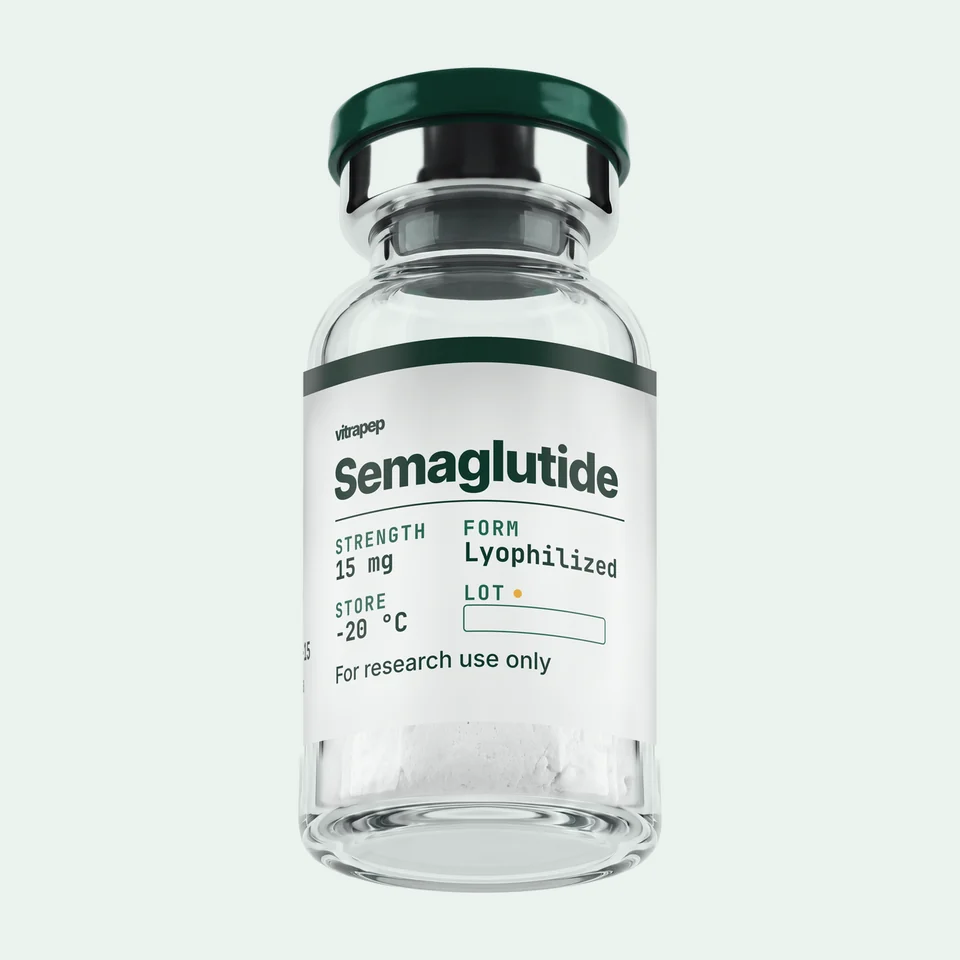
Semaglutide product page
Specifications for the semaglutide product page sold for laboratory research. COA available with each lot.