Ipamorelin benefits have attracted research interest because the small synthetic peptide was designed to stimulate growth-hormone release through the ghrelin receptor pathway. Early pharmacology studies reported selectivity for growth-hormone signaling in experimental models. A later Phase 2 trial studied ipamorelin for postoperative ileus, but it did not show a statistically significant difference on its main efficacy measure. The evidence is therefore scientifically interesting but limited for clinical applications.
Quick answer: Research suggests ipamorelin can stimulate growth-hormone release through ghrelin-receptor signaling in experimental models. Human research has also tested it in postoperative ileus, but the Phase 2 trial did not demonstrate significant efficacy on its key endpoint. Claims about muscle growth, body composition or anti-aging are not established by the available human trials.
What is ipamorelin, and why is it studied?
Ipamorelin is a synthetic five-amino-acid peptide developed as a selective growth-hormone secretagogue. It was designed to activate the growth-hormone secretagogue receptor, now commonly known as the ghrelin receptor. The receptor is found in the pituitary and hypothalamus and participates in signaling that regulates growth-hormone release.
The compound was first described in a 1998 pharmacology paper by Raun and colleagues. The researchers reported growth-hormone release in cultured rat pituitary cells, rats and pigs. Their work suggested that ipamorelin could stimulate growth-hormone signaling without producing the same degree of ACTH and cortisol response seen with some other secretagogues in the experimental comparisons.
This selectivity is a central reason ipamorelin became a research candidate. Researchers have explored whether a more focused hormonal profile might help distinguish it from earlier compounds. But a selective response in animals is not the same as demonstrated clinical benefit in people. Human trials are needed to establish efficacy, dose-independent safety characteristics and meaningful outcomes.
What does the growth-hormone research show?
Early cell and animal studies found that ipamorelin stimulated growth-hormone release through a ghrelin-receptor-like pathway. These studies provide the strongest mechanistic foundation for the compound.
Raun et al. (1998) reported that ipamorelin stimulated growth-hormone release from primary rat pituitary cells. In animal experiments, the peptide increased circulating growth hormone in rats and conscious pigs. The authors also examined other pituitary and adrenal hormones. In their pig experiments, ipamorelin did not produce significant ACTH or cortisol release compared with the comparator response, supporting the proposed selectivity of its pharmacological profile.
The findings were valuable because they established a clear mechanism to investigate. Growth-hormone secretagogues can be used to probe how the pituitary responds to signals from the hypothalamus and peripheral tissues. Ipamorelin provided a new tool for studying the ghrelin-receptor pathway.
The limits are equally clear. The original experiments were conducted in cells and animals. They did not demonstrate muscle growth, improved recovery, body-composition changes or longevity benefits in humans. Those outcomes require direct human trials with suitable comparison groups and validated endpoints.
Has ipamorelin been studied in humans?
Yes. The most prominent published human study examined ipamorelin for postoperative ileus after bowel resection.
Beck et al. (2014) reported a multicenter, double-blind, placebo-controlled Phase 2 study. The study enrolled 117 adults undergoing small- or large-bowel resection. The safety and modified intent-to-treat populations included 114 participants. Researchers evaluated ipamorelin as a potential treatment for postoperative ileus, a temporary slowing of gastrointestinal function that can occur after abdominal surgery.
The median time to the first tolerated solid meal was 25.3 hours in the ipamorelin group and 32.6 hours in the placebo group. The difference was not statistically significant. Overall treatment-emergent adverse events were reported in 87.5% of the ipamorelin group and 94.8% of the placebo group. The paper concluded that the trial did not demonstrate significant differences in key or secondary efficacy analyses.
This trial still contributes important information. It is a randomized human study, not merely a mechanistic experiment. Its result also shows why a biologically plausible receptor pathway does not guarantee a positive clinical endpoint. The authors noted that the proof-of-concept study was relatively small and included participants with a range of underlying conditions.
A separate human evidence base for ipamorelin in growth-hormone deficiency, muscle gain or body composition was not established in the sources reviewed for this article. Those claims should not be inferred from the early animal pharmacology paper.
Has ipamorelin been studied in humans
| Study | Model or participants | Main finding | Evidence type |
|---|---|---|---|
| Raun et al., 1998 | Rat pituitary cells, rats and pigs | Stimulated growth-hormone release with a selective profile in experimental models | Cell and animal |
| Beck et al., 2014 | 117 adults after bowel resection | No statistically significant difference in the primary postoperative-ileus endpoint | Human Phase 2 |
| FDA PCAC review, 2024 | Review of available data | Evidence did not support adding ipamorelin-related bulk substances to the 503A Bulks List | Regulatory review |
The human trial and regulatory review should be considered alongside the original animal pharmacology. Together, they show why ipamorelin remains an active research topic while its clinical applications remain unsettled.
What is known about ipamorelin and gastrointestinal research?
The gastrointestinal study was based on the idea that ghrelin-receptor stimulation can influence gastrointestinal motility. Ghrelin signaling has been studied in the stomach and intestines, making this pathway relevant to research on postoperative ileus.
The Phase 2 trial tested whether the biological rationale could translate into faster recovery of bowel function. Although the median time to a tolerated meal was numerically shorter in the ipamorelin group, the difference did not reach statistical significance. A favorable numerical trend is not proof of efficacy, especially when a study's prespecified primary analysis is negative.
This is a useful example of translational research. A receptor may have a plausible function, and an experimental compound may produce a measurable physiological response. Clinical benefit still needs to be demonstrated in people under controlled conditions.
FDA reviewed ipamorelin-related bulk drug substances for potential compounding-list inclusion. Its 2024 Pharmacy Compounding Advisory Committee materials stated that the available evidence did not support adding ipamorelin or ipamorelin acetate to the 503A Bulks List. The review raised concerns about characterization, impurity and endotoxin testing, limited clinical efficacy data and potential safety issues.
FDA's current compounding safety page also identifies potential immunogenicity concerns for certain routes because of aggregation and peptide-related impurities. It notes that a published study reported serious adverse events, including death, when ipamorelin was administered intravenously for gastric motility research. FDA states that it lacks sufficient information to assess safety for certain other injectable routes. This is a regulatory safety assessment, not a complete profile of all possible experimental contexts.
Are ipamorelin benefits established in humans?
No. The available human trial did not show a statistically significant improvement on its key efficacy outcome, and the animal growth-hormone findings have not established clinical benefits for muscle, body composition or aging.
The research remains valuable for understanding ghrelin-receptor pharmacology. The compound's selective activity in early experiments gives researchers a useful starting point for investigating endocrine signaling. The postoperative-ileus study also provides real human data, including a clear efficacy result that helps define what remains unproven.
Ipamorelin is not FDA-approved as a medicine. FDA has not approved an ipamorelin product for growth-hormone deficiency, postoperative ileus or other indications. The compounding review and safety-risk listing should be read as regulatory information about the substance and evidence gaps. They do not establish that an unapproved product is equivalent to the material used in a published study.
What should future ipamorelin research examine?
Future studies would need to establish a clear clinical question and prospectively defined endpoints. For growth-hormone signaling, researchers would need to determine whether changes in hormone release translate into meaningful and sustained outcomes. For gastrointestinal research, trials would need a sufficiently powered design and clinically meaningful measures of recovery.
Product characterization is also important. Peptide purity, identity, aggregation, impurities and stability can affect how a material behaves in laboratory or clinical research. Regulatory assessment has highlighted the importance of these factors for ipamorelin-related bulk substances.
The scientific case for studying the ghrelin receptor remains strong. Ipamorelin's early pharmacology offers an example of selective receptor signaling. Whether that selectivity can translate into a useful clinical application remains an open research question.
Product information and related Vitrapep research
Vitrapep sells ipamorelin for laboratory research use only. It is not for human or veterinary use. See the Vitrapep ipamorelin product page.
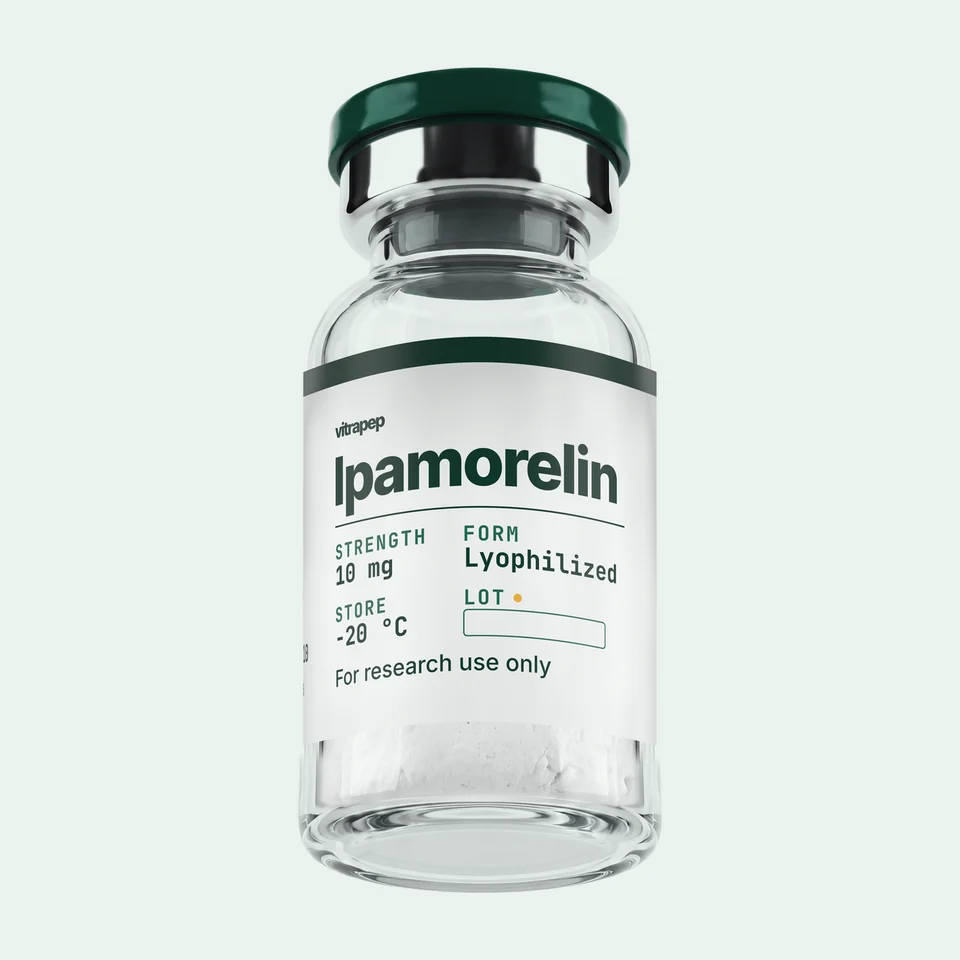
Vitrapep ipamorelin product page
Specifications for the Vitrapep ipamorelin product page sold for laboratory research. COA available with each lot.
Related reading: Ipamorelin complete guide, Ipamorelin and the ghrelin receptor mechanism, Ipamorelin price guide, and CJC-1295 versus ipamorelin.
FAQ
What are the potential ipamorelin benefits researchers are studying?
Research focuses on selective growth-hormone secretagogue activity and ghrelin-receptor signaling. A separate human trial examined postoperative ileus, but it did not meet its primary efficacy endpoint.
Does ipamorelin increase growth hormone?
Cell and animal studies reported increased growth-hormone release. These findings do not establish that ipamorelin produces a clinical benefit in humans.
Has ipamorelin been tested in a human clinical trial?
Yes. A randomized Phase 2 trial studied adults after bowel resection. It did not find a statistically significant difference in the primary postoperative-ileus outcome.
Is ipamorelin FDA-approved?
No. Ipamorelin is not FDA-approved as a medicine. FDA has also raised concerns about the evidence and characterization of ipamorelin-related compounded substances.
Does ipamorelin have proven effects on muscle growth or aging?
The available human trial evidence does not establish muscle-growth or anti-aging benefits. Such claims should not be inferred from growth-hormone findings in experimental models.
What to know now
- Early cell and animal studies found selective growth-hormone secretagogue activity.
- The main published human trial for postoperative ileus did not meet its primary efficacy endpoint.
- Ipamorelin is not FDA-approved, and FDA has identified evidence and product-characterization concerns.
What we’re watching
- Any new registered human trials that evaluate a clearly defined ipamorelin indication and prespecified clinical outcomes.
- FDA updates on ipamorelin-related bulk substances, compounding policy and safety information.