MOTS-c benefits are drawing scientific interest because this short peptide is encoded by mitochondrial DNA and appears to signal between mitochondria and the cell nucleus. Published studies report effects on metabolic pathways in cells and mice. Human studies have measured naturally produced MOTS-c around exercise, but have not established the effects of administering the peptide to people.
Quick answer: Published research suggests MOTS-c may influence metabolic homeostasis, skeletal-muscle signaling and exercise adaptation. The most encouraging functional results come from cell and animal models. Human research has measured endogenous MOTS-c, not demonstrated that administering MOTS-c improves health or performance in people.
What is MOTS-c, and why is it studied?
MOTS-c stands for mitochondrial open reading frame of the 12S rRNA-c. Lee and colleagues described it in 2015 as a peptide encoded by a short open reading frame within mitochondrial DNA. It contains 16 amino acids and was identified as a signaling molecule with effects on metabolic regulation.
The discovery was notable because mitochondria are usually discussed as cellular energy-producing structures. MOTS-c added evidence that mitochondria can also generate signaling peptides. This creates a research connection between mitochondrial function, muscle metabolism and broader cellular responses to stress.
MOTS-c has attracted interest in metabolic health, aging and physical-performance research. Studies examine its role in glucose handling, mitochondrial signaling and skeletal-muscle function. The proposed communication between mitochondrial and nuclear systems remains an active research question.
What does research show about MOTS-c and metabolism?
The first major MOTS-c paper reported metabolic effects in cultured cells and mice. Lee and colleagues found that MOTS-c altered the folate-methionine cycle and linked purine synthesis. These changes increased intracellular AICAR, a molecule associated with AMP-activated protein kinase (AMPK) signaling.
In cell experiments, this work connected MOTS-c with a pathway that senses cellular energy status. In mouse experiments, researchers reported improved glucose handling and protection against diet-associated insulin resistance. The study also reported less diet-induced obesity in treated mice. These are preclinical results, not clinical evidence in people.
The pathway is an important focus for follow-up research. AMPK is involved in cellular energy balance, and skeletal muscle is a major site of glucose use. Researchers are interested in whether mitochondrial-derived peptides can help explain how metabolic stress and exercise influence these processes.
A human observational study by Cataldo and colleagues examined plasma MOTS-c levels in lean and obese adults. The study included 20 participants. It reported an association between MOTS-c levels and insulin-sensitivity measures in lean participants, but not in the obese group. Because the study was observational and small, it cannot show that MOTS-c causes changes in insulin sensitivity.
What does exercise research show?
Exercise research offers one of the clearest bridges between MOTS-c biology and human physiology. Reynolds and colleagues published a 2021 study combining mouse experiments with measurements in human volunteers. In mice, MOTS-c was associated with improved physical performance across age groups. The research also examined muscle metabolism and cellular stress responses.
The human component involved a small group of young male volunteers. The researchers measured endogenous MOTS-c in skeletal muscle and blood before and after exercise. They reported increases in muscle expression and circulating levels following exercise. This suggests MOTS-c participates in the body's natural response to physical activity.
The distinction is important. The participants were not a clinical treatment group receiving MOTS-c. The study measured the body's own peptide response. It therefore does not establish that an external MOTS-c product improves exercise capacity or produces the same changes.
D'Souza and colleagues also compared plasma and skeletal-muscle MOTS-c in healthy men across age groups. They reported lower circulating levels in older groups, but approximately 1.5-fold higher muscle expression in middle-aged and older groups than in young men. The authors linked muscle expression with myofiber composition and called for further study of endogenous MOTS-c targets. This observational study describes natural biology. It does not show that administering the peptide changes aging or muscle function.
A separate human study by von Walden and colleagues examined circulating mitochondrial-derived peptides after endurance and resistance exercise. MOTS-c showed a trend toward an increase after endurance exercise, while humanin was the peptide with a statistically significant plasma increase. Findings are not uniform across peptides and measurements, reinforcing the distinction between endogenous levels and effects of an administered research compound.
What does exercise research show
| Study | Model or participants | Main finding | Evidence level |
|---|---|---|---|
| Lee et al., 2015 | Cultured cells and mice | Linked MOTS-c to folate-purine metabolism, AMPK signaling and improved metabolic measures in mice | Cell and animal |
| Cataldo et al., 2018 | 20 adults | MOTS-c levels correlated with insulin-sensitivity measures in lean participants, but not obese participants | Human observational |
| Reynolds et al., 2021 | Mice and 10 human volunteers | Mouse performance findings; endogenous MOTS-c increased in human muscle and circulation after exercise | Animal and human biomarker |
| Acute exercise study, 2021 | Adult volunteers | Examined circulating mitochondrial-derived peptides after endurance exercise; MOTS-c findings were not uniformly significant | Human biomarker |
The table summarizes different kinds of evidence. Only the mouse experiments tested administered MOTS-c for functional outcomes. Human studies to date help describe natural peptide biology and do not demonstrate a treatment effect.
What does the research suggest about aging and muscle function?
MOTS-c has become an interesting candidate in aging research because skeletal muscle changes with age and plays a central role in glucose metabolism. In the 2021 Reynolds study, researchers found improved treadmill performance in young, middle-aged and older mice. The study also explored changes in muscle gene expression and metabolic adaptation.
The same research examined older mice in which MOTS-c treatment was associated with better measures of physical capacity. These findings support further investigation into mitochondrial signaling and age-related muscle function. They do not establish that MOTS-c slows human aging or extends human lifespan.
Other studies have explored relationships between MOTS-c expression and muscle composition in people. Such studies can help identify biological associations and generate hypotheses. They cannot determine whether changing MOTS-c levels would change muscle function or health outcomes.
The most balanced interpretation is that MOTS-c connects several promising research themes. These include mitochondrial communication, metabolic flexibility, exercise adaptation and muscle aging. The next major step is a well-controlled human research program that directly evaluates the peptide and reports safety alongside biological outcomes.
Are MOTS-c benefits established in humans?
No clinical benefit from administering MOTS-c has been established in humans. Human studies have measured endogenous levels in blood or muscle. The key preclinical findings come from cell systems and animal models.
FDA materials provide an important regulatory perspective. In its review of MOTS-c-related bulk drug substances for compounding, FDA stated that it had not identified human exposure data for drug products containing MOTS-c. The agency also identified concerns about peptide-related impurities, product characterization and potential immunogenicity.
In 2026, MOTS-c was discussed at an FDA Pharmacy Compounding Advisory Committee meeting for proposed uses that included obesity and osteoporosis. The meeting concerned whether the substance should be considered for the 503A Bulks List. That process is not an approval application for a medicine. FDA's separate safety-risk listing identifies concerns with compounded drug products containing MOTS-c.
As of November 17, 2026, MOTS-c is not FDA-approved for any condition. The positive findings from animal and cellular work justify scientific interest. They do not resolve questions about human safety, clinical effectiveness or the quality of research products.
What are the next research priorities?
Future studies need to characterize native MOTS-c pharmacology and safety, then test whether animal findings translate to human physiology. Strong clinical studies should identify the molecular form, document product identity and define outcomes in advance.
Researchers should also distinguish native MOTS-c from modified analogues. Results from one molecule cannot automatically be attributed to another. Measurements of natural MOTS-c levels also cannot substitute for controlled studies of an administered compound.
The discovery of a mitochondrial-encoded peptide with measurable cellular effects created an important research direction. Careful translational work will show how much of this promise applies to human metabolic and muscle biology.
Product information and related Vitrapep research
Vitrapep sells MOTS-c for laboratory research use only. It is not for human or veterinary use. Its research product is not an FDA-approved medicine. See the Vitrapep MOTS-c product page.
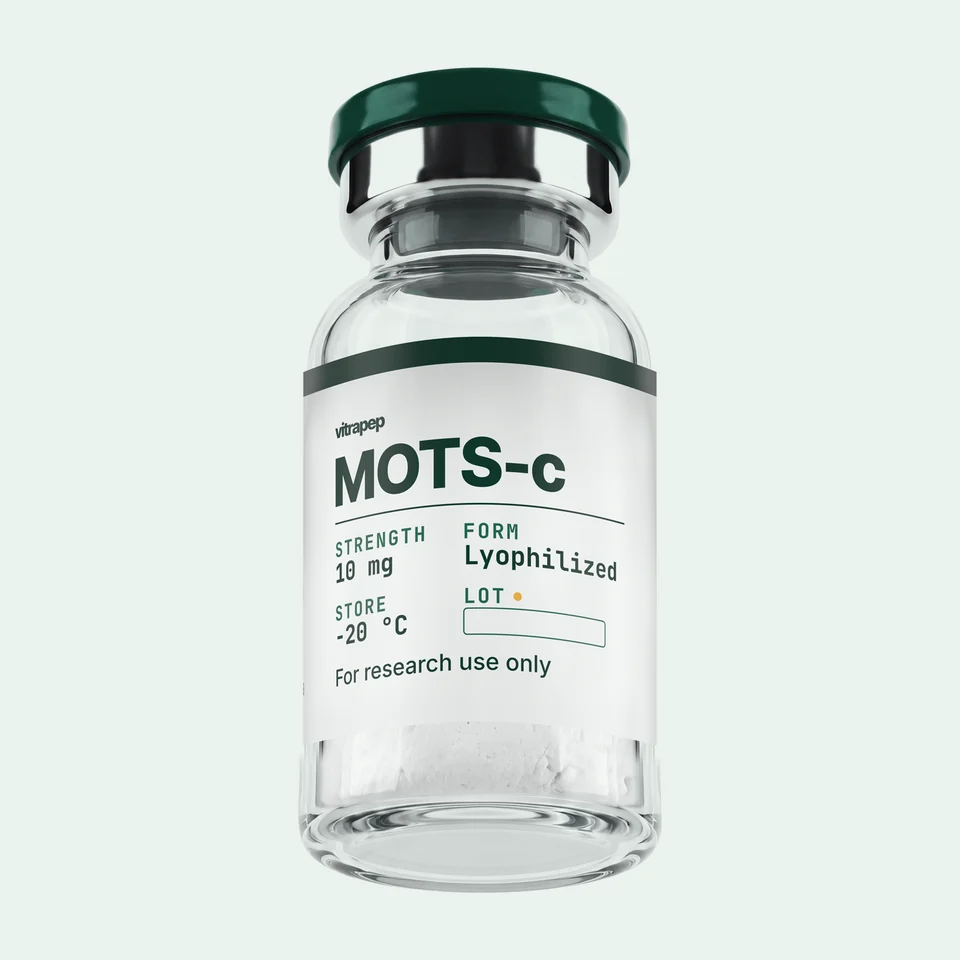
Vitrapep MOTS-c product page
Specifications for the Vitrapep MOTS-c product page sold for laboratory research. COA available with each lot.
Related reading: MOTS-c complete guide, MOTS-c and exercise research, and MOTS-c mechanism and AMPK activation.
FAQ
What are the potential MOTS-c benefits researchers are studying?
Research focuses on metabolic regulation, insulin signaling, skeletal-muscle adaptation and physical performance. The functional findings are mainly from cells and animal models.
Does MOTS-c activate AMPK?
Cell research links MOTS-c with changes in folate and purine metabolism that can increase AICAR and activate AMPK-related signaling. This mechanism is not yet established as a clinical effect in people.
Has MOTS-c improved exercise performance in humans?
No controlled human treatment study has established this. A small human study reported changes in endogenous MOTS-c after exercise, while animal experiments reported performance changes after experimental treatment.
Is MOTS-c FDA-approved?
No. MOTS-c is not FDA-approved for any condition. FDA has also identified safety and product-characterization concerns for compounded drug products containing MOTS-c.
Is there a published human trial of native MOTS-c?
Published human research has examined natural MOTS-c levels. FDA has stated that it has not identified human exposure data for drug products containing MOTS-c. These are different questions and should not be conflated.
What to know now
- MOTS-c is a 16-amino-acid peptide encoded by mitochondrial DNA and linked to metabolic signaling.
- Cell and mouse research reports promising metabolic and muscle-related findings.
- Human studies have measured endogenous MOTS-c, but have not established clinical benefits from administered MOTS-c.
What we’re watching
- Better-characterized human studies that distinguish native MOTS-c from analogues and related compounds.
- Further FDA actions concerning the compounding status and safety characterization of MOTS-c-related substances.
- Independent research testing whether pathways identified in cell and animal models translate to human physiology.