MOTS-c price questions start with one fact: there is no pharmacy price, because MOTS-c is not an approved medicine. What US suppliers sell is research-grade MOTS-c, a lyophilized peptide powder sold for laboratory research use only. This page sets out what those suppliers listed on November 17, 2026, per vial and per mg, what moves the price, and which listings deserve a closer look.
Quick answer: Research-grade MOTS-c listed at $59.99–$116.00 per 10 mg vial at the US suppliers we checked on November 17, 2026. Per mg, prices ran from $1.13 to $11.60, with the lowest figures on 40 mg and 50 mg vials. Vitrapep lists 10 mg at $65.99, or $6.60 per mg. For sourcing questions, see where to buy MOTS-c.
What research-grade MOTS-c is
MOTS-c, short for mitochondrial open reading frame of the 12S rRNA-c, is a peptide reported to contain 16 amino acids (FDA, 2026). Suppliers sell it as a freeze-dried powder in sealed vials, most often 10 mg. For the published research on the compound, see our MOTS-c research guide.
MOTS-c has no USP monograph and is not a component of an FDA-approved drug. A nomination that had placed it in FDA’s category 2 for compounding, over potential safety risks, was withdrawn (FDA, 2026). At a July 23, 2026 advisory committee meeting, FDA proposed that MOTS-c and MOTS-c acetate not be added to the list of bulk substances pharmacies may compound with, and noted that MOTS-c is listed as prohibited on the Global Drug Reference Online database used in sport (FDA, 2026). FDA’s meeting page showed no final decision as of November 17, 2026 (FDA, 2026).
So MOTS-c for sale in the US today is research material. It is a reagent for laboratory work, not a medicine, and it is for laboratory research use only, not for human or veterinary use. Our explainer on research use only labeling covers what that label means.
What US research suppliers list in November 2026
We checked supplier product pages on November 17, 2026, and recorded the listed single-vial price for each size the page showed. Prices exclude shipping, codes and multi-vial discounts. Blends that pair MOTS-c with other compounds are left out.
Research-grade MOTS-c prices at US suppliers, checked November 17, 2026
| Supplier | Vial size | Listed price | Price per mg |
|---|---|---|---|
| Purely Peptides | 10 mg | $59.99 | $6.00 |
| PS Peptides | 10 mg | $69.99 | $7.00 |
| PS Peptides | 50 mg | $189.99 | $3.80 |
| Biotech Peptides | 10 mg | $99.00 | $9.90 |
| American Peptides | 10 mg | $100.00 | $10.00 |
| Core Peptides | 10 mg | $116.00 | $11.60 |
| MyPurePeptide | 40 mg | $45.00 | $1.13 |
| Vitrapep | 10 mg | $65.99 | $6.60 |
Sources: supplier product pages listed in the references, read November 17, 2026. Price per mg is the listed price divided by the vial size. PS Peptides shows a $69.99–$189.99 range; the per-size prices are from the store’s own data for the listing. American Peptides showed no price for its 40 mg size. None of these listings used a code name in place of MOTS-c. All of these products are sold for laboratory research use only.
Three patterns stand out. First, 10 mg vials ran from $59.99 to $116.00, close to a twofold gap for the same labeled amount. Second, the largest vials were far cheaper per mg: PS Peptides charged $3.80 per mg at 50 mg against $7.00 at 10 mg, and the one 40 mg listing came to $1.13 per mg. Third, Vitrapep’s $65.99 is the second-lowest 10 mg price in the table.
What drives the price spread
Several costs sit behind every vial, and suppliers carry them differently. Our peptide prices explainer covers them across the whole catalog.
- Synthesis length. Peptides are built one amino acid at a time. In a study of over 500 solid-phase syntheses, coupling efficiencies fell as peptides got longer (Young et al., 1990). At 16 residues, MOTS-c is a mid-length chain.
- Characterization. In its July 2026 review, FDA found MOTS-c and its acetate “not well characterized” from a physical and chemical perspective (FDA, 2026). Suppliers that document identity and purity on each lot carry that cost.
- Purity and third-party testing. Raising HPLC purity means discarding more of each batch. Identity by mass spectrometry and purity by HPLC at an outside laboratory is a cost paid on every lot.
- Vial size. Filling, capping, labeling and testing a vial cost about the same at 10 mg or 50 mg. Spread over more milligrams, those fixed costs shrink per mg, which is why the large vials in Table 1 are cheapest per mg.
- Promotions. Quantity discounts and site-wide codes change the effective price from week to week. Purely Peptides took 5% to 20% off for two or more vials, and Core Peptides 5% to 10% off for five or more.
Red flags in very cheap listings
A low price is not proof of a problem. The lowest per-mg listing we found, $45.00 for a 40 mg vial, showed a dated third-party lab report on its product page. What matters is what the seller documents. These signs deserve a closer look:
- No lot-specific certificate. A credible certificate names the lot, the laboratory, the test date, HPLC purity and a mass spectrometry identity result. Our guide to reading a certificate of analysis walks through each field.
- No identity data. A listing should name MOTS-c and give its 16-residue sequence or molecular weight. Without them, the identity of the material cannot be checked against the label.
- A blend priced as a single compound. Some listings mix MOTS-c with NAD+ or other compounds. Check that the vial holds only MOTS-c before comparing prices.
- Inflated “original” prices. A struck-through price says nothing about the product. Compare the price actually charged.
- Human-use language. In a June 2023 warning letter to an online seller of peptides, FDA wrote that despite “research purpose only” and “not for human consumption” labels, evidence from the seller’s website showed the products were intended as drugs for human use (FDA, 2023). A research listing should carry no such claims.
What Vitrapep charges for MOTS-c
Vitrapep lists MOTS-c as a 10 mg lyophilized vial at $65.99, which works out to $6.60 per mg. Store prices may still change before launch. The product page lists the compound’s sequence and molecular formula. It is sold for laboratory research use only and is not for human or veterinary use. For a side-by-side look at sourcing questions, see where to buy MOTS-c, and for prices across the catalog, our peptide price list.
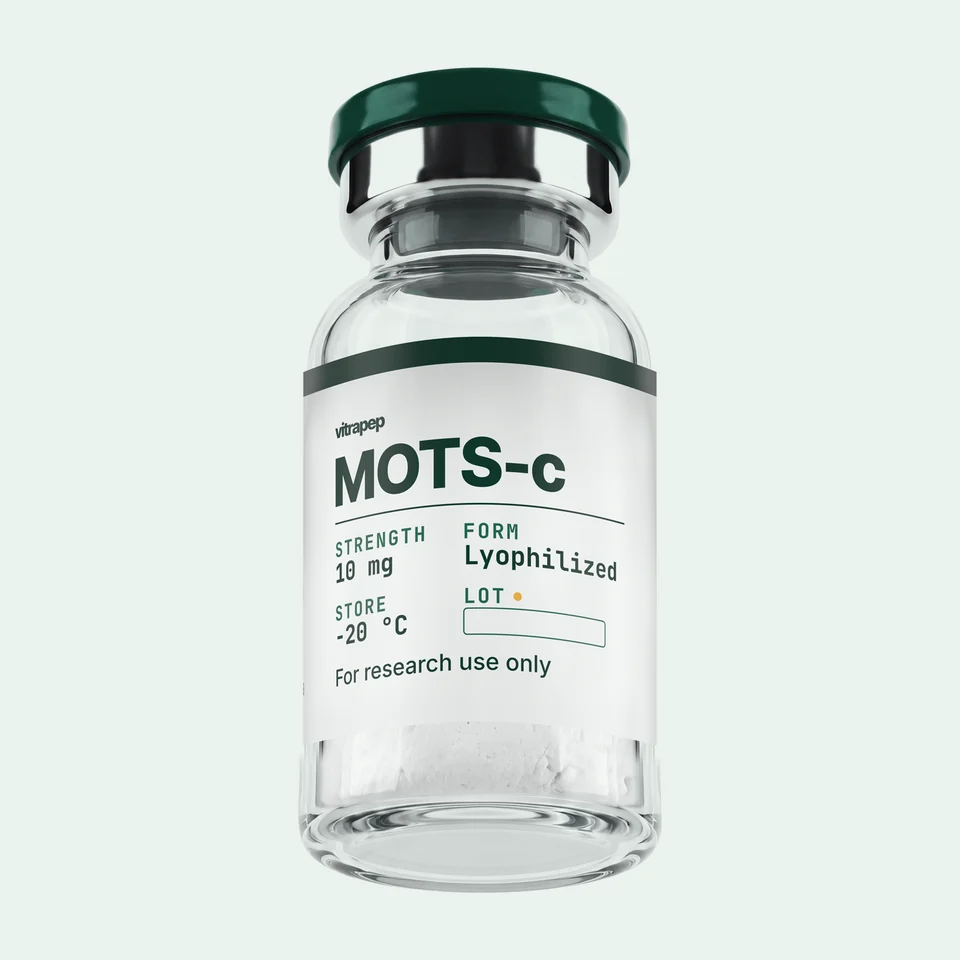
MOTS-c
Specifications and the current lot’s test documentation for the MOTS-c sold for laboratory research.
Frequently asked questions about MOTS-c price
How much does MOTS-c cost?
There is no pharmacy or list price because MOTS-c is not a component of any FDA-approved drug. Research-grade MOTS-c listed at $59.99 to $116.00 per 10 mg vial at the US suppliers we checked on November 17, 2026. Across 10 mg to 50 mg vials, prices ran from $1.13 to $11.60 per mg.
Can you buy MOTS-c with a prescription?
No. There is no approved MOTS-c product for a pharmacy to dispense or a plan to cover. In July 2026, FDA proposed that MOTS-c not be added to the list of bulk substances pharmacies may compound with.
What is research-grade MOTS-c?
It is a lyophilized peptide sold as a reagent for laboratory research. It is not a medicine, it has not been reviewed by FDA as a drug, and it is for laboratory research use only, not for human or veterinary use.
Why are larger MOTS-c vials cheaper per mg?
Much of the cost of a vial is fixed: filling, sealing, labeling and lot testing. Those costs are about the same for 10 mg or 50 mg, so they are spread over more milligrams in the larger size. PS Peptides, for example, listed $7.00 per mg at 10 mg and $3.80 per mg at 50 mg.
Is a cheap MOTS-c listing a bad sign?
Not by itself. Price differences between suppliers are normal and reflect testing, purity, vial size and overhead. A missing compound name, missing identity data and no lot-specific certificate are the signals worth checking.
What to know now
- No approved product, no pharmacy price. MOTS-c is not a component of any FDA-approved drug as of November 17, 2026.
- 10 mg vials listed at $59.99–$116.00. That was the range at the US research suppliers we checked that day.
- Per mg, $1.13 to $11.60. The 40 mg and 50 mg vials were the cheapest per mg.
- Vitrapep lists 10 mg at $65.99. That is $6.60 per mg, the second-lowest 10 mg price in our table.
- Check the lot, not just the price. A named compound and a lot-specific certificate matter more than a discount.
What we’re watching
First, FDA’s final decision on MOTS-c and the 503A bulks list after its July 2026 advisory committee meeting. Second, supplier pricing. Quantity discounts and site-wide codes move effective prices often, and we will re-check these listings as they change.