Retatrutide price questions have an unusual answer in 2026: there is no pharmacy price at all. Retatrutide is an investigational compound from Eli Lilly that is still in Phase 3 trials and has no FDA approval, so no pharmacy, insurer or manufacturer program sells it. What US suppliers list is research-grade material: a lyophilized powder sold for laboratory research use only. This page sets out what those suppliers listed on November 17, 2026, what moves the price, and which listings deserve a closer look.
Quick answer: There is no prescription price for retatrutide because it is not an approved medicine. Research-grade retatrutide listed at $80.00–$105.00 per 10 mg vial at the US suppliers we checked on November 17, 2026, and as low as $4.00 per mg in 30 mg and 40 mg vials. Vitrapep lists 10 mg at $99.99.
Why retatrutide has no pharmacy price
Retatrutide, also known by its research code LY3437943, is a single peptide that acts at three receptors: glucagon, GIP and GLP-1 (Coskun et al., 2022). Its Phase 2 trial was published in 2023 (Jastreboff et al., 2023). For the full research background, see our retatrutide research guide.
As of November 17, 2026, ClinicalTrials.gov lists 14 Phase 3 studies of retatrutide, all sponsored by Eli Lilly, including TRIUMPH-1 (NCT05929066). Retatrutide has no FDA approval. That has three practical results:
- No list price. A manufacturer list price exists only for an approved, marketed product.
- No insurance coverage or savings card. There is no approved product for a plan to cover.
- No compounded version. FDA states that retatrutide cannot be used in compounding under federal law, and it has sent warning letters to companies that marketed it or sold it to compounders (FDA, 2026).
So retatrutide for sale in the US today is research material. It is a reagent for laboratory work, not a medicine, and it is for laboratory research use only, not for human or veterinary use. Our explainer on research use only labeling covers what that label means.
What US research suppliers list in November 2026
We checked supplier product pages on November 17, 2026, and recorded the listed single-vial price for each size the page showed. Prices exclude shipping, codes and multi-vial discounts.
Research-grade retatrutide prices at US suppliers, checked November 17, 2026
| Supplier | Vial size | Listed price | Price per mg |
|---|---|---|---|
| MyPurePeptide | 10 mg | $80.00 | $8.00 |
| MyPurePeptide | 30 mg | $120.00 | $4.00 |
| Zeptix Labs | 10 mg | $89.99 | $9.00 |
| Zeptix Labs | 20 mg | $139.99 | $7.00 |
| Zeptix Labs | 30 mg | $169.99 | $5.67 |
| Purely Peptides | 15 mg | $99.99 | $6.67 |
| Purely Peptides | 20 mg | $109.99 | $5.50 |
| Purely Peptides | 30 mg | $129.99 | $4.33 |
| Purely Peptides | 40 mg | $169.99 | $4.25 |
| PS Peptides | 5 mg | $39.99 | $8.00 |
| American Peptides (listed as AP-RTA-3, code LY3437943) | 10 mg | $105.00 | $10.50 |
| Vitrapep | 10 mg | $99.99 | $10.00 |
Sources: supplier product pages listed in the references, read November 17, 2026. Price per mg is the listed price divided by the vial size. Zeptix Labs was running a buy-one-get-one offer. MyPurePeptide showed struck-through “original” prices of $699.99 (10 mg) and $799.99 (30 mg). PS Peptides offers sizes up to 100 mg, but its page showed a per-size price only for 5 mg. The American Peptides page does not use the name retatrutide.
Two patterns stand out. First, 10 mg vials cluster between $80 and $105. Second, the price per mg falls as the vial gets larger, from about $8–$10.50 at 10 mg to about $4.00–$4.33 at 30 mg and above. Vitrapep’s 10 mg price sits at the upper end of the 10 mg listings.
What drives the price spread
Retatrutide is one of the harder research peptides to make, and the cost shows up in every listing. These are the main levers, and our peptide prices explainer covers them across the whole catalog.
- Synthesis length. Peptides are built one amino acid at a time by solid-phase synthesis. Every added residue is another coupling step with its own yield loss, so long sequences cost more per mg than short ones (Verlander, 2007).
- Lipidation. Retatrutide carries a fatty diacid side chain attached through a linker on a lysine residue (Li et al., 2024). That is extra chemistry and extra purification on top of the peptide chain itself.
- Purity. Raising HPLC purity means discarding more of each batch during purification. Higher purity costs more per mg delivered.
- Third-party testing. Identity by mass spectrometry and purity by HPLC at an outside laboratory is a per-lot cost. Laboratories accredited to ISO/IEC 17025 have been assessed for testing competence. Suppliers that skip outside testing skip that cost.
- Vial size. Filling, capping, labeling and testing a vial cost about the same at 10 mg or 40 mg. Spread over more milligrams, those fixed costs shrink per mg.
- Promotions. Buy-one-get-one offers, first-order codes and pack discounts change the effective price from week to week.
Red flags in very cheap listings
A low price is not proof of a problem. It does leave less room for the steps that confirm what is in the vial. These signs deserve a closer look:
- Packs priced below about $20 a vial. One US listing offered a 10-vial pack for $189.00 on November 17, 2026, or $18.90 a vial (Peptixa Labs). At that level, ask for the specific lot’s test report before ordering.
- No compound name. A house code is not a problem by itself. If neither the product page nor the certificate names the compound, its identity cannot be checked against the label.
- Inflated “original” prices. A struck-through price many times higher than any real listing, such as $699.99 cut to $80.00, says nothing about the product.
- Human-use language. FDA has warned companies that sold GLP-1 products labeled “for research purposes” or “not for human consumption” while giving dosing instructions to consumers (FDA, 2026). A research listing should carry none.
- No lot-specific certificate. A credible certificate names the lot, the laboratory, the test date, HPLC purity and a mass spectrometry identity result. Our guide to reading a certificate of analysis walks through each field.
What Vitrapep charges for retatrutide
Vitrapep lists retatrutide as a 10 mg lyophilized vial at $99.99, which works out to $10.00 per mg. Store prices may still change before launch. The product page lists the compound’s identity data and how to look up the test report for each lot. It is sold for laboratory research use only and is not for human or veterinary use. For a side-by-side look at sourcing questions, see where to buy retatrutide.
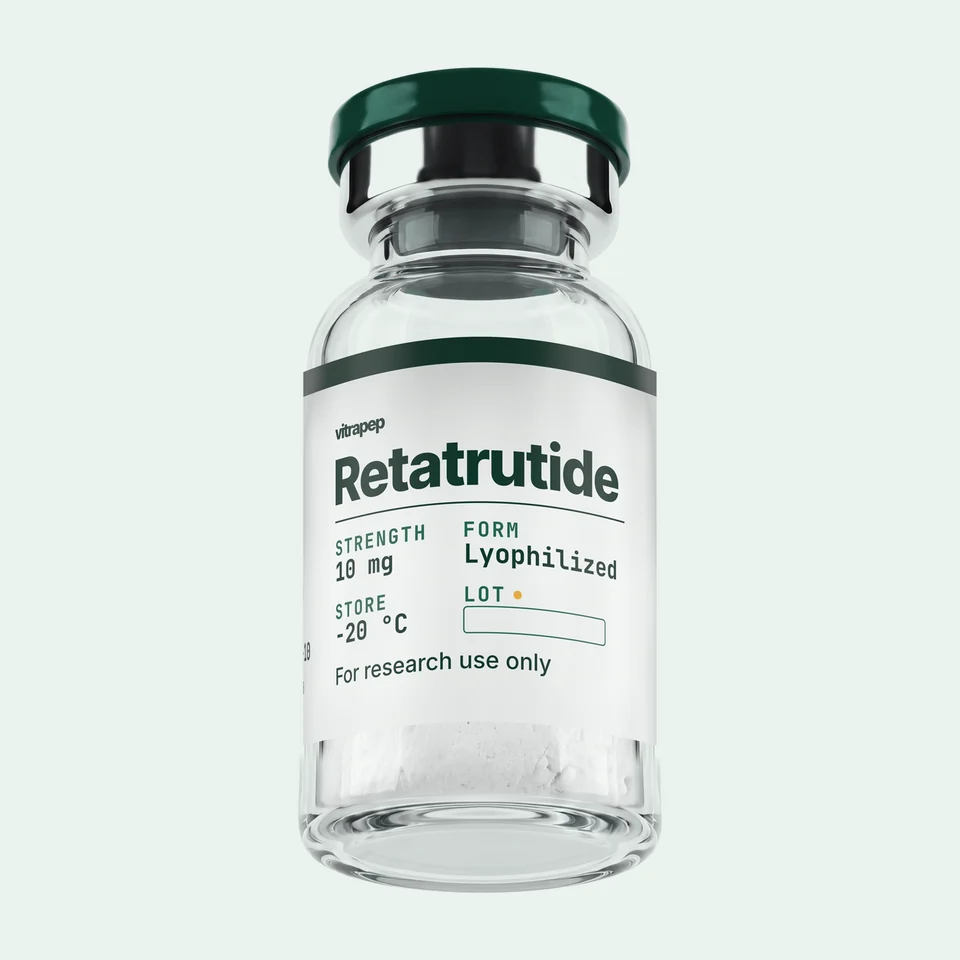
Retatrutide
Specifications and the current lot’s test documentation for the retatrutide sold for laboratory research.
Frequently asked questions about retatrutide price
How much does retatrutide cost?
There is no pharmacy or list price because retatrutide is not FDA-approved. Research-grade retatrutide listed at $80.00 to $105.00 per 10 mg vial at the US suppliers we checked on November 17, 2026. Across all vial sizes, prices ran from about $4.00 to $10.50 per mg.
Can you buy retatrutide with a prescription or through insurance?
No. Retatrutide has no FDA approval, so no pharmacy can fill a prescription for it and no plan covers it. FDA also states that it cannot be used in compounding under federal law (FDA, 2026). It remains in Phase 3 trials.
What is research-grade retatrutide?
It is a lyophilized peptide sold as a reagent for laboratory research. It is not a medicine, it has not been reviewed by FDA as a drug, and it is for laboratory research use only, not for human or veterinary use.
Why do larger vials cost less per mg?
Much of the cost of a vial is fixed: filling, sealing, labeling and lot testing. Those costs are about the same for a 10 mg or a 40 mg vial, so they are spread over more milligrams in the larger size. In our check, per-mg prices fell from about $8–$10.50 at 10 mg to about $4.00–$4.33 at 30 mg and above.
Is a cheaper retatrutide listing a bad sign?
Not by itself. Moderate price differences between suppliers are normal and reflect testing, purity, vial size and overhead. Prices far below the rest of the market, missing compound names, and missing lot-specific certificates are the signals worth checking.
What to know now
- No approved product, no pharmacy price. Retatrutide is in Phase 3 trials and has no FDA approval as of November 17, 2026.
- 10 mg vials listed at $80.00–$105.00. That is the range across the US research suppliers we checked that day.
- Per mg, bigger vials are cheaper. About $8–$10.50 per mg at 10 mg, about $4 per mg at 30–40 mg.
- Vitrapep lists 10 mg at $99.99. That is $10.00 per mg, near the top of the 10 mg range.
- Check the lot, not just the price. A named compound and a lot-specific certificate matter more than a discount.
What we’re watching
First, the Phase 3 program. ClinicalTrials.gov lists 14 Lilly-sponsored Phase 3 retatrutide studies, several still active. Any FDA decision would create a list price for the first time. Second, enforcement. FDA updated its page on unapproved GLP-1 products on October 1, 2026, and it names retatrutide directly. Third, supplier pricing. Larger vial sizes and multi-vial promotions are spreading, and we will re-check these listings as they change.