Selank peptide benefits have attracted attention because the synthetic peptide is related to tuftsin, a fragment of an immune-system protein. Researchers have explored its possible effects on anxiety-related symptoms and neurotransmitter systems. Several small Russian clinical studies reported favorable findings, and laboratory and animal work offers possible mechanisms. Larger, independent, placebo-controlled human trials are still missing from the published evidence base reviewed here.
Quick answer: Published research suggests Selank may influence anxiety-related symptoms and neurochemical pathways. Human clinical reports are small and largely consist of comparisons with active medicines rather than robust placebo-controlled trials. Animal, cell and brain-imaging studies help explain possible mechanisms, but do not establish a clinical benefit for every proposed use.
What is Selank, and why is it studied?
Selank is a synthetic heptapeptide developed from tuftsin, a naturally occurring fragment of immunoglobulin G. Researchers have examined it as a possible modulator of anxiety-related processes and neurochemical signaling. The peptide has been studied most often in Russian research settings.
The scientific interest is partly based on the relationship between immune signaling and the nervous system. Peptides can influence biological pathways beyond the tissues where they are first identified. Selank research has therefore explored possible interactions with enkephalin-related signaling, gamma-aminobutyric acid (GABA) pathways and brain networks involved in emotional processing.
This research is at an early translational stage. A mechanism observed in cells or animals can help form a scientific hypothesis. It does not prove that the same mechanism produces a meaningful effect in humans. The clinical studies also need to be assessed for sample size, comparison group and the quality of outcome reporting.
What did human anxiety studies report?
Small Russian clinical studies reported reductions in anxiety-related rating scales among patients receiving Selank. These studies provide an initial human signal, but their designs do not provide the same certainty as larger placebo-controlled trials.
Zozulia et al. (2008) published a clinical-biological study involving 62 patients with generalized anxiety disorder and neurasthenia. Thirty participants received Selank and 32 received medazepam. The PubMed abstract reported similar anxiolytic effects for the two groups. It also described antiasthenic and psychostimulant effects in the Selank group. The abstract does not describe a placebo group, and the article is in Russian.
Medvedev et al. (2014) reported a clinical comparison involving 60 patients with phobic-anxiety and somatoform disorders. The study compared Selank with phenazepam and reported anxiolytic effects, alongside a mild nootropic signal. Again, the study was not a placebo-controlled comparison. The accessible PubMed record provides an English abstract, while the full paper is in Russian.
These findings are worth following because they involve patients rather than only experimental models. At the same time, the studies are small and have limited accessible methodological detail. Without a placebo group, researchers cannot separate treatment effects from expectancy, natural symptom fluctuation or other study influences. Independent replication would strengthen confidence in the results.
What do brain-imaging studies suggest?
A human brain-imaging study found changes in resting-state functional connectivity after Selank exposure, offering a possible clue about how the peptide interacts with brain networks.
Panikratova et al. (2020) published a study involving 52 healthy participants. The researchers used resting-state functional magnetic resonance imaging before and after Selank, Semax or placebo. They reported differences in functional connectivity between the right amygdala and temporal-cortex regions. The amygdala is involved in processing emotional salience, including fear and threat-related signals.
This result is a mechanistic observation rather than proof of an anxiolytic outcome. The participants were healthy volunteers, and the study measured functional connectivity rather than a clinical anxiety endpoint. It nevertheless contributes to a growing interest in how peptide compounds may influence networks involved in emotion and cognition.
The brain-imaging findings should be considered alongside the patient studies, not as a replacement for them. Future work could test whether these changes are reproducible and whether they correspond to validated symptom improvements in people with anxiety disorders.
What do animal and cell studies suggest about Selank's mechanism?
Preclinical research has examined GABA-related gene expression, stress responses and neurotrophic signaling as possible pathways for Selank. These findings offer hypotheses for human research, but they do not establish clinical effects.
Several rat studies have examined changes in gene expression after Selank exposure, including a study of GABAergic neurotransmission and a study of Selank in an ethanol-related memory model. One study reported effects on genes involved in GABAergic neurotransmission in the frontal cortex. Another investigated Selank in rats with memory impairment related to ethanol exposure and examined brain-derived neurotrophic factor (BDNF). These studies suggest possible links between peptide signaling, neurotransmission and neural plasticity.
Cell work has also examined interactions between Selank, GABA and genes associated with GABAergic signaling. Results are not uniform across experimental conditions. For example, one cell study reported that Selank alone did not alter certain messenger-RNA measures, while combinations with other signaling molecules produced different patterns. Such details argue against describing Selank as a simple or fully understood GABA agonist.
Animal models are useful for testing pathways and generating hypotheses. However, findings in rodents cannot establish efficacy in people with anxiety disorders. Human trials need to confirm whether any biological changes are clinically meaningful and reproducible.
What do animal and cell studies suggest about Selank's mechanism
| Study | Model or participants | Main finding | Evidence type |
|---|---|---|---|
| Zozulia et al., 2008 | 62 patients with generalized anxiety disorder or neurasthenia | Selank and medazepam had similar reported anxiolytic effects | Human clinical comparison |
| Medvedev et al., 2014 | 60 patients with anxiety-related disorders | Reported anxiolytic and mild nootropic signals | Human clinical comparison |
| Panikratova et al., 2020 | 52 healthy participants | Differences in amygdala-temporal functional connectivity | Human neuroimaging |
| Selank gene-expression studies | Rats and cultured cells | Examined possible GABA-related and neurotrophic pathways | Animal and cell |
Are Selank benefits established in humans?
No broad clinical benefit has been established by large, independent human trials. The published clinical literature includes small Russian comparisons, while the mechanistic studies involve healthy volunteers, cells or animals.
The available human reports provide a reason for further study. They describe favorable anxiety-related signals and some changes in clinical rating scales. However, the absence of robust placebo-controlled replication limits the strength of the conclusions. The abstracts also provide less detail than would be expected in a large contemporary international trial program.
Selank is not FDA-approved as a medicine in the United States. FDA's compounding safety page identifies Selank acetate as a substance that may present immunogenicity concerns for certain routes because of potential aggregation and peptide-related impurities. The agency also states that it lacks important information about potential human safety issues. This is a regulatory assessment of compounded drug substances, not a conclusion about every research material or every experimental model.
The positive research case is therefore best framed as an early scientific signal. Selank is a peptide of interest in anxiety-related neurobiology. The clinical questions remain open, and future research needs stronger study designs, full reporting and independent replication.
What should future Selank studies examine?
Future studies should include placebo-controlled designs, clearly described participant groups and validated outcome measures. Trials should report both favorable and unfavorable outcomes, along with discontinuations and adverse events. This would allow readers to assess the signal more reliably.
Researchers may also benefit from linking clinical measures with mechanistic endpoints. Brain-imaging and neurochemical studies could help identify which biological pathways change and whether those changes correspond to symptom improvement. Larger studies across different research settings would help determine how generalizable the earlier findings are.
As of November 17, 2026, no large confirmatory international Phase 3 program was identified in the sources reviewed for this article. The immediate research priority is therefore replication, not extrapolation beyond the current evidence.
Product information and related Vitrapep research
Vitrapep sells Selank for laboratory research use only. It is not for human or veterinary use. See the Vitrapep Selank product page.
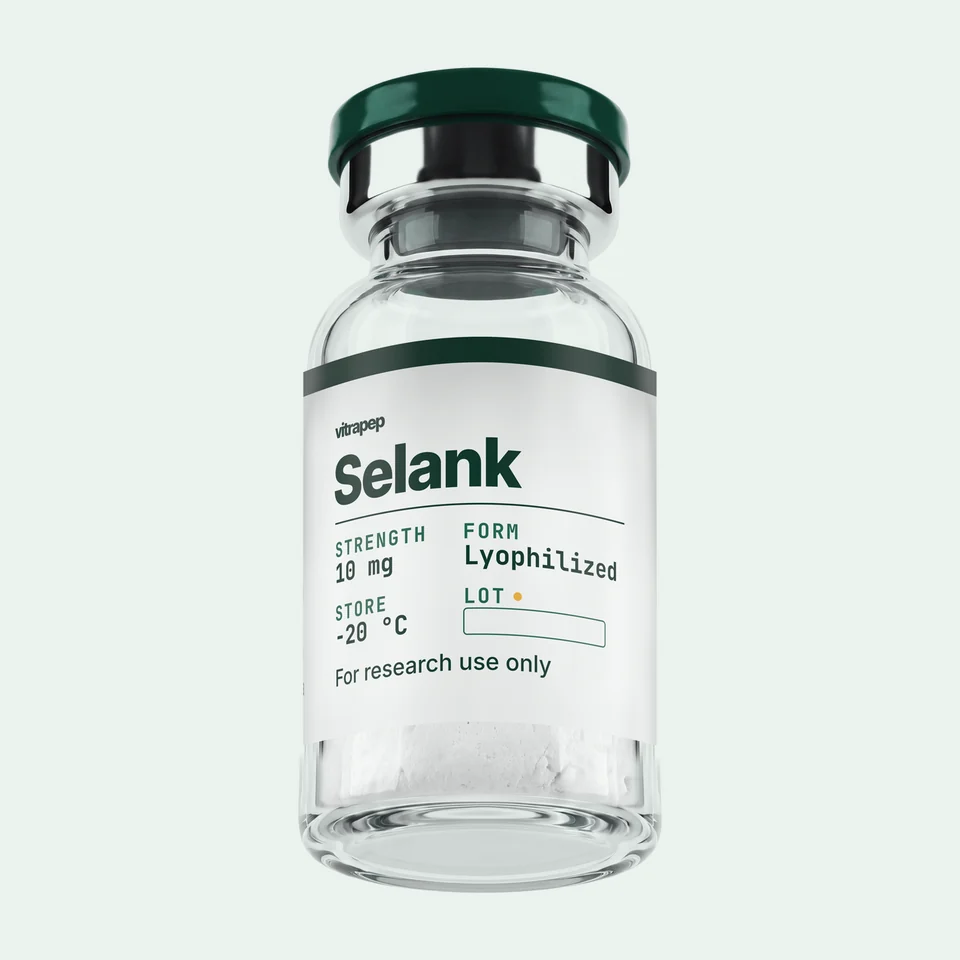
Vitrapep Selank product page
Specifications for the Vitrapep Selank product page sold for laboratory research. COA available with each lot.
Related reading: Selank complete guide, Selank anxiety trials, and Selank versus Semax.
FAQ
What are the potential Selank benefits researchers are studying?
Research has focused on anxiety-related symptoms, neurotransmitter signaling and brain connectivity. Human clinical reports are small, while additional mechanism studies have used animals and cells.
Does Selank have human clinical research?
Yes. Small Russian clinical comparisons have examined Selank in patients with anxiety-related disorders. The studies are limited and do not provide the same certainty as large placebo-controlled trials.
What does Selank research say about GABA?
Cell and animal studies have explored GABA-related gene expression and signaling. These findings suggest possible interactions, but they do not establish that Selank acts as a simple GABA agonist in people.
Is Selank FDA-approved?
No. Selank is not FDA-approved as a medicine in the United States. FDA has also noted unresolved safety-information and immunogenicity concerns for certain compounded formulations.
Are Selank's research findings conclusive?
No. The findings are interesting and justify further study, but small samples, limited trial designs and a lack of independent replication leave important questions open.
What to know now
- Small Russian patient studies reported anxiety-related signals with Selank compared with active medicines.
- A human imaging study found changes in functional connectivity, while animal and cell studies explore possible mechanisms.
- Selank is not FDA-approved, and larger placebo-controlled studies are needed.
What we’re watching
- Any independently conducted placebo-controlled clinical trial with prospectively registered outcomes.
- New FDA updates on Selank acetate and the information required to assess compounded formulations.