Selank sits in an unusual category. Russia approved it as a nasal-drop anxiolytic in 2009. That makes it one of the few grey-market peptides with actual regulatory approval somewhere in the world — but not in the U.S. Where to buy Selank in 2026 means a research-supply vendor, not a pharmacy. This guide covers the Russian-approval framing, the chemistry check that separates Selank from cheaper knockoffs (unacetylated tuftsin), and the price band US research suppliers listed on November 17, 2026 ($25.00–$52.00 per 10 mg vial).
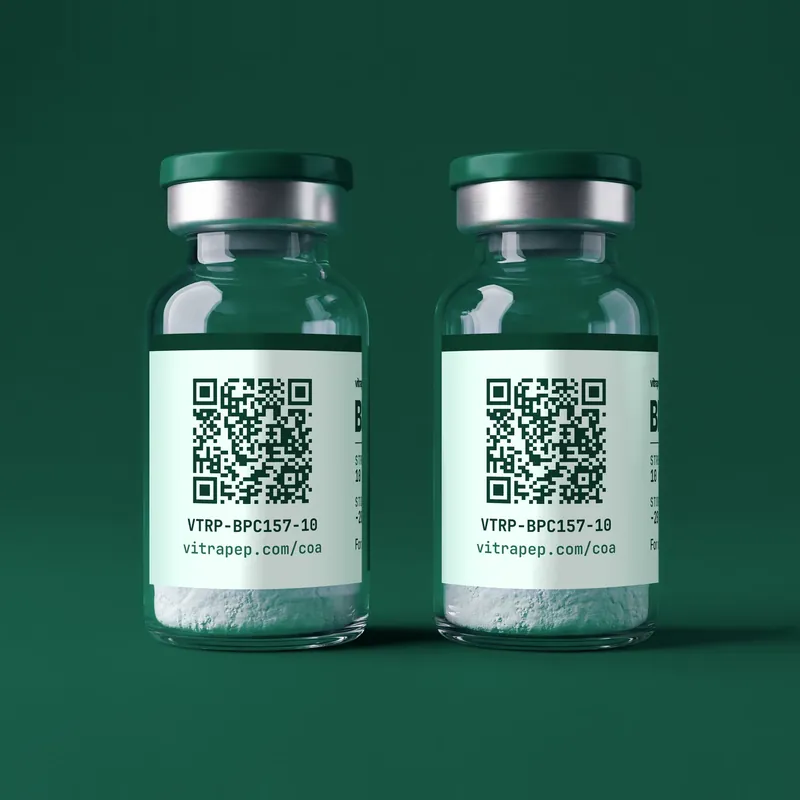
Get new research first
Research updatesOne short email when new peptide research drops or a new lab-verified batch lands — written from primary sources, no filler.
You’re on the list — check your inbox for a confirmation.
Could not save your email. Try again in a moment.
The 60-second answer: Buy lyophilized powder from a research-supply vendor. Get a third-party CoA from an ISO 17025-accredited lab showing HPLC ≥98%, mass-spec at 793.9 g/mol, and CAS 129954-34-3. Sequence must read Thr-Lys-Pro-Arg-Pro-Gly-Pro with N-acetylation explicitly noted. On November 17, 2026, US research suppliers listed 10 mg vials at $25.00–$52.00.
Research sourcing channels, and what each one provides
Selank’s odd regulatory geography means sourcing options depend on jurisdiction. In the U.S., three channels exist:
- U.S. prescription: Not available. Selank is not FDA-approved.
- Russian pharmacy import: Theoretically possible but heavily restricted. Russia approves Selank-0.15% as a nasal-drop. Personal importation is a legal gray zone and customs seizes shipments routinely.
- Research-supply vendor: The standard U.S. channel. Lyophilized powder under Research Use Only labeling.
What the research-supply channel does not provide: No physician oversight. No FDA-regulated batch testing. And no Western RCT evidence: zero PubMed-indexed randomized human trials of Selank for anxiety have been published. Russian approval was based on Russian-language clinical trials largely outside PubMed.
Compound identity: what is Selank
Selank (research code TP-7) is a synthetic analog of tuftsin. Tuftsin is a natural 4-residue immune peptide (Thr-Lys-Pro-Arg) that the human body produces from immunoglobulin G. Selank takes that core, extends it with Pro-Gly-Pro for enzyme stability, and adds an acetyl group on the N-terminus.
The N-acetylation matters. Unacetylated tuftsin is a different molecule with a different evidence base. Some grey-market suppliers sell tuftsin under the Selank label. The molecule of record in the Russian approval is the full N-acetylated 7-mer.
A 2022 rat study reported anxiolytic activity at 0.3 mg/kg, with performance “slightly inferior” to diazepam in a morphine-withdrawal model (Konstantinopolsky et al., 2022).
“
Selank modulated right amygdala functional connectivity within 5–20 minutes of intranasal administration in 52 healthy adults.
— Panikratova et al., 2020 (the one rigorous Western imaging study)
The four checks that matter for Selank
The standard eight vendor criteria apply. Four are sharper here.
1. What Russian approval does (and doesn’t) mean
Selank has real regulatory approval in Russia. Granted 2009, sustained since. The approval rests on Russian-language clinical trials largely outside the PubMed-indexed literature.
The honest framing: Selank has more clinical history than the typical grey-market peptide. That history doesn’t transfer to FDA or EMA validation. The right way to say it is “Russian-approved, Western research-only.” Any vendor saying “FDA-approved Selank” is wrong.
2. Tuftsin-analog identity verification
The CoA should list the 7-residue sequence with explicit N-acetylation, CAS 129954-34-3, and MW 793.9 g/mol. Mass-spec should show [M+H]+ near 794.9 within 0.5 Da. A different mass means a different compound — possibly unacetylated tuftsin, a truncated synthesis product, or something else entirely.
3. Lyophilized powder vs nasal spray
Russian clinical Selank is a nasal-drop solution (Selank-0.15%). Western research vendors sell lyophilized powder. Same molecule, different vehicle.
The lyophilized form has longer shelf life and is the standard reference compound form for Western research. Published studies have used intranasal (matching Russian clinical practice) or intraperitoneal (matching rodent literature) administration routes. Pre-mixed nasal sprays without vehicle, preservative, and stability disclosure should be passed over.
4. Anxiolytic-claim discipline
A Research Use Only vendor should describe what the molecule is and what the published evidence reports. Clinical claims cross into FDA jurisdiction. The cleanest signal: a product page that references Russian approval honestly and stops short of asserting Selank treats any human condition.
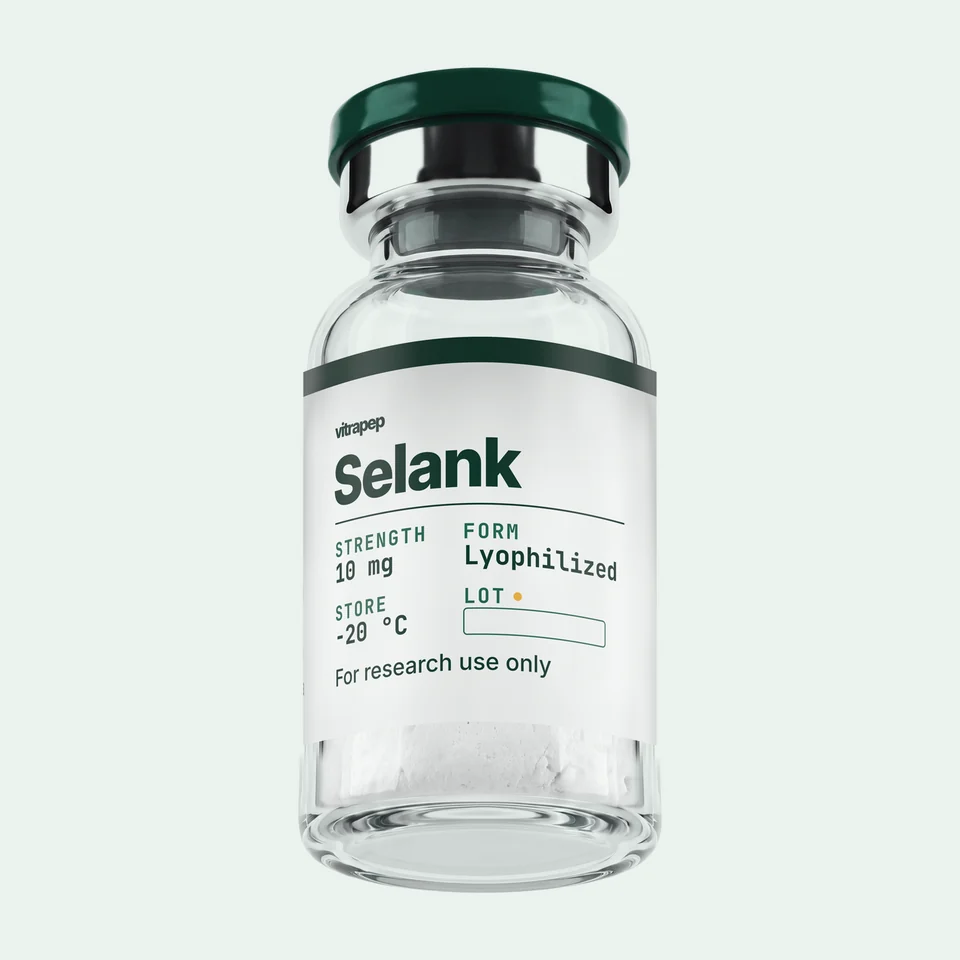
Selank
The standard N-acetylated tuftsin analog cited in the 2020 Selank vs Semax fMRI study and the 2022 morphine-withdrawal anxiolytic study. CAS 129954-34-3, theoretical mass 793.9 g/mol, ≥99% HPLC purity, third-party CoA on every lot.
2026 pricing reference
Selank is 7 residues with one modification (N-acetylation). Lower-end synthesis complexity. We checked US research supplier product pages on November 17, 2026. Listed single-vial prices, before shipping and codes:
- 10 mg vial: $25.00–$52.00 ($2.50–$5.20 per mg). Most common size.
- Multi-vial discounts: some suppliers discount larger orders.
The full table, with each supplier and source, is on our peptide price list.
Far below the rest of the market, the N-acetylation step and HPLC purification that separate crude 7-mer from research-grade Selank become questionable. Above $15 per mg reflects retail markup rather than synthesis cost.
The legal picture
Selank’s regulatory geography is unusual:
- FDA / EMA: Not approved for anything. No U.S. clinical trials.
- Russia: Approved by the Ministry of Health in 2009 for generalized anxiety disorder. Nasal-drop formulation (Selank-0.15%). Clinical trials in Russian, largely outside PubMed.
- U.S. legal status: Sold and bought as a research reference compound under Research Use Only labeling (21 CFR § 809.10(b)(9)). Selling for human consumption is illegal.
- WADA: Not explicitly listed. Athletes should still consult their sport’s anti-doping authority.
Red flags specific to Selank
- “FDA-approved Selank.” False. Suppliers claiming U.S. approval are misrepresenting the regulatory state.
- Tuftsin sold as Selank. Tuftsin is the 4-residue precursor (Thr-Lys-Pro-Arg). Selank is the N-acetylated 7-mer (Thr-Lys-Pro-Arg-Pro-Gly-Pro). Different molecules.
- Clinical claims on the product page. “Treats GAD.” “Cures PTSD.” FDA jurisdiction.
- Missing CAS 129954-34-3. The unique identifier. Its absence is a red flag.
- Mass-spec not matching 793.9 g/mol. Wrong mass, wrong molecule.
- Pre-mixed nasal sprays without vehicle disclosure. Solutions should disclose vehicle, preservative, concentration, and stability window. Otherwise lyophilized powder is safer.
- Internal QC only, no third-party ISO 17025 lab. An outside accredited lab is the standard.
Selank published evidence by tier.
Selank’s evidence base is unusual: real Russian regulatory approval plus a credible body of preclinical work, but essentially no PubMed-indexed Western randomized controlled trials. Researchers should match their evidence-tier expectations to this distinctive split.
Source: aggregate counts from the 2020 fMRI study (Panikratova et al., 2020), 2022 morphine-withdrawal study (Konstantinopolsky et al., 2022), and PubMed retrievals 2020–2026.
Selank
N-acetylated heptapeptide, CAS 129954-34-3. The same reference compound used across the Russian clinical literature underpinning the 2009 anxiolytic approval and the Western preclinical work cited in this guide. COA with HPLC trace and mass-spec ships with every order.
Frequently asked questions
Is Selank legal to buy in the USA?
Yes, as a research reference compound under Research Use Only labeling. It is not FDA- or EMA-approved. Russia is the only jurisdiction with approval (2009, generalized anxiety disorder, nasal-drop). Selling for human consumption is illegal; buying as research material is not.
What does Russian approval mean for a buyer?
Selank has genuine regulatory approval somewhere, which most grey-market peptides do not. The approval rests on Russian-language clinical trials largely outside PubMed and does not transfer to FDA or EMA validation. The molecule has more clinical history than the typical research peptide, but Western RCT evidence is essentially absent.
How is Selank different from a benzodiazepine?
Selank’s anxiolytic profile in the literature is reported as anxiolysis without sedation, classical withdrawal, or dependence. Its mechanism is described as interactions with GABA, serotonin, and dopamine systems rather than direct GABA-A allosteric modulation. A 2022 rat morphine-withdrawal study reported Selank’s effect “slightly inferior” to diazepam at 2 mg/kg — the “gentler” anxiolytic positioning (Konstantinopolsky et al., 2022).
Anxiolytic without sedation — is that a real effect?
The framing has reproducible preclinical support and one rigorous Western human study: the 2020 placebo-controlled fMRI in 52 healthy adults showing Selank modulated right amygdala functional connectivity within 5–20 minutes of intranasal administration (Panikratova et al., 2020). Western RCTs on standardized anxiety rating scales have not been published in PubMed.
How does Selank compare to Semax?
Both are short Russian heptapeptides with Pro-Gly-Pro stability extensions, both Russia-approved, both Western research-only. Selank is a tuftsin analog positioned as anxiolytic; Semax is an ACTH(4-7) analog positioned as a cognition-studied compound and neuroprotectant. Detailed comparison: Selank vs Semax.
Lyophilized powder vs nasal drops?
Russian clinical Selank is a nasal-drop (Selank-0.15%); Western research Selank is predominantly lyophilized powder for reconstitution. The molecule is identical — the lyophilized form has longer shelf life. Published Western studies have used intranasal administration (matching Russian clinical practice) or intraperitoneal administration (matching rodent literature).
What to know now
- CAS 129954-34-3, MW 793.9 g/mol, sequence Thr-Lys-Pro-Arg-Pro-Gly-Pro (N-acetylated). The numbers a credible CoA should show.
- $25.00–$52.00 per 10 mg vial on November 17, 2026. Seven residues, one N-acetylation — among the simpler peptides to synthesize.
- Russian-approved since 2009; not FDA- or EMA-approved. Real pharmaceutical approval, but only in Russia. Western use is research-only.
- N-acetylated heptapeptide only. Unacetylated tuftsin sold as Selank is the wrong molecule.
- Lyophilized powder is the Western research-grade form. Nasal sprays without vehicle disclosure should be passed over.
- Anxiolysis without sedation is the literature positioning. Western RCT evidence for anxiety treatment is essentially absent; preclinical and fMRI support exist.
What we’re watching
The most important Selank development to track is whether a Western RCT — in a generalized anxiety disorder population, with a validated rating scale and placebo control — ever publishes. The Russian approval rests on clinical work not searchable in PubMed; the only rigorous Western human evidence remains the 2020 fMRI study. Until a Western RCT runs, Selank stays in an unusual category: a real Russian pharmaceutical with a credible preclinical signal but no validation by Western evidence standards. Separately, watch for any WADA Prohibited List addition — the category is moving even though Selank is not currently listed.