Semax side effects are difficult to characterize because many published studies did not discuss adverse events in enough detail to calculate rates. A clinical report described a low proportion of side effects without numerical detail, while other studies either reported no events or did not discuss them. FDA's 2026 review highlighted the limited and uneven quality of the available safety information.
Quick answer: The published evidence is not sufficient to calculate how often Semax causes side effects. Adverse-event reporting is incomplete, many studies are small or difficult to independently assess, and FDA has not approved Semax as a drug. The absence of detailed reports should not be interpreted as proof of safety.
What are Semax side effects according to published research?
Published human reports do not provide a consistent, high-quality list of Semax adverse effects. The literature includes studies in people with cerebrovascular disease, facial pain, gastrointestinal conditions and other settings. Many articles did not discuss adverse events. A few reported no events or used broad descriptions without a numerical rate.
This makes the evidence different from a modern clinical safety database. In a well-reported trial, investigators define adverse events in advance, collect them systematically and report how many participants experienced each event. Several Semax publications do not provide that level of detail. A study that does not mention side effects cannot be treated as a study that found none.
Semax is a synthetic peptide related to a fragment of adrenocorticotropic hormone (ACTH). Research has examined possible effects on neurotrophic signaling and neurological function. Those biological questions are one reason the compound has attracted scientific interest. However, mechanistic research and reported clinical effects do not replace systematic safety monitoring.
What did human studies report about tolerability?
A 2005 Russian-language report by Gusev and colleagues examined Semax in 187 patients with different stages of cerebrovascular insufficiency. The abstract described a “minor percentage” of side effects and characterized tolerability favorably, but did not provide a numerical event rate or a detailed breakdown of symptoms. The phrase therefore cannot be converted into a percentage or used to estimate risk in other populations.
A 1996 report by Koroleva and colleagues involved 37 adults with facial pain, neuralgia or migraine-related conditions. The FDA's 2026 briefing summarized the publication as reporting no adverse events. That is a statement about the particular report, not proof that adverse events cannot occur. The sample was small and the finding cannot establish safety across all possible populations or uses.
A separate 1996 healthy-volunteer report by Kaplan and colleagues included 19 healthy adult men; FDA noted that adverse events were not discussed. The 2002 peptic-ulcer study by Ivanikov and colleagues also did not provide an adverse-event discussion in the FDA summary. Several other studies reviewed by FDA did not discuss adverse events. These included reports involving healthy volunteers and people with different medical conditions. When the primary publication gives no adverse-event information, the correct evidence classification is “not discussed,” rather than “none.”
What did human studies report about tolerability
| Study or source | Participants and setting | What the publication reported about adverse events | Evidence limitation |
|---|---|---|---|
| Gusev et al., 2005 | 187 patients with cerebrovascular insufficiency | “Minor percentage” of side effects; no numerical rate or detailed list in the abstract | Broad wording does not allow an incidence estimate |
| Koroleva et al., 1996 | 37 adults with facial pain, neuralgia or migraine | No adverse events reported in the summary reviewed by FDA | Small sample and limited detail |
| Kaplan et al., 1996 | 19 healthy adult men | Adverse events not discussed | Cannot assume no events occurred |
| Ivanikov et al., 2002 | 32 adults with peptic ulcer disease | Adverse events not discussed | Safety reporting unavailable in the summary |
| Child and adolescent reports reviewed by FDA | Several cohorts in neurological or psychiatric settings | Adverse events often not discussed | Details and methods varied across reports |
The available studies provide an initial picture of historical research, but not a dependable side-effect frequency. Some publications are in Russian, some are conference abstracts or brief reports, and some were not available in full to FDA reviewers. The populations and study methods also vary, making the findings difficult to combine.
What did FDA's 2026 review identify?
FDA's July 2026 Pharmacy Compounding Advisory Committee briefing reviewed Semax free base and acetate in the context of proposed bulk drug substances for compounding. The review stated that there were no human pharmacokinetic studies identified and that the available human safety information was limited. It also identified one spontaneous adverse-event report in the FDA Adverse Event Reporting System (FAERS).
The spontaneous report described ocular pain and burning after use of a nasal Semax product obtained online. The consumer reportedly sought medical care. A single report cannot establish that Semax caused the symptoms. Spontaneous reports lack a reliable denominator, may contain incomplete information and cannot determine the frequency of an event. FDA included the report as a safety signal for review, not as proof of a causal relationship.
FDA also noted limitations in the published clinical literature. Some studies did not discuss adverse events, some reports were not available in English, and the evidence did not provide a consistent basis for assessing pharmacokinetics or safety. Staff's assessment in the advisory briefing should be distinguished from a final FDA drug approval or a blanket legal determination about every product bearing the Semax name.
Semax is not an FDA-approved drug. The FDA review addressed whether Semax free base and acetate met criteria for inclusion on a list of bulk drug substances that may be used in compounding under section 503A. The staff recommendation in that process is not the same as approval through the drug application process.
Are reported side effects the same for every Semax product?
The available evidence does not allow that conclusion. Published clinical reports describe specific preparations and research settings. FDA's review also discussed the lack of human pharmacokinetic data and the limited evidence for different proposed formulations. Without adequate comparative studies, it is not possible to assume that different forms or preparations produce identical exposures or safety outcomes.
It is also important to distinguish the active molecule from the quality and characteristics of a particular preparation. Analytical identity, purity, stability and formulation can influence what is actually being studied. These factors do not prove that a particular product causes an adverse event, but they are part of why research and regulatory evaluation require more than a compound name.
Some Semax research has examined neurological pathways and neurotrophic signaling. These proposed mechanisms remain interesting research topics. The available adverse-event literature, however, does not establish that Semax is safe for a particular person or suitable for a particular use. Positive mechanistic findings and incomplete safety reporting can coexist.
What is still unknown about Semax safety?
The first major gap is the lack of systematic adverse-event reporting. Studies that omit safety information cannot reliably identify common or uncommon events. Even reports that state no events occurred may be too small to detect rare reactions.
The second gap is pharmacokinetics. FDA did not identify human pharmacokinetic studies in its 2026 review. Without such information, exposure patterns and relationships between exposure and adverse events are difficult to characterize.
The third gap is independent assessment of the older literature. Several studies were published in Russian journals or were available only as brief summaries. FDA's review notes that the information available to reviewers was incomplete for some reports. More accessible, well-designed studies with transparent safety reporting would materially improve the evidence base.
For additional background, see Vitrapep's Semax complete guide, Semax research summary, and Semax ACTH and BDNF mechanism article.
Vitrapep research material
Vitrapep sells Semax for laboratory research use only. It is not for human or veterinary use.
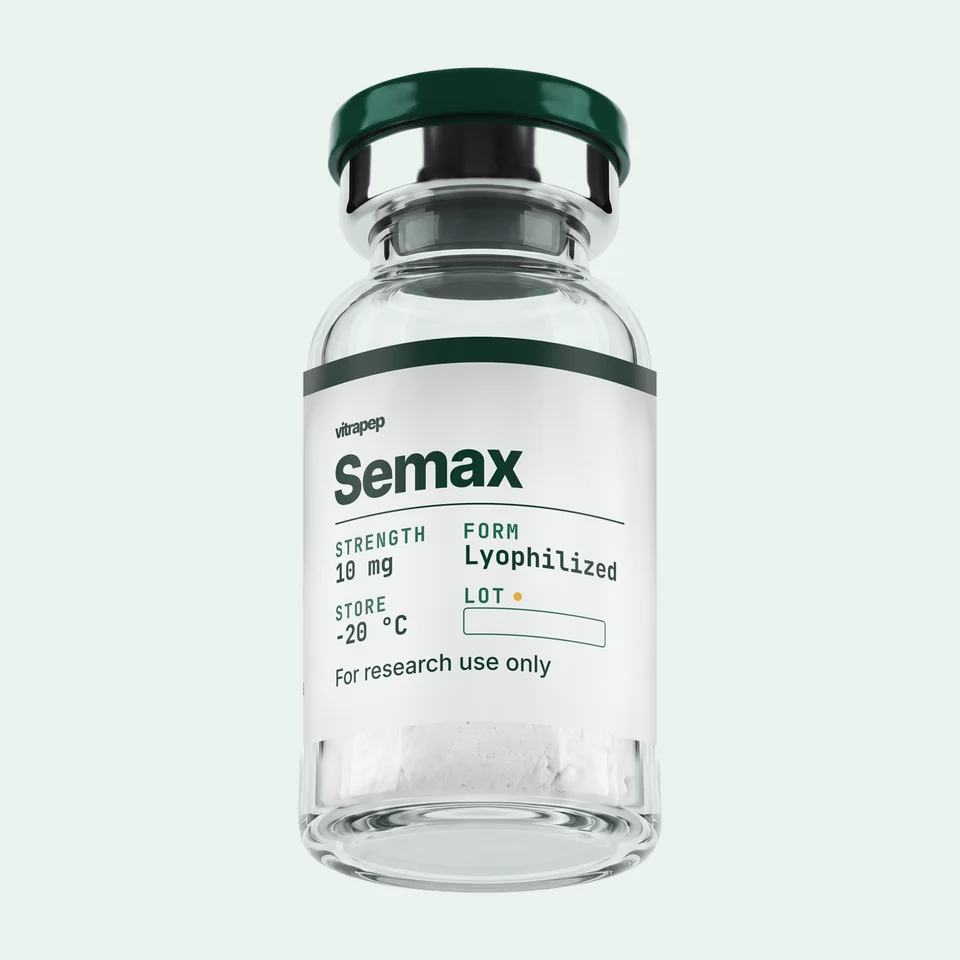
Semax
Specifications for the Semax sold for laboratory research. COA available with each lot.
Frequently asked questions
What side effects have been reported with Semax?
Published reports are inconsistent. One report described a “minor percentage” without a numerical rate, another small study reported no adverse events, and many studies did not discuss side effects.
Did FDA identify a Semax safety report?
Yes. FDA's 2026 briefing described one spontaneous report involving ocular pain and burning after use of a Semax nasal product. A single report cannot establish causality or incidence.
Is Semax FDA-approved?
No. Semax is not an FDA-approved drug. FDA's 2026 review considered Semax free base and acetate in a bulk-drug-substance compounding context.
Does a study that does not mention side effects mean Semax caused none?
No. “Not discussed” is not the same as “none occurred.” Without systematic collection and reporting, the safety result is unknown.
Are Semax side effects well understood in humans?
No. The available literature is too limited and inconsistently reported to establish reliable event rates or a complete human safety profile.
What to know now
- Human Semax studies exist, but adverse-event reporting is uneven and often incomplete.
- A 2005 report described a “minor percentage” of side effects without a numerical rate; other studies did not discuss adverse events.
- FDA's 2026 review identified one spontaneous ocular-symptom report but did not establish causality or a side-effect incidence rate.
What we’re watching
- Publication of accessible, well-designed human studies with standardized adverse-event collection.
- Any additional FDA review or regulatory action concerning Semax free base or acetate.
- Human pharmacokinetic studies that help clarify exposure and support more complete safety evaluation.