Tesamorelin benefits have been studied most extensively in adults living with HIV who developed excess abdominal fat associated with lipodystrophy. In this specific population, randomized trials found reductions in visceral adipose tissue and improvements in selected body-composition measures. The findings are clinically meaningful, but they do not establish tesamorelin as a general weight-loss treatment.
Quick answer: The strongest published tesamorelin benefits are reductions in visceral abdominal fat in adults with HIV-associated lipodystrophy. Clinical studies also report changes in some lipid and liver-fat measures. The FDA-approved indication is narrow, and the medicine is not indicated for general weight-loss management.
What is tesamorelin, and how does it work?
Tesamorelin is a synthetic analogue of growth hormone-releasing hormone (GHRH). It acts on GHRH receptors in the pituitary and stimulates the body's release of growth hormone. Growth hormone then affects several tissues and can increase insulin-like growth factor 1 (IGF-1).
The mechanism helps explain why researchers studied tesamorelin for visceral adipose tissue. Visceral fat is stored around internal organs and differs biologically from subcutaneous fat beneath the skin. The clinical program focused on excess abdominal fat in people with HIV-associated lipodystrophy, a condition that can occur in the context of HIV and antiretroviral treatment.
Tesamorelin is not a direct substitute for every growth-hormone-related compound. It is a defined GHRH analogue with a specific clinical evidence base and a specific FDA-approved product indication. Findings from its HIV-associated lipodystrophy trials should not automatically be generalized to other populations.
The peptide mechanism remains scientifically relevant because it links endocrine signaling with changes in fat distribution. Its value in the approved setting comes from clinical trials rather than from mechanistic theory alone.
What did the pivotal clinical trials report?
The pivotal trials found that tesamorelin reduced visceral adipose tissue in adults with HIV-associated lipodystrophy and excess abdominal fat. Falutz and colleagues published a randomized, placebo-controlled study in The New England Journal of Medicine in 2007. It enrolled 412 adults with HIV and abdominal fat accumulation.
At the end of the 26-week study period, visceral adipose tissue decreased by 27.8 square centimeters in the tesamorelin group. The placebo group had an increase of 5.1 square centimeters. The between-group result supported the use of tesamorelin as a targeted approach to excess visceral fat in this population.
A second randomized trial enrolled 404 adults with HIV-associated central fat accumulation. The published report found a 10.9% reduction in visceral adipose tissue in the tesamorelin group, compared with a 0.6% reduction in the placebo group. When treatment was discontinued in the extension phase, some of the visceral-fat improvement was lost. This finding suggests that the measured response was linked to ongoing exposure in the trial, rather than a permanent change.
A pooled analysis of two Phase 3 trials included 806 participants. At the primary endpoint, the treatment effect on visceral adipose tissue was a 15.4% reduction compared with placebo. These large randomized datasets form the foundation of the FDA-approved indication.
What other body-composition findings have been reported?
A randomized clinical trial published in JAMA in 2014 examined tesamorelin in HIV-infected adults with abdominal fat accumulation. It reported a reduction in visceral adipose tissue and a reduction in liver fat compared with placebo. The between-group difference in visceral adipose tissue change was 42 square centimeters. The study also found a 2.9 percentage-point between-group difference in hepatic lipid-to-water percentage.
The 2026 meta-analysis by Badran and colleagues synthesized five randomized controlled trials in adults with HIV-associated lipodystrophy. The analysis reported a mean reduction of 27.71 square centimeters in visceral adipose tissue compared with control. It also reported reductions in trunk fat and hepatic fat percentage, alongside an increase in lean body mass.
The meta-analysis did not find a significant reduction in body mass index or subcutaneous adipose tissue. That result is useful because it highlights the distinction between changing visceral fat and producing broad weight loss. Tesamorelin's clinical effect is more accurately described as a targeted body-composition change within the studied population.
What other body-composition findings have been reported
| Study | Participants or design | Main findings | Evidence level |
|---|---|---|---|
| Falutz et al., 2007 | 412 adults with HIV and abdominal fat accumulation | Visceral adipose tissue decreased 27.8 cm² with tesamorelin and increased 5.1 cm² with placebo | Randomized human trial |
| Falutz et al., 2010 | 404 adults with HIV-associated central fat accumulation | Visceral adipose tissue changed by -10.9% versus -0.6% at the primary endpoint | Randomized human trial |
| Falutz et al., 2010 pooled analysis | Two Phase 3 trials, 806 participants | Pooled treatment effect of -15.4% in visceral adipose tissue | Pooled randomized-trial analysis |
| Stanley et al., 2014 | Randomized trial in adults with HIV and abdominal fat accumulation | Reduced visceral fat and hepatic fat compared with placebo | Randomized human trial |
| Badran et al., 2026 | Meta-analysis of five randomized trials | Lower visceral and hepatic fat; higher lean body mass; no significant BMI reduction | Meta-analysis of human trials |
These studies support a specific clinical benefit in HIV-associated lipodystrophy. They do not prove the same results in adults without HIV or in people seeking general weight reduction.
Is tesamorelin FDA-approved, and what is the approved use?
Yes. The FDA-approved tesamorelin product EGRIFTA WR is indicated to reduce excess abdominal fat in adults with HIV-associated lipodystrophy. The current U.S. prescribing information states that long-term cardiovascular safety has not been established. It also states that the product is not indicated for weight-loss management.
This narrow indication is important. FDA approval applies to the named prescription product and its approved use. It does not mean every tesamorelin product or research material has been reviewed or approved by FDA. It also does not establish efficacy for general obesity, bodybuilding, anti-aging or other uses not included in the label.
The approved mechanism is consistent with the research focus. Tesamorelin stimulates growth hormone release and can increase IGF-1. The product label also identifies risks involving glucose tolerance, fluid retention, hypersensitivity and neoplasms. These points belong alongside the efficacy findings in any balanced summary.
What questions remain open?
Research beyond HIV-associated lipodystrophy is ongoing, but the evidence is less established. A small Phase 2 randomized study published in 2025 evaluated tesamorelin in people with HIV and abdominal obesity with a focus on neurocognitive outcomes. It did not find a significant between-group difference in the primary cognitive outcome. It did report changes in body-composition measures.
The 2026 meta-analysis supports the existing evidence for visceral fat reduction, but its included studies were conducted in the same broad clinical population. It cannot establish benefit in every population or for every proposed outcome.
Long-term cardiovascular outcomes also remain important. The FDA label specifically notes that long-term cardiovascular safety has not been established. Further research may refine how the body-composition effects translate into longer-term clinical outcomes.
What does the evidence mean for research?
Tesamorelin is a useful example of a peptide research program progressing from endocrine mechanism to controlled clinical trials and a narrow FDA-approved indication. The clinical evidence is stronger than for many research peptides because it includes multiple randomized studies and a regulatory label.
The findings are most relevant when interpreted within the population and outcomes actually studied. The benefit is a targeted reduction in excess visceral abdominal fat for adults with HIV-associated lipodystrophy. It is not evidence that tesamorelin is a general fat-loss product.
For peptide research, the case illustrates why mechanism, patient population and validated endpoints must be considered together. A measurable body-composition change is valuable, but it should not be broadened into claims that the studies did not test.
Product information and related Vitrapep research
Vitrapep sells tesamorelin for laboratory research use only. It is not for human or veterinary use. The Vitrapep research-use material is distinct from the FDA-approved prescription product described in the clinical literature. See the Vitrapep tesamorelin product page.
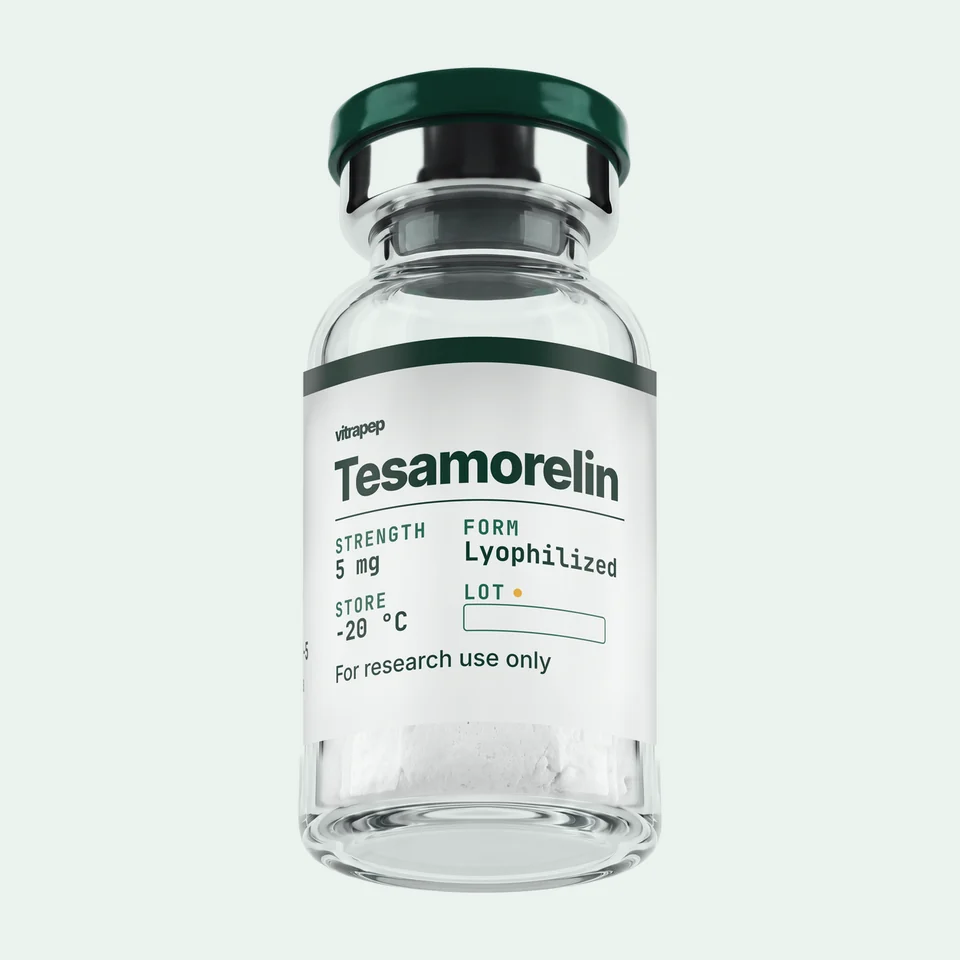
Vitrapep tesamorelin product page
Specifications for the Vitrapep tesamorelin product page sold for laboratory research. COA available with each lot.
Related reading: Tesamorelin complete guide, tesamorelin and HIV-associated lipodystrophy, tesamorelin cognition trials, and tesamorelin vs. sermorelin.
FAQ
What are the main tesamorelin benefits?
The clearest established benefit is a reduction in excess visceral abdominal fat in adults with HIV-associated lipodystrophy. Clinical studies also reported changes in some lipid and liver-fat measures.
Does tesamorelin reduce visceral fat?
Randomized trials found reductions in visceral adipose tissue compared with placebo in adults with HIV-associated lipodystrophy. The FDA-approved indication is limited to that population.
Is tesamorelin approved for general weight loss?
No. The FDA label states that EGRIFTA WR is not indicated for weight-loss management. Its approved use is reduction of excess abdominal fat in adults with HIV-associated lipodystrophy.
Does tesamorelin affect liver fat?
A randomized clinical trial and a later meta-analysis reported reductions in liver-fat measures in the studied HIV-associated lipodystrophy population. These findings do not establish a broad liver-disease indication.
Is research-use tesamorelin the same as FDA-approved EGRIFTA WR?
No. A research-use material is not the same as an FDA-approved prescription product. The prescription product's approval and trial evidence do not automatically apply to other materials.
What to know now
- Randomized trials support tesamorelin's ability to reduce visceral abdominal fat in adults with HIV-associated lipodystrophy.
- A 2026 meta-analysis of five trials also reported improvements in selected body-composition and hepatic-fat measures.
- FDA approval is narrow. EGRIFTA WR is not indicated for general weight-loss management.
What we’re watching
- Further peer-reviewed analyses of longer-term metabolic and cardiovascular outcomes in the approved population.
- Additional clinical research examining cognitive or other outcomes, with attention to trial design and meaningful endpoints.
- Updates to the FDA prescribing information and any new regulatory findings.