Tesamorelin side effects are documented in randomized trials involving adults with HIV-associated lipodystrophy and in the current U.S. prescribing information for EGRIFTA WR. The most common reported reactions include injection-site events, arthralgia, pain in the extremities, myalgia and peripheral edema. The label also highlights clinically important risks involving glucose intolerance, elevated IGF-1, hypersensitivity and malignancy considerations.
Quick answer: Tesamorelin side effects reported in clinical trials include injection-site reactions, joint pain, extremity pain, muscle pain, peripheral edema, tingling sensations and rash. The FDA label also warns about glucose intolerance or diabetes, increased IGF-1, hypersensitivity and neoplasm considerations. These findings come mainly from adults with HIV-associated lipodystrophy.
What did the tesamorelin trials report?
The current EGRIFTA WR label summarizes adverse reactions from clinical trials in adults with HIV-associated lipodystrophy and excess abdominal fat. A total of 740 participants received tesamorelin across the clinical program. Of these, 543 received it during the initial placebo-controlled phase, while 263 participants received placebo for the comparison dataset.
The label's adverse-reaction table reports events occurring in at least 1% of participants and more frequently in the tesamorelin group during the first 26 weeks. These pooled trial data provide the clearest standardized summary of reported reactions. They should not be used to compare tesamorelin directly with other medicines because adverse-event rates vary across trials and populations.
What did the tesamorelin trials report
| Adverse reaction | Tesamorelin group | Placebo group | Pooled trial context |
|---|---|---|---|
| Injection-site reaction | 17% | 6% | 543 vs. 263 participants; first 26 weeks |
| Arthralgia | 13% | 11% | Same pooled dataset |
| Pain in extremity | 6% | 5% | Same pooled dataset |
| Myalgia | 6% | 2% | Same pooled dataset |
| Peripheral edema | 6% | 2% | Same pooled dataset |
| Paresthesia | 5% | 2% | Same pooled dataset |
| Hypoesthesia | 4% | 2% | Same pooled dataset |
| Rash | 4% | 2% | Same pooled dataset |
The table reproduces the percentages in the label's adverse-reaction table. The label's narrative also reports an overall injection-site-reaction incidence of 25% in tesamorelin-treated participants and 14% in placebo participants. That broader figure uses a more inclusive grouping of injection-site events. The two figures should not be presented as though they are the same analysis.
Which side effects were most commonly reported?
Injection-site reactions were among the most frequently reported events. The prescribing information lists redness, itching, pain, irritation and bruising among the possible reactions. In the pooled adverse-reaction table, the grouped injection-site category occurred more frequently in the tesamorelin group than placebo.
Joint and muscle-related symptoms were also reported. Arthralgia, or joint pain, was recorded in 13% of tesamorelin-treated participants and 11% of placebo participants. Myalgia was reported in 6% and 2%, respectively. Pain in an extremity was reported in 6% and 5%.
Fluid-retention effects are relevant because tesamorelin stimulates growth hormone release. The label describes edema, arthralgia and carpal tunnel syndrome as possible manifestations. Peripheral edema was reported in 6% of the tesamorelin group and 2% of the placebo group in the pooled table.
Sensory symptoms were also included. Paresthesia was reported in 5% of tesamorelin-treated participants and 2% of placebo participants. Hypoesthesia was reported in 4% and 2%. Rash was reported in 4% and 2%.
These are reported event rates, not a prediction that any particular person will experience them. The underlying trials enrolled adults with HIV-associated lipodystrophy, so the event rates may not apply to every population or formulation.
What did the FDA label say about glucose and diabetes?
The FDA label warns that tesamorelin can cause glucose intolerance and diabetes mellitus. In the clinical-trial dataset, 5% of participants receiving tesamorelin crossed the HbA1c threshold used to define diabetes, compared with 1% of participants receiving placebo. The label reports a hazard ratio of 3.3, with a confidence interval from 1.4 to 9.6.
This is an important finding because it connects the hormone pathway with glucose regulation. Growth hormone can influence insulin sensitivity, and tesamorelin stimulates endogenous growth hormone secretion. The prescribing information therefore includes glucose intolerance among its warnings and precautions.
The label also reports increased IGF-1. Among participants treated for 26 weeks, 47% had IGF-1 levels above two standard-deviation scores, and 36% had levels above three standard-deviation scores. The label explains that the effects of prolonged IGF-1 elevations are unknown. These laboratory changes are not the same as a clinical diagnosis, but they are part of the approved product's safety profile.
What other serious warnings are included?
The FDA label includes several warnings that go beyond the adverse-reaction table. It advises careful consideration in people with a history of malignancy and contraindicates use in people with active malignancy. This warning reflects the growth-factor activity of the growth hormone pathway. It does not mean that the clinical trials established tesamorelin as a cause of cancer.
Hypersensitivity reactions occurred in 4% of participants treated with tesamorelin in clinical trials. Reported reactions included itching, redness, flushing, urticaria and rash. The label also notes the potential for fluid retention and related musculoskeletal effects.
The label reports increased mortality in patients with acute critical illness after treatment with pharmacologic amounts of growth hormone. Because tesamorelin stimulates growth hormone production, the prescribing information includes a warning concerning acute critical illness.
The FDA label also states that long-term cardiovascular safety has not been established. The approved indication is reduction of excess abdominal fat in adults with HIV-associated lipodystrophy. EGRIFTA WR is not indicated for general weight-loss management.
Who was studied, and what are the evidence limits?
The main clinical safety dataset involved adults with HIV-associated lipodystrophy and excess abdominal fat. The pooled 26-week dataset included 543 participants receiving tesamorelin and 263 receiving placebo. Additional extension data evaluated longer exposure, but those results should be interpreted separately from the primary placebo-controlled period.
The population is important. Adults living with HIV may have distinct metabolic, medication and health characteristics. The rates in these trials cannot automatically be generalized to people without HIV, people using other formulations or people obtaining research-use materials.
The FDA label is the primary source for the approved product's reported adverse reactions and warnings. Individual clinical publications add context about the populations and trial design. A small number of events or a lack of a reported event in a trial does not establish that a risk is impossible.
What is the regulatory status of tesamorelin?
Tesamorelin is the active ingredient in FDA-approved prescription products for a narrow indication. EGRIFTA WR is indicated to reduce excess abdominal fat in adults with HIV-associated lipodystrophy. The label expressly states that it is not indicated for weight-loss management and that long-term cardiovascular safety has not been established.
This approval does not extend to every tesamorelin material. Research-use products are not the same as the approved prescription formulation. The FDA's clinical-trial safety table and product warnings should not be treated as a certificate of quality for an unrelated research lot.
Product information and related Vitrapep research
Vitrapep sells tesamorelin for laboratory research use only. It is not for human or veterinary use. The research-use material is separate from the FDA-approved prescription product. See the Vitrapep tesamorelin product page.
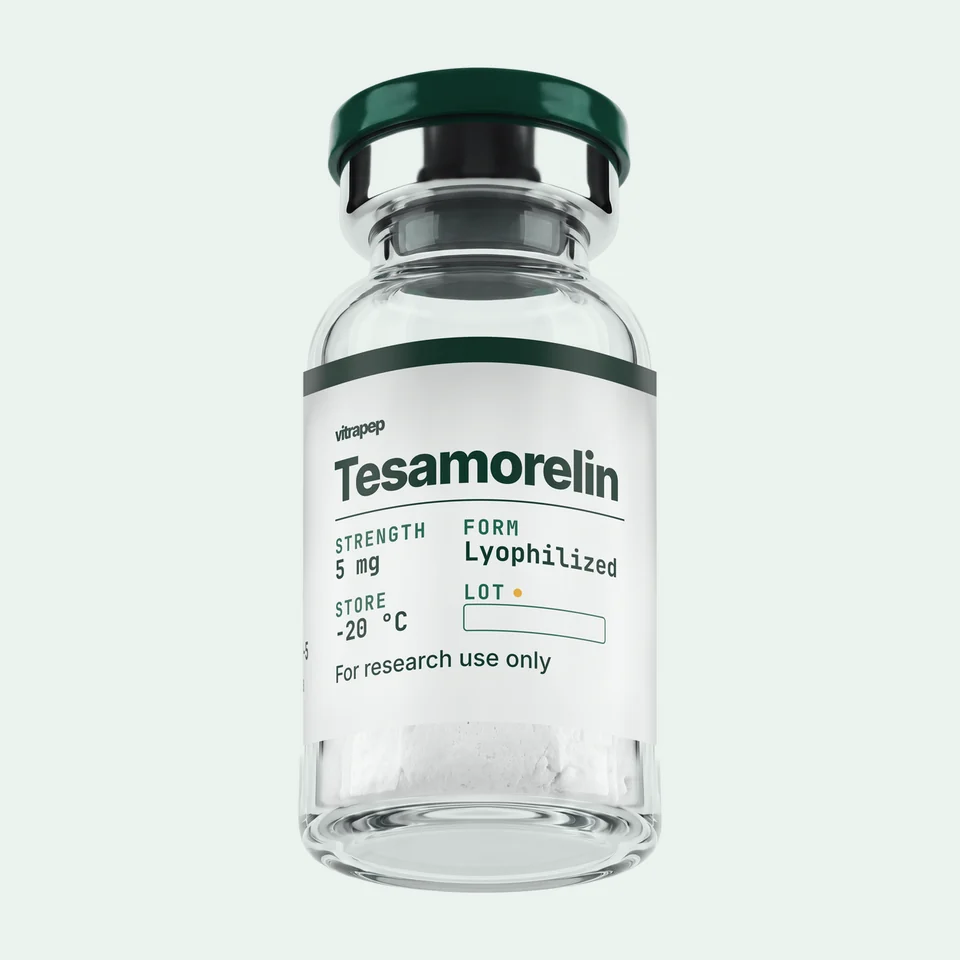
Vitrapep tesamorelin product page
Specifications for the Vitrapep tesamorelin product page sold for laboratory research. COA available with each lot.
Related reading: Tesamorelin complete guide, tesamorelin benefits and clinical evidence, tesamorelin and HIV-associated lipodystrophy, and tesamorelin vs. sermorelin.
FAQ
What are the most common tesamorelin side effects?
The FDA label lists injection-site reactions, arthralgia, pain in an extremity, myalgia, peripheral edema, paresthesia, hypoesthesia and rash among adverse reactions reported more frequently than placebo.
Can tesamorelin affect blood sugar?
Yes. The FDA label warns that glucose intolerance or diabetes mellitus may develop. In the clinical-trial dataset, 5% of tesamorelin participants and 1% of placebo participants crossed the HbA1c threshold for diabetes.
Does tesamorelin increase IGF-1?
Yes. The approved product stimulates growth hormone production and increases serum IGF-1. The label notes that the effects of prolonged IGF-1 elevations are unknown.
Were serious hypersensitivity reactions reported?
The FDA label reports hypersensitivity reactions in 4% of participants treated with tesamorelin in clinical trials. Reactions included itching, redness, flushing, urticaria and rash.
Is tesamorelin approved for general weight loss?
No. EGRIFTA WR is indicated for reducing excess abdominal fat in adults with HIV-associated lipodystrophy. The label says it is not indicated for weight-loss management.
What to know now
- The pooled 26-week safety table included 543 tesamorelin-treated participants and 263 placebo participants.
- Injection-site reactions, arthralgia, muscle symptoms and edema were among the reported adverse reactions.
- The FDA label highlights glucose intolerance, elevated IGF-1, hypersensitivity and malignancy-related warnings.
What we’re watching
- Any future revisions to EGRIFTA WR prescribing information and its safety warnings.
- Longer-term clinical data on cardiovascular outcomes and sustained changes in IGF-1.
- New studies that evaluate safety in populations outside the approved HIV-associated lipodystrophy indication.