Thymulin was first detected in 1973 as a serum activity that vanished when the thymus was removed from mice. Its nine-amino-acid structure was reported in 1977, and in 1982 researchers showed it works only when bound to zinc. Human data come from a few studies published in the 1980s.
Quick answer: Thymulin is a natural thymus peptide that needs zinc to be active. It has been studied mainly for effects on T-cell development and inflammation. Thymulin is not approved by the FDA for any use. FDA lists thymulin acetate among compounding nominations made without adequate support.
What is thymulin and how was it discovered?
In 1973, Bach and Dardenne described a factor in normal mouse serum that made bone marrow cells carry a T-cell marker [2]. The activity disappeared after the thymus was removed, with a half-life of 2.5 hours. It returned after a thymus graft and faded progressively in ageing mice [2].
The researchers named it facteur thymique sérique (FTS), or serum thymic factor. In 1977 they purified it from 1,000 liters of pig serum (Dardenne et al., 1977). Pléau and colleagues then reported its sequence of nine amino acids. A synthetic copy showed the same biological activity as the natural peptide [3].
The first residue is pyroglutamic acid, a ring-closed form of glutamic acid [1], [3]. Antibodies against FTS stained epithelial cells in young mouse thymus, more often in the medulla than the cortex [5]. FTS-like material was also isolated from thymosin fraction V, a thymus extract (Dardenne et al., 1980).
Thymulin is a different molecule from thymosin alpha-1 and thymosin beta-4. A 2026 paper lists all three as products of thymic epithelial cells [12]. See the thymosin alpha-1 complete guide and the thymosin beta-4 complete guide.
Why does thymulin need zinc?
In 1982, Dardenne and colleagues treated FTS with a chelating agent that removes metal ions [4]. The peptide lost its activity in the standard rosette assay. Adding zinc restored it, and some other metals did so to a lesser extent. One zinc ion per peptide gave the best activation [4].
The authors concluded that FTS exists in two forms. The zinc-free form is biologically inactive. The zinc-bound form is active, and they proposed the name thymulin, or FTS-Zn, for it [4]. The international nonproprietary name of the synthetic peptide is nonathymulin [1].
Why does thymulin need zinc
| Property | Thymulin |
|---|---|
| Other names | Facteur thymique sérique (FTS), serum thymic factor, FTS-Zn, nonathymulin (INN) [1], [4] |
| Class | Thymic peptide hormone; nonapeptide [3], [11] |
| Sequence | pGlu-Ala-Lys-Ser-Gln-Gly-Gly-Ser-Asn-OH, where pGlu is pyroglutamic acid [1], [3] |
| Molecular formula | C33H54N12O15, peptide without zinc (PubChem CID 3085284) [1] |
| Molecular weight | 858.9 g/mol [1] |
| CAS number and FDA UNII | 63958-90-7; 9H198D04WL [1] |
| Active form | Bound to zinc at a one-to-one ratio [4] |
| Source in the body | Thymic epithelial cells [5], [11] |
| First isolated | 1977, from pig serum [3] |
| FDA status | No product in Drugs@FDA on November 18, 2026 |
| FDA compounding lists | Thymulin acetate in 503A category 3 [13] |
| WADA status | Not named on the 2026 List; section S0 covers unapproved substances [14] |
How does thymulin work?
Its first known effect was on immature T cells. In the original assays, it made bone marrow cells take on T-cell surface markers [2]. Pléau and colleagues later found high-affinity binding sites for FTS on two human T-cell lines (Pléau et al., 1980). B-cell lines showed none.
Later work turned to inflammation. In a 1993 lab study, thymulin lowered interleukin-6 release from blood immune cells of healthy volunteers (Safieh-Garabedian et al., 1993). At the highest concentration tested, it also lowered TNF-alpha in cells from volunteers and from patients with lupus. At the lowest concentration, it raised interleukin-1 alpha from volunteers' cells.
A 2014 review summarized animal and lab evidence that thymulin acts on the pituitary gland and reduces inflammation and pain [11].
In 2026, Kanemaru and colleagues found that thymulin reduced inflammatory cytokines from human blood immune cells in the lab, in an age-dependent way [12]. The authors traced this to blocked NF-kappaB signaling, a main switch for inflammatory genes. In older mice with breast tumors, thymulin slowed tumor growth, improved survival and made tumors more responsive to anti-PD-L1 immunotherapy [12]. Young mice showed little effect. One author reported consulting for a drug company.
A 2020 study gave one nanoparticle-based thymulin gene treatment to mice with established allergic asthma (da Silva et al., 2020). Twenty days later, lung inflammation, fibrosis and mechanics had normalized. None of these animal or cell findings has been tested in people.
How do age and zinc affect thymulin levels?
In 1984, Fabris and colleagues found markedly reduced circulating FTS in healthy people over 50 and in most young people with Down syndrome [6]. Adding zinc sulfate to their plasma in the lab raised activity to the range of young healthy people. The authors suggested the decline may reflect reduced zinc-dependent activation rather than a primary failure of the thymus [6].
Prasad and colleagues studied 14 people with mild zinc deficiency, including two volunteers made deficient by diet and six with sickle cell anemia [7]. Serum thymulin activity fell during deficiency and was corrected by zinc supplementation. The authors proposed thymulin activity as a sensitive marker of zinc deficiency in humans [7].
These studies measured the body's own thymulin with a bioassay. They did not give the peptide, so they do not show what added thymulin would do.
What is thymulin being studied for?
A ClinicalTrials.gov search on November 18, 2026 found no registered trial testing thymulin, nonathymulin or serum thymic factor. The only record that mentions thymulin is a completed trial of zinc supplements in 320 infants in Pakistan (NCT01229579). Vitrapep's guide on how to find a peptide clinical trial explains how registry searches work.
Current research is preclinical. It covers age-related inflammation and cancer immunotherapy in mice [12], gene therapy in asthma models, and hormone changes in thymus-deficient nude mice [11].
What did human studies of thymulin show?
Immunodeficient children. In 1982, Bordigoni and colleagues reported three children with IgA and IgE deficiency and T-cell defects [8]. Infections became less frequent and less severe. Serum IgA appeared within four weeks in the two who lacked it, and vaccine antibodies rose. In two children, improvement regressed during a pause in treatment and returned after restart [8].
Cancer patients. A 1983 report gave FTS to four cancer patients (Dokhelar et al., 1983). Natural killer cell activity rose in two with low starting values and fell in two with normal or high values.
Rheumatoid arthritis. Amor and colleagues ran two randomized, double-blind, placebo-controlled trials comparing three dose levels of nonathymulin [9]. At the most effective level, 56% of patients improved on global assessment, against 17% on placebo (p < 0.02). Four objective measures also improved. The abstract reports no clear change in immune measures and does not give patient numbers [9].
Multiple sclerosis. Roullet and colleagues randomized 40 matched patients with evolving multiple sclerosis and moderate disability to nonathymulin or placebo [10]. After six months of treatment and six of follow-up, disability scores did not differ between groups. The authors concluded it was not effective [10].
What did human studies of thymulin show
| Study | Population and size | Design | Main result | Evidence level |
|---|---|---|---|---|
| Bordigoni et al., 1982 [8] | 3 children with IgA deficiency and T-cell defects | Uncontrolled case series | Fewer infections; IgA appeared in 2 of 2 who lacked it | Human case reports |
| Dokhelar et al., 1983 | 4 patients with cancer | Uncontrolled | NK activity rose in 2 and fell in 2 | Human, very small |
| Amor et al., 1987 [9] | Patients with rheumatoid arthritis; size not in abstract | Two randomized, double-blind, placebo-controlled trials | Global improvement 56% vs 17% at the most effective level | Human randomized trials |
| Roullet et al., 1989 [10] | 40 patients with multiple sclerosis | Randomized, double-blind, placebo-controlled pilot | No difference in disability measures | Human randomized trial |
Bach and Dardenne, who first described the peptide, co-authored the arthritis trials, the case series and the cancer report [8], [9]. A PubMed search on November 18, 2026 found no later controlled trial of the peptide itself.
What side effects were reported with thymulin?
No FDA label exists for thymulin. Side-effect information comes only from the studies above, and it is thin.
The arthritis trials reported "minimal adverse effects" but the abstract lists none [9]. In the multiple sclerosis trial, "no significant side effects were recorded" [10]. The abstracts of the case series and the cancer report do not discuss adverse events [8]. A study that does not mention side effects cannot be read as showing none.
Outside the arthritis trials, whose size is not given, the reports above cover 47 people. Vitrapep's guide on how to evaluate peptide research explains why small, older studies carry less weight.
What is the regulatory status of thymulin?
Thymulin is not approved by the FDA for any use. An openFDA search of Drugs@FDA on November 18, 2026 found no product listing thymulin or nonathymulin as an active ingredient. Vitrapep keeps a list of FDA-approved peptide medicines.
FDA tracks substances nominated for use by compounding pharmacies. Its 503A list, updated May 14, 2026, places thymulin acetate in category 3, "Bulk Drug Substances Nominated Without Adequate Support" [13]. Thymulin does not appear on FDA's category 2 page of substances that may present significant safety risks. It was not on the agenda of FDA's July 23-24, 2026 compounding advisory committee meeting.
A research-use-only label does not make a product an approved drug or make use in people legal or safe. See research peptides and human-use risks.
In sport, the WADA 2026 Prohibited List does not name thymulin [14]. Section S0 covers any pharmacological substance not addressed elsewhere on the List and with no current government approval for human therapeutic use [14]. Such substances are prohibited at all times. Vitrapep summarizes the peptides on the WADA 2026 list.
What is still unknown about thymulin?
Efficacy in people is unsettled. The arthritis signal came from 1980s trials co-authored by the peptide's discoverers and has not been retested in a published controlled trial. The multiple sclerosis trial was negative [9], [10].
Safety is largely undocumented, because adverse events were reported briefly or not at all [8], [9], [10].
Measured levels are hard to interpret. The human level studies measured activity, which depends on zinc and can be masked by blood inhibitors [6], [7]. The 2026 cancer immunotherapy and asthma gene therapy results come from mice, and whether they apply to people is unknown [12].
Names also cause confusion. PubChem lists "Thymalin" among synonyms for nonathymulin [1]. Thymalin is a different product, a polypeptide extract of thymus (Linkova et al., 2023).
Vitrapep research material
Vitrapep sells thymulin for laboratory research use only. It is not for human or veterinary use.
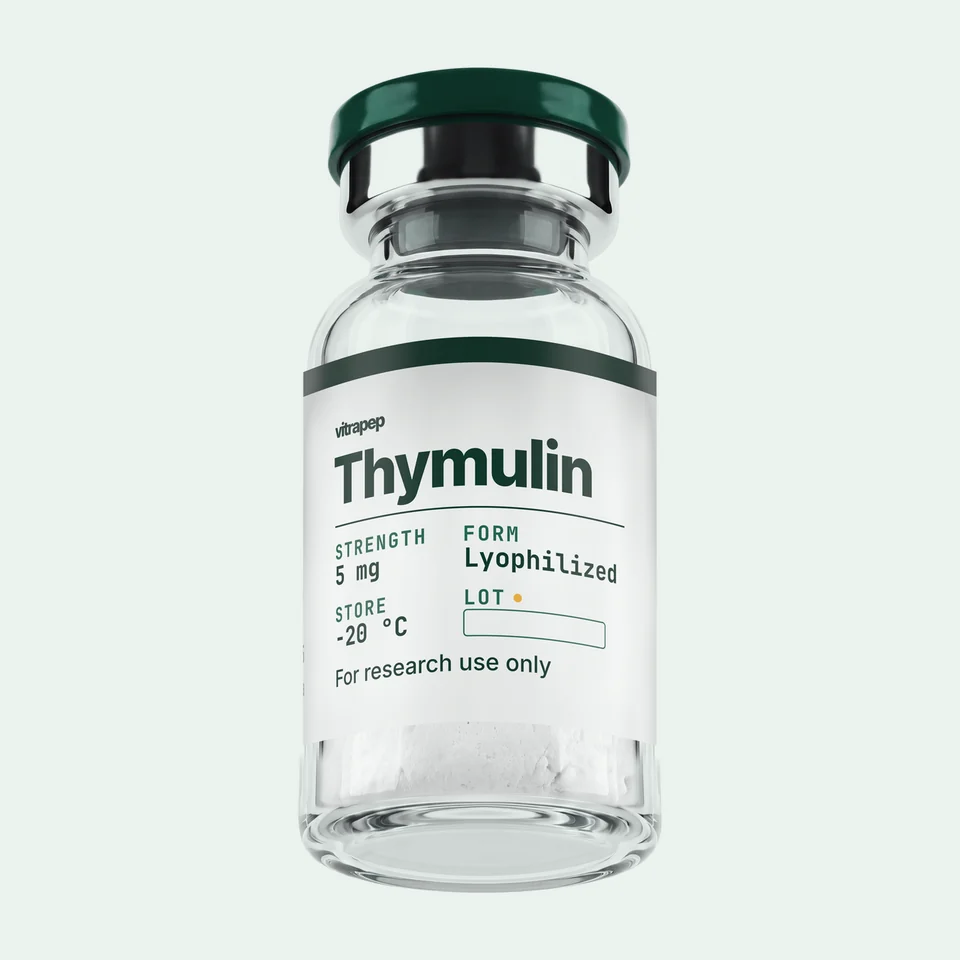
Thymulin
Specifications for the thymulin sold for laboratory research. COA available with each lot.
Frequently asked questions
What does thymulin do?
In lab and animal studies, it promotes T-cell markers on immature cells and lowers some inflammatory signals. Effects in people are not established.
Why does thymulin need zinc?
A 1982 study found that FTS without zinc was inactive in its standard assay. Zinc bound at a one-to-one ratio restored activity, and that zinc-bound form was named thymulin.
Is thymulin the same as thymalin?
No. Thymulin is a single nine-amino-acid peptide. Thymalin is a polypeptide extract of thymus.
Is thymulin FDA-approved?
No. No product containing it appears in Drugs@FDA. FDA lists thymulin acetate in category 3 of its 503A compounding nominations.
Has thymulin been tested in people?
Only in a few studies published from 1982 to 1989. They include a three-child case series, a four-patient report, two arthritis trials and a 40-patient multiple sclerosis trial. No trial is registered today.
Is thymulin banned in sport?
The WADA 2026 Prohibited List does not name it. Section S0 prohibits pharmacological substances not covered elsewhere and without current government approval for human therapeutic use.
Is there an approved dose of thymulin?
No. It is not an approved drug, so no FDA-reviewed dose exists. See why research peptides have no dose.
What to know now
- Thymulin is a nine-amino-acid thymus peptide that is active only when bound to zinc.
- Its blood activity falls with age and with mild zinc deficiency, based on bioassay studies.
- Human studies are few and date from the 1980s: an arthritis signal and a negative multiple sclerosis trial.
- It is not FDA-approved, and FDA lists thymulin acetate in 503A compounding category 3.
What we’re watching
- Whether other groups repeat the 2026 mouse findings on age-related inflammation and cancer immunotherapy.
- Any registered human trial of thymulin on ClinicalTrials.gov.
- Any change to the compounding category of thymulin acetate on FDA's 503A nominations list.