Thymosin beta-4 benefits are often described online with claims borrowed from animal studies or from the shorter TB-500 fragment. The human record is narrower: small safety studies and a few randomized trials in eye disease, skin ulcers and heart attack. Their main results were mixed.
Quick answer: Thymosin beta-4 is a naturally occurring peptide that regulates actin, a building block of the cell skeleton. Thymosin beta-4 is not approved by the FDA for any use. Benefits measured in people are limited to small, mixed or subgroup results, and WADA prohibits it in sport at all times.
What is thymosin beta-4 and how is it built?
Thymosin beta-4 is a chain of 43 amino acids whose first residue carries an acetyl group. Low, Hu and Goldstein reported its sequence in 1981, from peptide purified out of calf thymus [2]. It was one of several peptides in an extract called thymosin fraction 5 and was first studied as a possible thymic hormone [2].
A decade later, Safer and colleagues found that Fx, the peptide holding most unpolymerized actin in human platelets, had the same sequence [3]. FDA's 2026 review notes that many cell types make it and that it appears in blood, saliva, tears and wound fluid [4].
The human gene is TMSB4X, on the X chromosome (NCBI Gene). The peptide shares a name, but not a structure, with the subject of the thymosin alpha-1 complete guide. For background on amino acid chains, see what peptides are.
What is thymosin beta-4 and how is it built
| Property | Thymosin beta-4 |
|---|---|
| Class | Beta-thymosin; actin-sequestering peptide [3] |
| Length | 43 amino acids, acetylated at the N-terminus [2] |
| Sequence | Ac-SDKPDMAEIEKFDKSKLKKTETQEKNPLPSKETIEQEKQAGES [1] |
| Molecular formula | C212H350N56O78S (PubChem CID 16132341) [1] |
| Molecular weight | 4963 g/mol in PubChem; 4982 reported for the calf peptide in 1981 [1], [2] |
| CAS number and USAN | 77591-33-4; timbetasin [1] |
| Actin-binding region | LKKTET, within residues 17 to 23, which TB-500 copies [4] |
| Development codes | RGN-259, RGN-137 (RegeneRx, ReGenTree); NL005 (Beijing Northland Biotech) |
| FDA status | No approved product in Drugs@FDA on November 18, 2026 |
| WADA status | Prohibited at all times, section S2.3 [13] |
How is thymosin beta-4 different from TB-500?
FDA's 2026 review describes TB-500 as a synthetic N-acetylated heptapeptide, a chain of seven amino acids. It matches residues 17 through 23 (LKKTETQ) of full-length thymosin beta-4 [4]. FDA states that "thymosin beta-4 and TB-500 are not the same substance," although many websites use the names interchangeably [4].
This matters when reading evidence. The human trials below tested the full 43-residue peptide or a recombinant version. FDA found no articles in which TB-500 was given to humans [4]. FDA also notes that acetylation can change a peptide's lifespan, folding and binding [4]. The fragment has its own TB-500 complete guide.
How does thymosin beta-4 work?
Its best-established role is inside cells. Thymosin beta-4 binds single actin molecules, called G-actin, in a 1:1 complex and blocks them from joining filaments [3]. Actin filaments form much of the cell's internal skeleton, so this pool of free actin helps control cell shape and movement [3], [4].
Other activities come from laboratory and animal work. In a 1999 rat wound study, thymosin beta-4 increased re-epithelialization by 42% over saline at day 4 (Malinda et al., 1999).
In 2004, Bock-Marquette and colleagues found that thymosin beta-4 formed a complex with PINCH and integrin-linked kinase, activating the survival enzyme Akt [5]. After coronary artery ligation in mice, treatment improved early heart muscle cell survival and heart function [5]. Its first four residues also form Ac-SDKP, a peptide studied for antifibrotic effects in rats (Cavasin et al., 2004). None of these effects has been confirmed in people.
What is thymosin beta-4 being studied for?
ClinicalTrials.gov lists trials of full-length thymosin beta-4 in three areas, searched on November 18, 2026. Vitrapep's guide on how to find a peptide clinical trial explains registry statuses.
Eye disease. RGN-259 is an eye-drop formulation developed by ReGenTree. It was tested in dry eye in Phase 2, Phase 2/3 (NCT02597803) and two Phase 3 trials [9], [10]. In neurotrophic keratopathy, a corneal disease caused by nerve damage, SEER-1 was stopped early [11]. SEER-2 (NCT05555589) enrolled 70 adults and was completed on July 28, 2026, with no results posted.
Skin wounds. RegeneRx ran Phase 2 trials of a thymosin beta-4 gel in venous stasis ulcers, pressure ulcers and epidermolysis bullosa, a genetic blistering disease. The epidermolysis bullosa trial (NCT00311766) ended after 30 of 36 planned patients because too few were available.
Heart attack. Beijing Northland Biotech now develops NL005, a recombinant form [8]. Two Phase 2 trials in acute myocardial infarction are listed as completed (NCT05485818, NCT05984134). A Phase 2c trial (NCT07586865), first posted in May 2026, lists an estimated 189 patients.
What did the key thymosin beta-4 trials show?
ARISE-2 and ARISE-3 randomized 601 and 700 adults with dry eye to RGN-259 or placebo [9], [10]. Both measured changes in ocular discomfort and corneal staining, a dye test of surface damage, after a chamber challenge that provokes symptoms. Registry group means were nearly identical, and no statistical comparison is posted. An earlier Phase 2 trial in 72 adults also missed both primary endpoints (Sosne and Ousler, 2015).
SEER-1 enrolled 18 adults with neurotrophic keratopathy and persistent corneal defects [11]. Complete healing at four weeks occurred in 6 of 10 on RGN-259 and 1 of 8 on placebo (p = 0.0656). The authors, several employed by the sponsor or its parent company, called this a strong trend. It did not reach the usual 0.05 threshold.
NL005 in heart attack. Zhang and colleagues randomized 96 adults with ST-elevation myocardial infarction, all treated with a procedure to reopen the artery [7]. At 90 days, overall infarct size did not differ significantly from placebo. Among 43 patients whose treatment began earliest, infarcted areas were significantly smaller [7]. Subgroup results need confirmation.
Venous stasis ulcers. Guarnera and colleagues randomized 73 patients at eight European sites and judged safety comparable to placebo [12]. They suggested healing might be faster in some groups. The registry shows wound closure by day 84 in 12 of 55 on thymosin beta-4 and 4 of 17 on placebo (NCT00832091).
What did the key thymosin beta-4 trials show
| Trial | Population and size | Design | Main result | Evidence level |
|---|---|---|---|---|
| ARISE-2, NCT02974907 [9] | 601 adults with dry eye | Phase 3, placebo-controlled | Discomfort change 0.07 vs -0.04 at day 29; no test posted | Human randomized trial |
| ARISE-3, NCT03937882 [10] | 700 adults with dry eye | Phase 3, placebo-controlled | Staining change -0.41 vs -0.46; discomfort -0.4 vs -0.4 at day 15 | Human randomized trial |
| SEER-1, NCT02600429 [11] | 18 adults with neurotrophic keratopathy | Phase 3, stopped early for a business decision | Complete healing 6 of 10 vs 1 of 8 (p = 0.0656) | Human randomized trial, very small |
| Zhang et al., 2025 [7] | 96 adults with ST-elevation heart attack | Randomized, double-blind | No significant overall difference in infarct size; smaller in an early-treated subgroup | Human randomized trial, plus mouse studies |
| Guarnera et al., 2010 [12] | 73 adults with venous stasis ulcers | Phase 2, placebo-controlled | Wound closure 12 of 55 vs 4 of 17 by day 84 (registry) | Human randomized trial |
What side effects were reported in thymosin beta-4 trials?
No FDA label exists, so side-effect data come only from trial papers and registry postings. Registry tables list events by group without stating whether the drug caused them.
What side effects were reported in thymosin beta-4 trials
| Study | Participants | Serious adverse events | Other reported events |
|---|---|---|---|
| Ruff et al., 2010 [6] | 40 healthy volunteers, single-dose and two-week phases | None | Infrequent, mild or moderate |
| Wang et al., 2021 [8] | 84 healthy volunteers given NL005 | None | Mild to moderate |
| ARISE-2 [9] | 601 adults with dry eye | 3 of 299 on RGN-259; 2 of 302 on placebo | Eye pain 3 vs 1; reduced visual acuity 1 vs 10 |
| ARISE-3 [10] | 699 adults in the safety analysis | None in either group | Instillation-site pain 23 of 350 vs 16 of 349 |
| SEER-1 [11] | 18 adults with neurotrophic keratopathy | 1 of 10 (depression) vs 0 of 8 | Paper reports no significant adverse effects |
| Venous ulcer trial, NCT00832091 | 72 adults | 3 of 55 vs 1 of 17 | Paper reports safety comparable to placebo [12] |
These data have clear limits. Adverse events were collected for about four to six weeks in the eye trials [9], [10]. Most trials were too small to detect rare or delayed harms, and eye drops mainly reflect local exposure. None tested material sold for laboratory research. The TB-500 side effects page explains why these results cannot stand in for the fragment.
What is the regulatory status of thymosin beta-4?
Thymosin beta-4 is not approved by the FDA for any use. On November 18, 2026, an openFDA search of Drugs@FDA found no product with thymosin beta-4 or timbetasin as an active ingredient. Vitrapep keeps a list of FDA-approved peptide medicines.
FDA's July 23-24, 2026 Pharmacy Compounding Advisory Committee reviewed TB-500-related bulk drug substances, not full-length thymosin beta-4 (Federal Register notice). For TB-500, FDA said the evaluation criteria weigh against adding it to the 503A bulks list [4]. Because FDA treats the two as different substances, that review does not settle the full-length peptide's status.
A research-use-only label does not make a product an approved drug or make use in people legal or safe. See research peptides and human-use risks and why research peptides have no dose.
In sport, the WADA 2026 Prohibited List names "Thymosin-ß4 and its derivatives e.g. TB-500" under S2.3, growth factors and growth factor modulators [13]. Substances in S2 are prohibited at all times, in and out of competition [13].
What is still unknown about thymosin beta-4?
Efficacy in people is unsettled. The two largest trials posted similar results for RGN-259 and placebo [9], [10]. Favorable signals came from a very small trial or a subgroup [7], [11].
Long-term safety is unknown, since adverse-event collection lasted weeks or a few months [6], [9], [10].
Tumor biology is an open question. In 2003, Cha and colleagues engineered mouse melanoma cells to make extra thymosin beta-4 [14]. In mice, those cells formed larger tumors and about four times as many lung nodules as control cells. The authors proposed that thymosin beta-4 may promote metastasis through cell migration and blood vessel growth [14]. These animal and cell experiments do not show that thymosin beta-4 causes cancer in people.
Vitrapep research material
Vitrapep sells thymosin beta-4 for laboratory research use only. It is not for human or veterinary use.
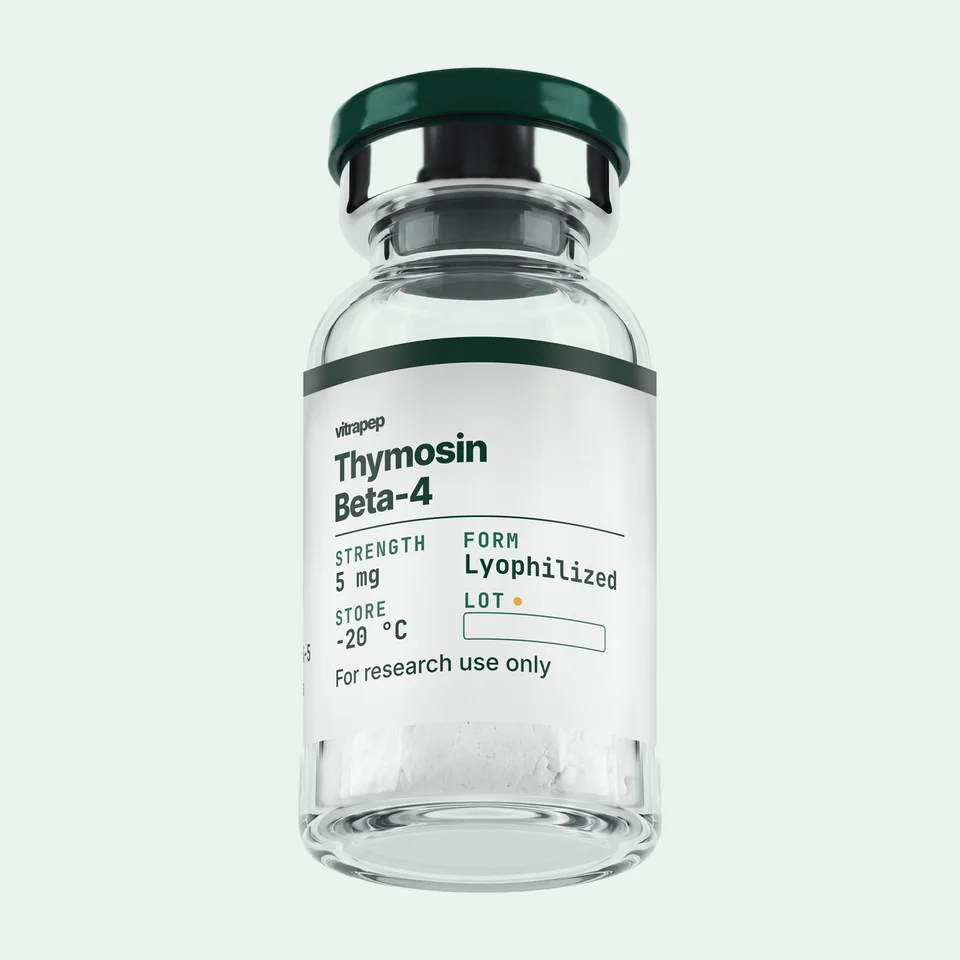
Thymosin beta-4
Specifications for the thymosin beta-4 sold for laboratory research. COA available with each lot.
Frequently asked questions
What are the benefits of thymosin beta-4?
Measured benefits in people are limited. A very small corneal trial showed a healing trend, and a heart attack trial found smaller damage only in a subgroup. The largest dry-eye trials posted results similar to placebo.
Is thymosin beta-4 the same as TB-500?
No. FDA describes TB-500 as a synthetic copy of residues 17 to 23 and says the two are not the same substance. Evidence for one cannot be assumed to apply to the other.
Is thymosin beta-4 FDA-approved?
No. No product containing it is approved, and none appears in Drugs@FDA. The eye and heart versions remain investigational.
Is thymosin beta-4 a peptide or a protein?
FDA's 2026 review calls it a peptide, while some papers call it a protein. It has 43 amino acids and a molecular weight of 4963 g/mol in PubChem.
What side effects were reported in thymosin beta-4 trials?
Phase 1 studies in healthy volunteers reported mild or moderate events and no serious ones. In the eye trials, instillation-site pain and eye pain occurred in both groups. No long-term safety data exist.
Is thymosin beta-4 banned in sport?
Yes. The WADA 2026 Prohibited List names thymosin-ß4 and its derivatives under section S2.3. Substances in that section are prohibited at all times.
Is there an approved dose of thymosin beta-4?
No. It is not an approved drug, so no FDA-reviewed dose exists.
What to know now
- Thymosin beta-4 is a natural 43-residue actin-binding peptide; TB-500 is a separate seven-residue fragment.
- Its tissue-repair effects come mostly from animal and cell studies.
- Phase 3 dry-eye trials posted near-identical results to placebo; smaller corneal and heart trials showed signals that need confirmation.
- No product is FDA-approved, and WADA prohibits it at all times.
What we’re watching
- Posted results from SEER-2 (NCT05555589) in neurotrophic keratopathy.
- Recruitment and results for the NL005 Phase 2c heart attack trial (NCT07586865).
- Any FDA review of full-length thymosin beta-4, which the July 2026 compounding review did not cover.