TB 500 side effects are often described online without a clear distinction between TB-500 and full-length thymosin beta-4. These are not the same substance. Evidence from full-length thymosin beta-4 cannot establish the safety of the TB-500 fragment.
Quick answer: There is not enough human evidence to define TB-500 side effects. FDA has not identified human exposure data for drug products containing the TB-500 fragment. Its safety assessment highlights potential immune reactions and product-quality concerns.
What is known about TB-500 side effects?
The available evidence does not establish a reliable list of TB-500 side effects in humans. FDA states that it has not identified human exposure data for drug products containing thymosin beta-4 fragment LKKTETQ.
This is different from saying that TB-500 has no side effects. It means the agency does not have the human exposure information needed to characterize them.
Online claims that assign specific symptoms to TB-500 should be checked against direct human evidence. Findings from other molecules should not be presented as TB-500 findings.
What safety concerns has the FDA identified?
FDA says compounded drugs containing TB-500 may pose a risk of immunogenicity for certain routes of administration. The agency cites potential aggregation and peptide-related impurities.
FDA also says it lacks important information about safety issues raised by the fragment. This includes whether it would cause harm when administered to humans.
The July 2026 FDA briefing materials discuss TB-500-related bulk drug substances. They describe the absence of identified human exposure data and concerns about immunogenicity. Read the FDA briefing package.
What else does the FDA TB-500 briefing document report?
FDA’s separate written review of TB-500, dated May 15, 2026, covers both the free base and the acetate form. Read the TB-500 briefing document.
FDA searched its adverse event reporting system, FAERS, through March 26, 2025. The search retrieved no reports, and FDA’s literature search found no adverse event cases. FDA notes that FAERS reporting is voluntary, so the result is not proof of safety.
A separate search of FDA’s complaint system for foods, supplements and cosmetics covered January 2004 to March 2025. It found two reports about “blended TB-500 and BPC-157,” but neither included a safety assessment.
FDA did not identify any acute, repeat-dose, genotoxicity, reproductive or carcinogenicity studies of either form. It also found no human studies of how the body absorbs, processes or responds to TB-500.
In horses, TB-500 reached the bloodstream and fell below measurable levels within 10 hours. Horse and rat studies show it is broken down into shorter peptides. Apart from one metabolite that showed activity in a cell assay, FDA says the pharmacology of these breakdown products is unknown.
FDA also flags an identity problem. TB-500 is a common name, not an official drug name, and FDA has seen different salts and derivatives sold under it. FDA calls this a safety risk because a patient could receive a different substance than prescribed.
FDA adds that data on the LKKTETQ sequence without its acetyl group cannot be applied directly to TB-500. Acetylation can change a peptide’s lifespan, folding and binding properties.
FDA proposed that neither form be added to the 503A bulks list. The agency says it will not make a final determination until it has considered the advisory committee’s input.
Is TB-500 the same as full-length thymosin beta-4?
No. TB-500 is commonly used to refer to the seven-amino-acid fragment LKKTETQ. Full-length thymosin beta-4 is a much larger naturally occurring peptide.
The distinction is important when reading safety research. Human studies of full-length thymosin beta-4 do not establish the safety of the shorter TB-500 fragment.
A first-in-human study of recombinant human thymosin beta-4 reported mild-to-moderate adverse events and no serious adverse events in its study population. That research evaluated a different substance. It should not be used as proof of TB-500 safety. Read the thymosin beta-4 study.
What did trials of full-length thymosin beta-4 report?
The largest human safety datasets in this peptide family come from full-length thymosin beta-4, not the TB-500 fragment. Most come from short trials of RGN-259, an eye-drop formulation, in dry eye and neurotrophic keratopathy. Neurotrophic keratopathy is a corneal condition tied to nerve damage. A small Phase 1 study also tested a systemic form in healthy volunteers.
Which human safety data exist for thymosin beta-4 and TB-500
| Study | Molecule | Population and size | Reported adverse events | Relevance to the TB-500 fragment |
|---|---|---|---|---|
| Ruff et al., 2010 (Phase 1) | Full-length thymosin beta-4, synthetic, systemic | 40 healthy volunteers in four cohorts; single-dose and two-week phases | Infrequent, mild or moderate events; no serious events or dose-limiting toxicities | Different molecule; small, short study |
| ARISE-2, NCT02974907 (Phase 3) | Full-length thymosin beta-4 eye drops (RGN-259) | 601 adults with dry eye; events collected for about 6 weeks | Serious events: 3 of 299 on RGN-259 and 2 of 302 on placebo. Eye pain: 3 vs. 1 | Local eye exposure; different molecule |
| ARISE-3, NCT03937882 (Phase 3) | Full-length thymosin beta-4 eye drops (RGN-259) | 700 adults with dry eye, 699 in the safety analysis; about 4 weeks | No serious events in either group. Instillation-site pain: 23 of 350 vs. 16 of 349 on placebo | Local eye exposure; different molecule |
| SEER-1, NCT02600429 (Phase 3, stopped early) | Full-length thymosin beta-4 eye drops (RGN-259) | 18 adults with neurotrophic keratopathy; about 6 weeks | Paper: no significant adverse effects. Registry: one serious event (depression) among 10 on RGN-259 | Very small; local eye exposure |
| FDA briefing document, 2026 | TB-500 fragment | No clinical studies or human exposure data identified | FAERS: no reports. Complaint system: two reports without safety assessments | Direct, but documents a data gap |
| NCT07487363 (Phase 1/2) | TB-500 fragment | Estimated 80 adults with stable ASCVD; recruiting | No results posted | Direct; results pending |
Serious events in these trials were uncommon and similar in number between groups. SEER-1 was stopped early for a business decision, and its paper reported no significant adverse effects. Read the SEER-1 paper.
These results describe a different, larger molecule, mostly used on the eye for a few weeks. They cannot show how the TB-500 fragment behaves elsewhere in the body.
Does the TB-500 research include human clinical trials?
A registered Phase 1/2 study is listed for TB-500 fragment in people with stable atherosclerotic cardiovascular disease. The trial registry should be checked for current status and posted results.
A registered study does not mean safety or effectiveness has been demonstrated. Results must be reported and evaluated before conclusions can be drawn.
The study is ClinicalTrials.gov record NCT07487363.
As of November 18, 2026, the registry lists the study as recruiting, with an estimated 80 adults aged 40 to 75. Its primary outcomes are treatment-emergent adverse events over 12 weeks and serious adverse events over 28 days. No results are posted. Vitrapep’s guide on how to find a peptide clinical trial explains what registry statuses such as recruiting mean.
What is the difference between immunogenicity and toxicity?
Immunogenicity describes the potential to trigger an immune response. Toxicity refers to harmful effects caused by a substance or exposure.
They are related safety considerations but are not interchangeable. A peptide may raise immunogenicity concerns even when direct human toxicity data are unavailable.
FDA's TB-500 assessment focuses on the lack of human exposure data and potential immunogenicity concerns. It does not provide a complete clinical adverse-event profile.
FDA’s TB-500 briefing says the consequences of an immune response can range from antibodies with no apparent clinical signs to life-threatening reactions. Neutralizing antibodies may also reduce a drug’s effect or act against the body’s own matching peptide. FDA did not identify clinical studies of immunogenicity or aggregation for TB-500.
Is TB-500 FDA-approved?
The FDA sources cited here do not identify TB-500 as an FDA-approved medicine. FDA's review of bulk drug substances for compounding is separate from drug approval.
A research-use-only label does not establish that a product is approved for human use. FDA's safety concerns also include the characterization and quality of peptide substances.
TB-500 is also banned in sport. The World Anti-Doping Agency’s 2026 Prohibited List names thymosin beta-4 and its derivatives, with TB-500 as an example, under section S2.3. Substances in section S2 are prohibited at all times. See the WADA Prohibited List.
In 2013, WADA approved a Ghent University project on TB-500 metabolism and detection. In human liver preparations and plasma or serum, TB-500 was cut step by step from one end. Its acetyl group appeared to protect the other end. The team made reference standards for three metabolites and shared them with doping control labs. Read the WADA project summary.
For broader context, see research peptides and human-use risks.
What is still unknown about TB-500 safety?
FDA identified no human safety data for the TB-500 fragment, short or long term. The eye-drop trials of full-length thymosin beta-4 in Table 1 collected adverse events for about four to six weeks. Results from NCT07487363 may add controlled safety data for the fragment itself.
Researchers have also raised open questions about thymosin beta-4 in tumor biology. A 2013 review describes beta-thymosins, including thymosin beta-4, as involved in normal cell migration and in tumor metastasis. It notes that the mechanisms are not fully understood. Read the review.
In a 2003 mouse study, melanoma cells engineered to make extra thymosin beta-4 formed larger tumors and more lung metastases. Tumors from those cells also had more blood vessels. The authors proposed that thymosin beta-4 may promote metastasis through cell migration and blood vessel growth. Read the mouse study.
These findings concern full-length thymosin beta-4 made inside cells, studied in laboratory and animal models. They do not show that TB-500 causes cancer. FDA also identified no carcinogenicity studies of the fragment, so the question remains open.
For more background, see Vitrapep’s TB-500 complete guide, TB-500 research summary, BPC-157 vs TB-500 comparison and BPC-157 side effects.
Vitrapep research material
Vitrapep sells TB-500 for laboratory research use only. It is not for human or veterinary use.
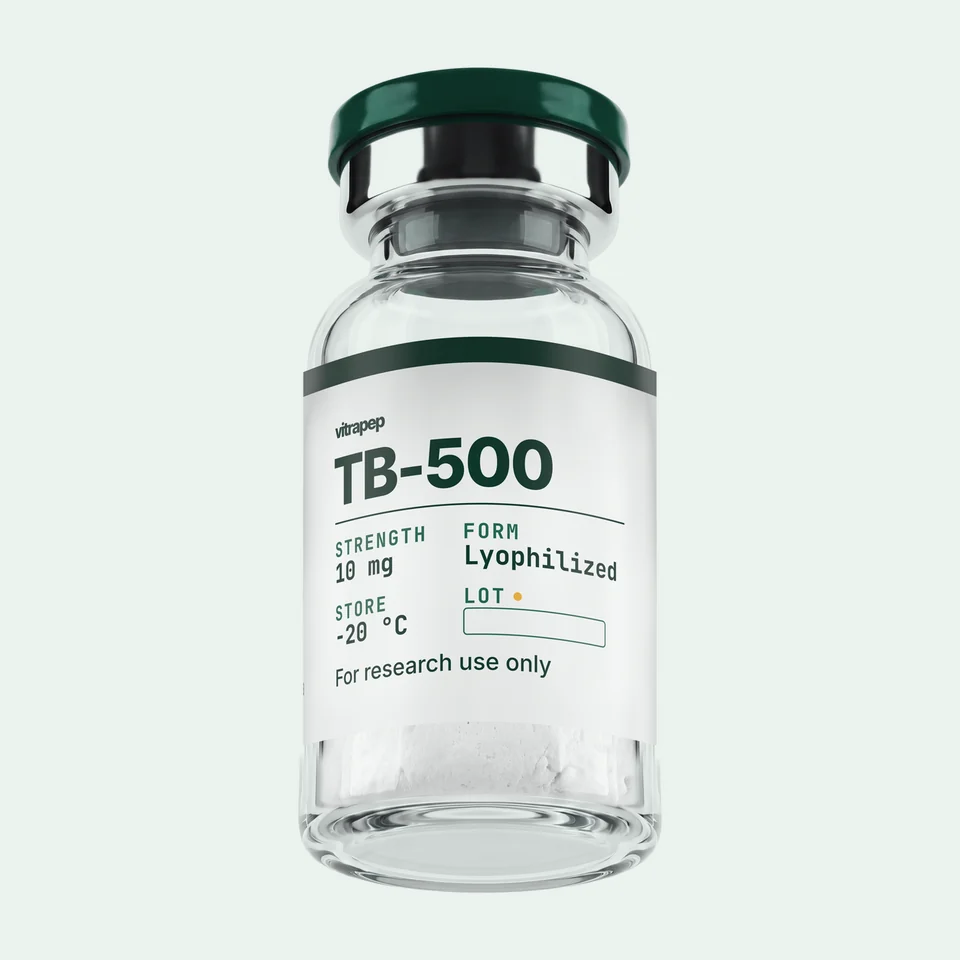
TB-500
Specifications for the TB-500 sold for laboratory research. COA available with each lot.
Frequently asked questions
What are the known TB-500 side effects?
A reliable human side-effect profile has not been established. FDA says it has not identified human exposure data for drug products containing the TB-500 fragment.
Has TB-500 been tested in humans?
A registered Phase 1/2 study is listed on ClinicalTrials.gov. Registration alone does not establish completed testing or demonstrated safety.
Is TB-500 the same as thymosin beta-4?
No. TB-500 is commonly identified as a seven-amino-acid fragment of thymosin beta-4. Evidence for full-length thymosin beta-4 cannot be assumed to apply to TB-500.
What does FDA say about TB-500 safety?
FDA highlights potential immunogenicity risks, aggregation and peptide-related impurities. It also states that it has not identified human exposure data for drug products containing the fragment.
Does TB-500 have FDA approval?
The cited FDA materials do not identify TB-500 as an FDA-approved medicine.
Do thymosin beta-4 eye-drop trials show that TB-500 is safe?
No. Those trials tested full-length thymosin beta-4 as eye drops, mostly for a few weeks. They cannot establish the safety of the TB-500 fragment.
Is TB-500 banned in sport?
Yes. WADA’s 2026 Prohibited List names TB-500 as an example of thymosin beta-4 derivatives under section S2.3. Substances in that section are prohibited at all times.
Has TB-500 been tested for cancer risk?
FDA did not identify any carcinogenicity studies of TB-500. Lab and animal research on full-length thymosin beta-4 raises open questions about tumor cell migration, but it does not show that TB-500 causes cancer.
What to know now
- TB-500 and full-length thymosin beta-4 are different substances.
- FDA has not identified human exposure data for drug products containing the TB-500 fragment.
- Potential immunogenicity, aggregation and peptide-related impurities are key safety concerns.
- The largest human safety datasets come from short eye-drop trials of full-length thymosin beta-4, not TB-500.
What we’re watching
- Results from the registered TB-500 Phase 1/2 study, NCT07487363.
- Further FDA evaluations of TB-500-related bulk drug substances.
- Research that directly evaluates the fragment rather than full-length thymosin beta-4.
- Any long-term or carcinogenicity data for the TB-500 fragment.