TB 500 price searches return listings that do not always describe the same substance. FDA describes TB-500 as a seven-amino-acid fragment of thymosin beta-4. Many listings sold under the TB-500 name describe the full 43-residue protein instead. This page sets out what ten listings showed on November 18, 2026, and what each said was in the vial.
Quick answer: There is no FDA-approved TB-500 and no list price for one. Research listings named TB-500 priced 10 mg vials from $25.00 to $140.00 on November 18, 2026. They did not all describe the same molecule, so their prices are not directly comparable.
Why does a TB-500 price depend on which molecule is in the vial?
FDA's 2026 review describes TB-500 as a synthetic fragment of thymosin beta-4, amino acids 17 to 23, with an acetyl group on the first residue (FDA briefing, 2026). Its sequence is Ac-Leu-Lys-Lys-Thr-Glu-Thr-Gln, written Ac-LKKTETQ. FDA notes that TB-500 is a common name, not a United States Adopted Name. The agency says it has encountered "multiple salts, and derivatives, including different active moieties, sold commercially under the same common name."
Full-length thymosin beta-4 is a different substance. Its 43-residue sequence was reported in 1981 from calf thymus, with an acetyl group blocking the N-terminus (Low et al., 1981). PubChem lists it under the US adopted name timbetasin (PubChem CID 16132341). Websites often use the two names interchangeably. FDA's review states plainly that "thymosin beta-4 and TB-500 are not the same substance."
The fragment's tie to the TB-500 name comes from doping-control chemistry. In 2012, a Ghent University laboratory identified Ac-LKKTETQ in a product sold as TB-500 (Esposito et al., 2012). The same year, a Hong Kong racing laboratory described TB-500 as a veterinary preparation whose key ingredient is N-acetylated LKKTETQ (Ho et al., 2012).
Why does a TB-500 price depend on which molecule is in the vial
| Property | TB-500 (fragment) | Thymosin beta-4 (full length) |
|---|---|---|
| Length | 7 amino acids, residues 17 to 23 of thymosin beta-4 | 43 amino acids |
| Sequence | Ac-LKKTETQ | Acetylated 43-residue chain containing LKKTETQ at positions 17 to 23 |
| Molecular formula | C38H68N10O14 | C212H350N56O78S |
| Molecular weight | 889.0 g/mol (acetate salt 949.1 g/mol) | 4,963 g/mol |
| CAS number | 885340-08-9 (free base) | 77591-33-4 |
| PubChem CID | 62707662 | 16132341 |
| Official name | None; FDA calls TB-500 a common name | Timbetasin (USAN) |
| FDA-approved drug | None | None |
| WADA 2026 list | Section S2.3, prohibited at all times | Section S2.3, prohibited at all times |
Sources: FDA briefing (2026), PubChem, Low et al. (1981) and the WADA Prohibited List 2026.
Is there an approved TB-500 medicine with a published price?
No. FDA's briefing states that neither TB-500 free base nor TB-500 acetate is a component of an FDA-approved drug. A search of openFDA's Drugs@FDA data on November 18, 2026, found no application for thymosin beta-4, timbetasin or TB-500. With no approved product, there is no manufacturer list price or pharmacy price to report.
FDA reviewed TB-500 for a different list: bulk substances that 503A pharmacies may use in compounding. The nomination was withdrawn, and FDA evaluated both forms on its own initiative. It proposed adding neither, citing poor characterization, no compounding history and no data on use in humans. The Pharmacy Compounding Advisory Committee discussed TB-500 on July 23, 2026 (91 FR 20465). We found no final FDA determination as of November 18, 2026.
FDA's page of bulk substances that may present significant safety risks lists "Thymosin beta-4, fragment (LKKTETQ), also known as TB-500" among withdrawn nominations. It says FDA "has not identified any human exposure data" for drug products containing the fragment. The briefing adds that no TB-500 product is approved in Canada, Australia, the United Kingdom or seven other European countries checked, or by the European Medicines Agency.
One registered trial is testing the fragment. ClinicalTrials.gov lists NCT07487363 as a recruiting Phase 1/2 study in an estimated 80 adults with stable atherosclerotic cardiovascular disease. No results were posted on November 18, 2026. A registered trial does not create an approved product or a retail price; see how to find a peptide clinical trial.
What did TB-500 listings cost on November 18, 2026?
We read TB-500 product pages at 11 online research-peptide suppliers that list prices in US dollars. One was out of stock with no price shown. For the other ten, we recorded the listed single-vial price and what the page said was in the vial. Prices exclude shipping and codes, and other sellers are not named.
What did TB-500 listings cost on November 18, 2026
| Listing | Name on the page | What the page says is in the vial | Vial size | Listed price |
|---|---|---|---|---|
| A | TB-500 (Thymosin Beta-4) | Full length: 43-residue sequence, C212H350N56O78S, 4,963 g/mol | 10 mg | $124.00 |
| B | TB-500 (Thymosin Beta 4) | Full length: 43 amino acids, 4,963 g/mol | 5 mg; 10 mg | $78.00; $140.00 |
| C | TB-500 | Full length: CAS 77591-33-4, 4,963.4 Da | 10 mg | $25.00 |
| D | Thymosin Beta-4 (TB-500) | Full length; states it is not the Ac-LKKTETQ fragment | 10 mg | $67.95 |
| E | TB-500 Fragment (17-23) | Fragment: Ac-LKKTETQ, 889.02 g/mol, CAS 885340-08-9 | 5 mg; 10 mg | $21.76; $53.86 (sale) |
| F | Tb-500 | Called a fragment; no sequence, formula or weight given | 10 mg | $65.00 |
| G | TB-500 | Conflicting: fragment data in one block, full-length formula and 4,963.4 g/mol in another | 10 mg | $100.00 |
| H | TB-500 (Thymosin Beta-4 Fragment) | Conflicting: called a fragment and a 43-amino-acid peptide, with the full-length CAS number | 5 mg; 10 mg | $44.99; $79.99 |
| I | TB-500 | Conflicting: full-length formula and CAS number, but a sequence that departs from thymosin beta-4 after residue 28 | 5 mg | $44.99 |
| J | TB-500 | Not stated on the page | 10 mg | $49.99 |
| Vitrapep | TB-500 | Fragment: Ac-LKKTETQ, C38H68N10O14, 889.0 g/mol | 10 mg | $74.99 |
Sources: supplier product pages and the Vitrapep catalog, read November 18, 2026. Listing E showed struck-through regular prices of $48.95 and $96.95. Listing I also gave a PubChem ID that belongs to an unrelated compound. The seller behind listing H separately listed "TB-4," described as full-length thymosin beta-4, at $89.99 for 10 mg.
Three patterns stand out. First, one name covered two molecules, and only one listing described the fragment with matching sequence, formula and weight. Second, three listings mixed values for the two molecules on one page. Third, prices spread widely within one molecule: the four full-length listings priced 10 mg from $25.00 to $140.00.
FDA's own web search, reported in its 2026 briefing, found TB-500 sold online in 2, 3, 5, 10 and 15 mg sizes, labeled for research use only. FDA also noted that several supplier sites used the free-base CAS number for the acetate salt. Vitrapep's peptide price list keeps the fragment and thymosin beta-4 in separate rows for this reason.
Why can't fragment and full-length prices be compared per mg?
Price per mg only works when every vial holds the same substance. TB-500 listings fail that test. The fragment weighs 889.0 g/mol and full-length thymosin beta-4 about 4,963 g/mol. A milligram of each holds a different number of molecules, with a different structure.
The two also differ in what has been studied. Much of the published research used the full-length protein. FDA identified no clinical studies of TB-500 in humans; the TB-500 side effects page covers that gap. A cheaper milligram of one molecule is not a cheaper milligram of the other.
Salt form adds a further layer. FDA lists TB-500 free base at 889.01 g/mol and the acetate at 949.1 g/mol, and treats them as distinct bulk substances. A listing that does not say which form it sells leaves its milligram figure open to interpretation.
What drives the spread in TB-500 prices?
Vitrapep's peptide prices explainer covers these levers in general. For TB-500:
- Chain length. In solid-phase synthesis, each amino acid is added in its own coupling step, as FDA's briefing describes for TB-500. Made this way, a 43-residue chain needs 36 more coupling steps than a 7-residue chain. FDA notes that incomplete couplings and truncations create related impurities that are similar in structure and hard to identify.
- Acetylation and salt form. Both molecules carry an N-terminal acetyl group. For the fragment, FDA describes acetylation as a separate synthesis step. Free base and acetate salt are different materials with different weights.
- Testing per lot. FDA's example certificate for TB-500 free base reported appearance, LC-MS identity and HPLC purity only. It did not cover assay, impurities, bacterial endotoxins or aggregates. Each added test is a cost some listings carry and others do not.
- Vial size. Filling, sealing and lot testing cost about the same per vial, so a larger vial spreads them over more milligrams.
- Promotions. Listing E's sale prices were 44 to 56 percent below its struck-through prices. Other listings used first-order codes and quantity tiers.
What should a listing show before its price can be judged?
- The molecule by name and sequence. A fragment listing should give Ac-LKKTETQ. A full-length listing should name thymosin beta-4 and give all 43 residues.
- A matching molecular weight and CAS number. The fragment free base is 889.0 g/mol, CAS 885340-08-9. Thymosin beta-4 is about 4,963 g/mol, CAS 77591-33-4. Listings G, H and I mixed these values.
- Mass spectrometry on a lot-specific certificate. The two weights differ more than fivefold, so a mass result separates them. The 2012 Ghent study used high-resolution mass spectrometry to find Ac-LKKTETQ in a TB-500 product. See LC-MS identity testing.
- Tests beyond purity. FDA flagged missing assay, impurity, endotoxin and aggregate data in public TB-500 certificates.
- No human-use language. FDA found TB-500 marketed online for many conditions, and one site with administration instructions. A research listing should carry neither; see research peptides and human-use risks.
What does Vitrapep charge for TB-500?
Vitrapep lists TB-500 as a 10 mg lyophilized vial at $74.99, or $7.50 per mg of the fragment. Its product page gives the sequence Ac-LKKTETQ, the formula C38H68N10O14 and a molecular weight of 889.0 g/mol. Each lot's certificate reports LC-MS identity, HPLC purity, net content and endotoxin. Any two vials save 20%, and three or more save 25%. Store prices may still change before launch.
Among fragment listings, $74.99 falls between listing E's sale and regular 10 mg prices. It is not comparable per mg with the full-length listings in Table 2. Vitrapep sells full-length thymosin beta-4 as a separate product. The TB-500 complete guide covers the research behind both.
Vitrapep research material
Vitrapep sells TB-500 for laboratory research use only. It is not for human or veterinary use.
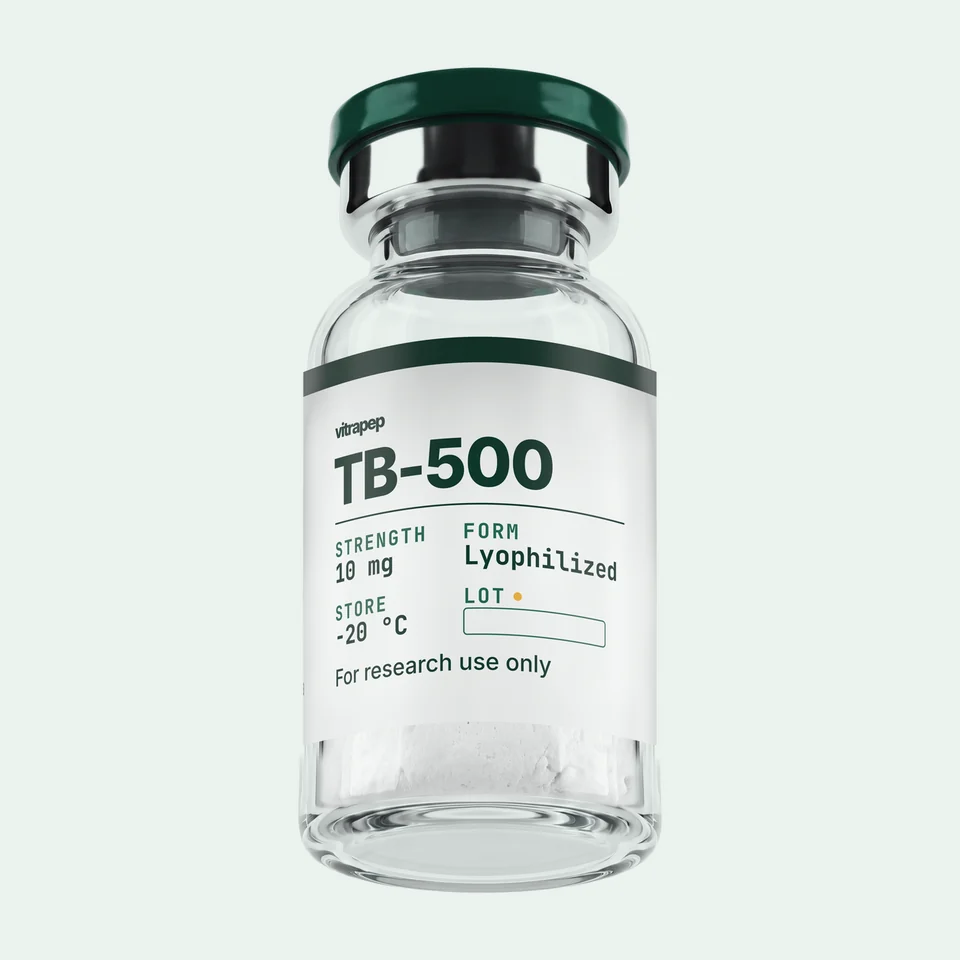
TB-500
Specifications for the TB-500 sold for laboratory research. COA available with each lot.
Frequently asked questions
How much does TB-500 cost?
Research listings named TB-500 priced 10 mg vials from $25.00 to $140.00 on November 18, 2026. Those listings described different molecules, so the range mixes unlike products. No approved TB-500 product exists to carry a prescription price.
Is TB-500 the same as thymosin beta-4?
No. FDA describes TB-500 as the acetylated seven-residue fragment Ac-LKKTETQ, residues 17 to 23 of thymosin beta-4. Full-length thymosin beta-4 has 43 residues, and FDA states they are not the same substance.
Why are some TB-500 listings much cheaper than others?
Listings differ in which molecule they describe, salt form, vial size, testing and promotions. A low price alone does not show which of these explains it.
Can fragment and full-length TB-500 prices be compared per mg?
No. They are different substances with different molecular weights. Per-mg comparisons only work within one molecule and one salt form.
Is there a prescription or FDA-approved TB-500?
No. FDA says TB-500 is not a component of any FDA-approved drug. In 2026 it proposed not adding TB-500 to the 503A compounding bulks list, and we found no final decision as of November 18, 2026.
Does a research-use-only label make TB-500 legal for human use?
No. The label describes a product sold for laboratory work. It does not make a product approved, legal or safe for people; see what research use only means.
Is TB-500 banned in sport?
Yes. WADA's 2026 Prohibited List names thymosin beta-4 and its derivatives, with TB-500 as the example, under section S2.3. That section is prohibited at all times.
What to know now
- TB-500 has no FDA-approved form, so it has no list or pharmacy price.
- FDA describes TB-500 as the fragment Ac-LKKTETQ; full-length thymosin beta-4 has 43 residues.
- On November 18, 2026, 10 mg vials named TB-500 listed at $25.00 to $140.00.
- Only one of ten listings described the fragment consistently. Vitrapep lists it at $74.99 for 10 mg.
What we’re watching
- FDA's final decision on TB-500 free base and acetate for the 503A bulks list.
- Results from NCT07487363, the registered Phase 1/2 trial of the fragment.
- Naming on listings, where one name still covers two molecules.
- Price changes, which we will re-check and date.