KPV is the smallest peptide you’ll ever buy: three amino acids, 342 daltons, the tail end of a natural anti-inflammatory hormone. Where to buy KPV in 2026 turns on two questions you can answer in 30 seconds with a Certificate of Analysis: did your supplier ship Lys-Pro-Val and only Lys-Pro-Val, and does the form you got match the form the published research used? We’ll walk you through both checks.
Get new research first
Research updatesOne short email when new peptide research drops or a new lab-verified batch lands — written from primary sources, no filler.
You’re on the list — check your inbox for a confirmation.
Could not save your email. Try again in a moment.
The 60-second answer: Buy from a research-supply vendor. Get a third-party CoA showing HPLC purity ≥98%, mass-spec at 342.4 g/mol, and the sequence Lys-Pro-Val (nothing more). On November 17, 2026, US research suppliers listed it at $20.00–$39.00 per vial.
Your three channels, and what each one gets you
KPV has the quietest regulatory profile of any peptide in this guide. No FDA approval. No scheduled status. No WADA listing. So how do you actually buy it? Three channels exist:
- Doctor’s prescription: Not available. KPV isn’t an FDA-approved drug. No physician can write a normal prescription.
- Compounding pharmacy: Unusual. Some compounding pharmacies will prepare KPV with a prescription. The FDA hasn’t formally evaluated it under the 503A bulk-drug-substances framework, so the status is ambiguous and can change.
- Research-supply vendor: The standard channel. Lyophilized powder sold under Research Use Only labeling. No prescription needed.
What the research-supply channel doesn’t give you: No physician oversight. No prescribed dose. No FDA-regulated batch testing. No human trial safety data — zero KPV randomized controlled trials in humans have been published. You’re also unlikely to find a properly delivery-engineered oral formulation. Vendors ship the bare lyophilized peptide.
What you’re actually buying
KPV is the simplest peptide in this library. Sequence: Lys-Pro-Val. Three residues. No modifications. No conjugation. Molecular formula C16H30N4O4. Mass 342.4 g/mol.
The biology is what makes a three-residue peptide interesting. KPV is the C-terminus (the tail end) of a natural hormone called α-MSH. α-MSH engages five receptors (MC1R through MC5R) that drive pigmentation, appetite, and inflammation.
The truncation matters. KPV keeps most of the anti-inflammatory activity of the full hormone while losing the receptor engagement that drives pigmentation and cardiovascular effects (Gravina et al., 2023).
The smallness is also why oral delivery is on the table. Most peptide drugs (insulin, GLP-1 drugs, even the 15-residue BPC-157) get destroyed by stomach acid and gut enzymes. A tripeptide is small enough to ride a built-in transporter (PepT1) in the gut wall. That was the basis for the foundational 2008 Dalmasso paper showing oral KPV nanoparticles reduced colitis in mice (Dalmasso et al., 2008).
“
PepT1-mediated tripeptide KPV uptake reduces intestinal inflammation.
— Dalmasso et al., Gastroenterology, 2008
The four checks that matter for KPV
The standard eight vendor criteria apply. Four are sharper here.
1. Sequence: Lys-Pro-Val, nothing else
The CoA identity line should read L-Lysyl-L-Prolyl-L-Valine or H-Lys-Pro-Val-OH. Mass-spec at 342.4 g/mol confirms the sequence.
Watch for vendors marketing longer α-MSH fragments under the KPV brand: the 4-residue HFRW core, the 7-residue Ac-EHFRWGK, or the full 13-residue α-MSH. These are different molecules with different receptor effects. If the CoA doesn’t say Lys-Pro-Val, you’re not buying KPV.
2. Mass-spec at 343.4 [M+H]+
The theoretical free-peptide mass is 342.4 g/mol. The mass-spec peak should land at 343.4 (within 0.5 Da). A higher mass means a longer peptide, a modified variant, or extra counterion. For a peptide this small, the mass-spec check is the single most direct identity confirmation.
3. Form: injectable lyophilized, not capsules
This is where KPV diverges from most peptides in this series. The published IBD evidence uses delivery-engineered formulations — pH-sensitive nanoparticles and hydrogels — not bare capsules.
The 2021 Sun paper used a special crosslinked hydrogel for rectal delivery in a colitis rat model (Sun et al., 2021). Research vendors stock KPV as lyophilized powder. Over-the-counter “oral KPV capsules” without a delivery system don’t match anything in the published literature.
4. Pricing: three residues should be cheap
Three-residue synthesis is among the cheapest peptide production. On November 17, 2026, US research suppliers listed KPV at $2.00–$9.75 per mg. Above $100 per 10 mg is retail markup. A price far below the market can mean skipped HPLC purification and crude tripeptide with synthesis impurities.
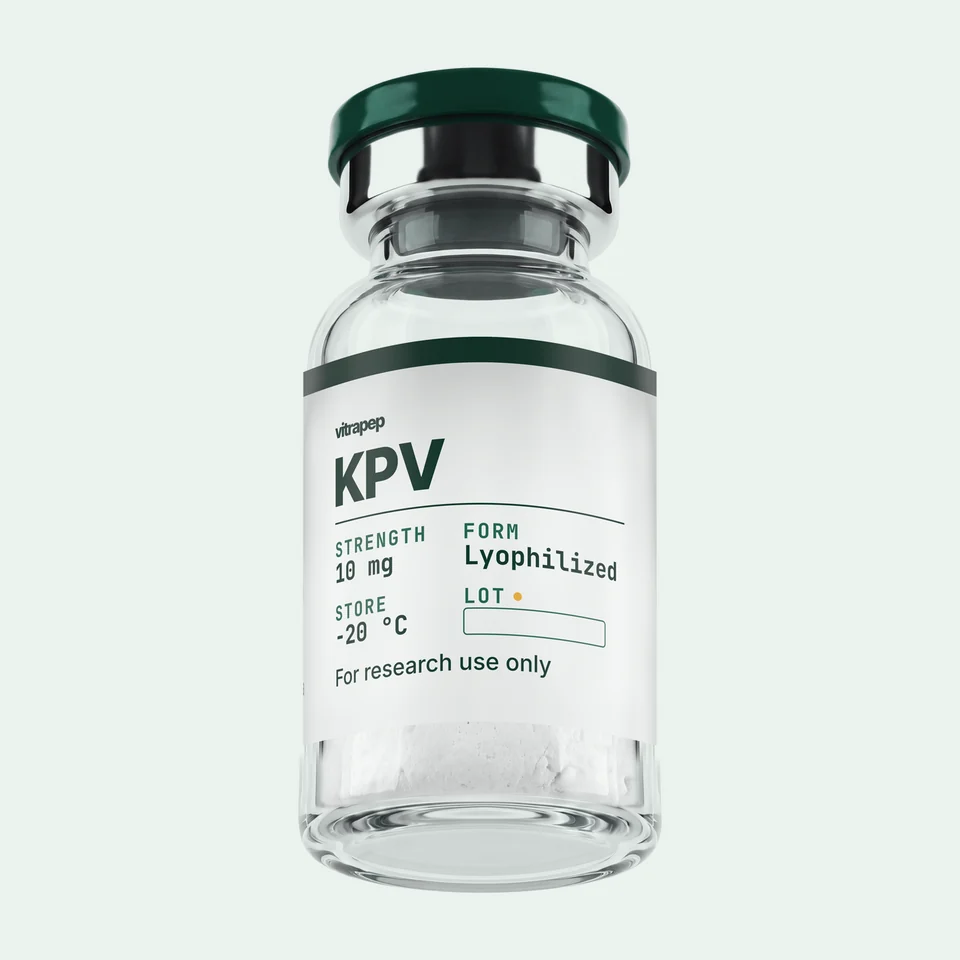
KPV
The same Lys-Pro-Val tripeptide cited across the 2008 Dalmasso oral-nanoparticle work, the 2021 Sun hydrogel study, and the 2023 Gravina melanocortin-system IBD review. Mass-spec at 342.4 g/mol, ≥99% HPLC purity, third-party CoA on every lot.
What you should pay in 2026
KPV is the cheapest peptide to make in this catalogue. Three residues, no modifications. We checked US research supplier product pages on November 17, 2026. Listed single-vial prices, before shipping and codes:
- 4 mg vial: $38.00–$39.00 ($9.50–$9.75 per mg).
- 10 mg vial: $20.00 at the one supplier that showed a 10 mg price ($2.00 per mg). Standard research-grade vial.
- Multi-vial discounts: some suppliers discount larger orders.
The full table, with each supplier and source, is on our peptide price list.
Tirzepatide has dozens of synthesis steps. A tripeptide does not. KPV at $150 per 10 mg is markup, not chemistry. Far below the market, you may be getting crude tripeptide with skipped purification.
The legal picture
KPV is the quietest peptide in the regulatory landscape. No FDA approval. Not on the 503A categorization lists. Not scheduled under the Controlled Substances Act. Not on the WADA Prohibited List.
The operating channel is sale as a research reference compound under Research Use Only labeling (21 CFR § 809.10(b)(9)). The quiet status reflects the thin evidence base, not regulatory endorsement. KPV simply hasn’t been the subject of a trial big enough to force a regulator’s hand either way.
Red flags specific to KPV
- “KPV-Plus,” “Advanced KPV,” or KPV-branded longer fragments. KPV is Lys-Pro-Val. Three residues. Any longer fragment under the KPV brand is a different molecule.
- Over-the-counter oral KPV capsules without a delivery system. The published IBD literature uses delivery-engineered nanoparticles and hydrogels. Bare oral KPV gets destroyed in the upper gut before it reaches the colon.
- Clinical claims about IBD treatment. “KPV treats ulcerative colitis.” “Natural alternative to mesalamine.” That’s an unapproved drug claim. The FDA acts on these.
- Pricing above $100 per 10 mg vial. Three-residue synthesis is cheap. High prices are markup, not chemistry.
- Pricing far below other listings. The HPLC purification step may have been skipped.
- Mass-spec not matching 343.4 [M+H]+. Wrong mass means wrong molecule. Critical for a peptide this small, where any sequence change shifts the total mass noticeably.
- Internal QC only, no third-party ISO 17025 lab. The standard is an outside accredited lab on the report.
KPV published evidence by tier.
The KPV literature is among the thinnest in the research-peptide library. The 2020–2026 PubMed window returns only four results directly engaging with KPV biology — though the foundational 2008 IBD work and the older topical-dermatology studies sit just outside that window. Match your evidence-tier expectations to the actual published basis.
Source: aggregate counts from PubMed 2020–2026 retrievals, the 2023 melanocortin-IBD review (Gravina et al., 2023), and the foundational 2008 PepT1 nanoparticle work (Dalmasso et al., 2008).
KPV
Lys-Pro-Val tripeptide, theoretical mass 342.4 g/mol. The same reference compound used across the foundational 2008 IBD nanoparticle work and the 2021 colitis hydrogel study. COA with HPLC trace and mass-spec ships with every order.
Frequently asked questions
Is KPV legal to buy in the USA?
Yes, as a research reference compound. Not FDA-approved. Not scheduled. Not on the WADA Prohibited List. Selling it for human consumption is illegal. Buying it as research material under Research Use Only labeling is not.
What evidence supports KPV for IBD research?
The IBD evidence is preclinical and built on delivery-engineered formulations, not bare peptide. The 2008 Dalmasso paper showed oral KPV nanoparticles reduced colitis in mice. The 2021 Sun paper used a hydrogel in rats. The 2023 Gravina review aggregates the melanocortin case for IBD. Zero randomized controlled trials of KPV in human IBD have been published.
How does KPV differ from its α-MSH parent peptide?
α-MSH is a 13-residue hormone. It activates five melanocortin receptors that drive pigmentation, appetite, and inflammation. KPV is only the last three residues. The truncation drops the pigmentation and cardiovascular effects while keeping most of the anti-inflammatory activity.
Oral capsules or injectable KPV?
The published research uses delivery-engineered oral formulations: pH-sensitive nanoparticles or hydrogels that release KPV in the colon. Vendors mostly stock lyophilized powder for reconstitution and injection. Over-the-counter oral capsules without a delivery system don’t match anything tested in the literature.
Have KPV and BPC-157 been co-investigated in research?
No published controlled study has tested the KPV + BPC-157 combination in any model. The mechanistic rationale that has appeared in the literature is that BPC-157 has been investigated for tissue-repair and angiogenesis pathways while KPV has been investigated for NF-κB-driven inflammatory transcription — making co-investigation mechanistically plausible but empirically untested. Both compounds individually have preclinical evidence bases that significantly outpace their controlled human-trial data.
How much should research-grade KPV cost?
On November 17, 2026, US research suppliers listed KPV at $38.00–$39.00 per 4 mg vial and $20.00 for one 10 mg vial ($2.00–$9.75 per mg). Above that range is retail markup. Far below it, you’re probably getting crude tripeptide with skipped purification. Our peptide price list has the full table.
What to know now
- Sequence Lys-Pro-Val, MW 342.4 g/mol, [M+H]+ 343.4. The numbers your CoA should show.
- $2.00–$9.75 per mg on November 17, 2026. Three residues, no modifications — the cheapest synthesis in the catalogue.
- Not scheduled, not WADA-listed, not 503A categorized. Research Use Only labeling is the operating channel.
- Published IBD evidence uses delivery-engineered formulations. Nanoparticles or hydrogels, not bare capsules.
- Three residues only. Longer fragments mislabeled as “KPV variants” are different molecules.
- Among the thinnest evidence bases in the library. 4 PubMed papers 2020–2026, 3 foundational IBD studies, 0 RCTs.
What we’re watching
The big KPV development to track: whether a delivery-engineered oral or rectal formulation makes it to a Phase I/II trial in mild-to-moderate ulcerative colitis. The translational case has always been strongest as a colon-targeted anti-inflammatory. The 2008 Dalmasso and Kannengiesser nanoparticle work and the 2021 Sun hydrogel paper establish proof of concept in rodents. The next step hasn’t happened. Separately, watch for any FDA 503A bulk-drug-substances review of KPV. The molecule hasn’t been formally evaluated under that framework as of May 2026. The status could change either way once it is.