GHK-Cu benefits attract interest because this copper-binding tripeptide interacts with processes involved in tissue maintenance. Laboratory studies report changes in collagen and other extracellular-matrix components. Animal wound models have also produced encouraging findings. A small controlled human study has explored topical GHK-Cu for eyebrow thinning, but larger trials are still needed.
Quick answer: Published research suggests GHK-Cu can influence collagen production and extracellular-matrix remodeling in laboratory models. Animal wound studies and a small topical eyebrow study provide additional signals. These findings do not establish broad clinical benefits, and human evidence remains much smaller than the cell and animal literature.
What is GHK-Cu, and why is it studied?
GHK-Cu is a complex formed when the short peptide glycyl-L-histidyl-L-lysine (GHK) binds copper. Researchers first identified GHK in human plasma. The peptide's ability to bind copper helped establish it as a candidate signaling molecule in tissue biology.
The interest in GHK-Cu is not limited to one pathway. Studies have examined fibroblast activity, collagen production, glycosaminoglycan synthesis, matrix metalloproteinases and wound-associated repair processes. These pathways help maintain the extracellular matrix, the network of proteins and carbohydrates surrounding cells.
Fibroblasts are connective-tissue cells that produce collagen and other matrix components. Their activity is important in skin structure and tissue repair. In 1988, Maquart et al. (1988) reported that GHK-Cu stimulated collagen synthesis in cultured fibroblasts. The response occurred without an increase in cell number, suggesting a change in cellular activity rather than simply more cells in the dish.
This early result helped establish the research rationale for GHK-Cu. Later experiments examined whether the peptide could also influence matrix turnover. That broader view matters because tissue maintenance involves both building and remodeling extracellular material.
What does research show about collagen and skin structure?
Cell studies suggest GHK-Cu can influence several components of the extracellular matrix, including collagen and glycosaminoglycans. The most direct evidence comes from cultured human fibroblasts rather than clinical skin outcomes.
Maquart and colleagues reported increased collagen synthesis in cultured fibroblasts in 1988. A separate Maquart et al. study (1992) found increased glycosaminoglycan synthesis in normal human fibroblast cultures. Glycosaminoglycans help organize the extracellular matrix and contribute to tissue hydration and structure. These results are useful mechanistic signals, but they do not prove that a topical formulation produces the same effects in human skin.
Simeon et al. (2000) later reported that GHK-Cu increased matrix metalloproteinase-2 expression in cultured dermal fibroblasts. The study also found increased secretion of tissue inhibitors of metalloproteinases. This suggests the peptide may influence matrix remodeling, not only matrix production. Remodeling is a coordinated process, and the balance between synthesis and breakdown is important.
The distinction between cell activity and visible skin change is central. Cell culture experiments allow scientists to examine biological mechanisms under controlled conditions. They cannot reproduce the complexity of living skin, where absorption, inflammation, local metabolism and formulation all affect exposure.
A 2006 randomized study by Miller et al. evaluated a topical copper-tripeptide product after carbon-dioxide laser resurfacing. Thirteen participants completed the study. Blinded assessments did not find significant differences in erythema resolution, wrinkles or overall skin appearance. Participants using the copper peptide product did report greater satisfaction with skin quality. This result is worth reporting because it provides a small human comparison, but it does not establish a measurable improvement in the objective skin outcomes.
What do wound-healing studies show?
Animal and laboratory studies provide a positive research signal for GHK-Cu in tissue-repair models. The evidence is strongest for changes in extracellular-matrix formation rather than demonstrated clinical healing in people.
In 1993, Maquart et al. studied GHK-Cu in rat experimental wounds. The investigators used implanted wound chambers and reported increases in dry weight, DNA, total protein, collagen and glycosaminoglycan content. These findings indicate increased connective-tissue accumulation in that animal model. They do not establish an effect in human wounds.
More recent biomaterials research has explored ways to incorporate GHK-related peptides into wound dressings and hydrogels. A 2023 study by Lee et al. developed a hydrogel containing GHK peptide nanofibers and assessed its biological activity in preclinical wound-healing models. This work reflects a broader research interest in using peptide signals within engineered materials. It remains preclinical and should not be read as proof that a commercial peptide product has the same properties.
Taken together, the findings suggest GHK-Cu is biologically active in several processes relevant to tissue repair. The next step is to determine which mechanisms translate into reproducible benefits in well-designed human studies. Researchers also need to establish how formulation and product characterization affect results.
Is there human research on GHK-Cu and hair growth?
A small 2026 human study reported favorable eyebrow-hair measures with a topical GHK-Cu serum, but the result requires replication in larger trials.
Bo et al. (2026) reported a randomized, double-blind, vehicle-controlled, split-face study involving 18 healthy participants. One eyebrow received a topical serum containing GHK-Cu, while the other received the vehicle comparison. The study followed changes over 12 weeks and reported favorable findings for hair count, hair diameter and photographic assessments.
This is a relevant early human signal because it goes beyond cell and animal models. Its limits are equally important. The study was small, examined eyebrow hypotrichosis rather than scalp hair loss, and was published in conference proceedings. It cannot establish long-term effects or show that all GHK-Cu products produce comparable outcomes.
Researchers will need larger, independently replicated studies with prespecified endpoints. Future work should also distinguish eyebrow findings from scalp hair outcomes and compare specific formulations rather than treating all copper-peptide products as interchangeable.
Is there human research on GHK-Cu and hair growth
| Study | Model or participants | Main finding | Evidence type |
|---|---|---|---|
| Maquart et al., 1988 | Cultured fibroblasts | Increased collagen synthesis | Cell |
| Maquart et al., 1992 | Human fibroblast cultures | Increased synthesis of selected glycosaminoglycans | Cell |
| Maquart et al., 1993 | Rat experimental wounds | Increased connective-tissue and matrix components | Animal |
| Miller et al., 2006 | 13 people after laser resurfacing | No significant objective skin-outcome difference; satisfaction favored GHK-Cu group | Human |
| Bo et al., 2026 | 18 people, split-face eyebrow study | Favorable eyebrow-hair measures reported | Human |
Are GHK-Cu benefits established in humans?
No broad clinical benefit has been established. Human research is limited and includes small studies in specific topical settings. Most mechanistic findings come from cell cultures and animal models.
This evidence profile still makes GHK-Cu an interesting research compound. It connects copper biology with fibroblast signaling and matrix remodeling, and the early eyebrow study provides a question that larger studies can test. The responsible interpretation is that the science has a plausible foundation, but clinical validation remains incomplete.
Regulatory status also depends on the product and intended use. GHK-Cu is not an FDA-approved drug. FDA has listed compounded injectable GHK-Cu among substances that may raise significant safety concerns, citing potential immunogenicity from aggregation and peptide-related impurities, together with limited human safety data. FDA's separate bulk-substance page states that non-injectable GHK-Cu is under evaluation for potential compounding-list consideration. That administrative status is not drug approval and does not establish efficacy.
The route-specific distinction matters. FDA's stated concerns about compounded injectable preparations should not be generalized into a finding about every topical cosmetic formulation. Conversely, topical findings should not be used to imply that injectable products have equivalent evidence or safety information.
What are the next research priorities?
Future studies can clarify which GHK-Cu effects are reproducible in people and which formulations are most appropriate for each research question. Larger controlled trials would help test eyebrow findings, skin appearance measures and wound-related outcomes separately.
Researchers are also studying delivery systems, including hydrogels and other carriers. These approaches may help control how peptides interact with a target tissue. They also introduce formulation questions, since a peptide's biological activity can depend on stability, purity and the surrounding material.
A registered Phase 2 study of topical GHK-Cu gel for acute wounds is another item to monitor. Results should be interpreted only after the study is completed and its findings are made public. FDA has also indicated that it intends to consult the Pharmacy Compounding Advisory Committee on non-injectable GHK-Cu before the end of February 2027.
Product information and related Vitrapep research
Vitrapep sells GHK-Cu for laboratory research use only. It is not for human or veterinary use. See the Vitrapep GHK-Cu product page.
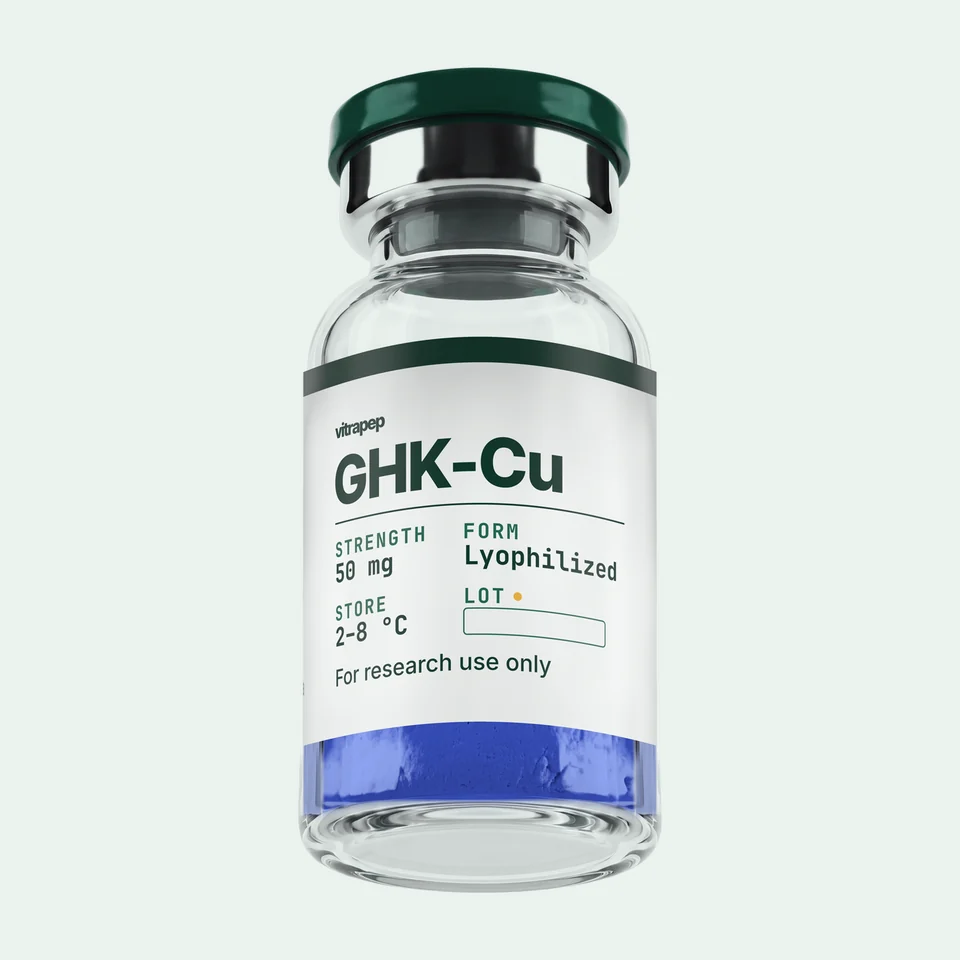
Vitrapep GHK-Cu product page
Specifications for the Vitrapep GHK-Cu product page sold for laboratory research. COA available with each lot.
Related reading: GHK-Cu complete guide, GHK-Cu mechanism and collagen synthesis, GHK-Cu wound-healing research, and GHK-Cu hair-follicle research.
FAQ
What are the main GHK-Cu benefits researchers are studying?
The main areas include collagen signaling, extracellular-matrix remodeling, wound-repair biology and hair-related research. Most findings are preclinical, with a small human eyebrow study adding early clinical evidence.
Does GHK-Cu increase collagen?
Cultured fibroblast studies report increased collagen synthesis after GHK-Cu exposure. These laboratory findings do not by themselves prove a visible or durable effect in human skin.
Is there human research on GHK-Cu for hair?
A small 2026 split-face study involving 18 people reported favorable eyebrow-hair measures. It did not study scalp hair loss and needs larger independent replication.
Is GHK-Cu FDA-approved?
No. GHK-Cu is not an FDA-approved drug. FDA has separately identified safety concerns for compounded injectable preparations and is evaluating non-injectable GHK-Cu for possible compounding-list consideration.
Are topical and injectable GHK-Cu findings interchangeable?
No. Formulation and route can change exposure and safety considerations. Topical studies should not be treated as evidence for injectable products.
What to know now
- Cell and animal studies support GHK-Cu activity in collagen and extracellular-matrix research.
- A small human eyebrow study reported a positive signal, but clinical evidence remains limited.
- FDA has not approved GHK-Cu as a drug and has raised specific concerns about compounded injectable products.
What we’re watching
- Results from the registered Phase 2 topical GHK-Cu wound study, once reported.
- FDA's planned Pharmacy Compounding Advisory Committee consultation on non-injectable GHK-Cu before the end of February 2027.