GHK-Cu price depends on which GHK-Cu you mean. The same copper peptide appears in skincare under the ingredient name copper tripeptide-1, and it is sold separately as research-grade powder in vials for laboratory work. This page covers the second: what US research suppliers listed on November 17, 2026, per vial and per mg. It also answers whether GHK-Cu is legal, using FDA records checked the same day.
Quick answer: Research-grade GHK-Cu listed at $34.99–$64.00 per 50 mg vial and $35.00–$59.99 per 100 mg vial at the US suppliers we checked on November 17, 2026. Is GHK-Cu legal? As a cosmetic ingredient it can be sold without FDA approval, like other cosmetic ingredients. It is not an approved drug, and pharmacy compounding with it is still under FDA review. Vitrapep lists 50 mg at $60.99.
Two kinds of GHK-Cu: skincare ingredient and research vial
GHK-Cu is the tripeptide glycyl-histidyl-lysine bound to copper. PubChem lists it under the names GHK-Cu, prezatide copper and copper tripeptide-1, the last marked as its INCI name, the naming system used on cosmetic ingredient labels (PubChem CID 71587328). For the research background, see our GHK-Cu research guide.
The two categories are sold and regulated differently:
- Cosmetic ingredient. In a skincare product, copper tripeptide-1 is one listed ingredient in a finished formula sold to consumers. FDA says cosmetic products and ingredients do not need FDA premarket approval, except color additives, and that companies are legally responsible for their safety (FDA).
- Research vial. A research vial holds lyophilized GHK-Cu powder sold as a laboratory reagent. It is for laboratory research use only, not for human or veterinary use, and it is not a cosmetic product.
Their prices cannot be compared. A serum is priced per bottle of formula. A research vial is priced per mg of peptide. Our overview of cosmetic skin peptides covers the ingredient side.
What US research suppliers list in November 2026
We checked supplier product pages on November 17, 2026, and recorded the listed single-vial price for each size the page showed. Prices exclude shipping, codes and multi-vial discounts.
Research-grade GHK-Cu prices at US suppliers, checked November 17, 2026
| Supplier | Vial size | Listed price | Price per mg |
|---|---|---|---|
| Purely Peptides | 50 mg | $34.99 | $0.70 |
| Purely Peptides | 100 mg | $49.99 | $0.50 |
| PS Peptides | 50 mg | $34.99 | $0.70 |
| PS Peptides | 100 mg | $44.99 | $0.45 |
| Zeptix Labs | 50 mg | $39.99 | $0.80 |
| Zeptix Labs | 100 mg | $59.99 | $0.60 |
| American Peptides | 50 mg | $50.00 | $1.00 |
| Core Peptides | 50 mg | $58.00 | $1.16 |
| Biotech Peptides | 50 mg | $64.00 | $1.28 |
| MyPurePeptide | 100 mg | $35.00 | $0.35 |
| Vitrapep | 50 mg | $60.99 | $1.22 |
Sources: supplier product pages listed in the references, read November 17, 2026. Price per mg is the listed price divided by the vial size. PS Peptides size prices are from the store’s own data for the listing. Core Peptides showed $69.00 struck through. Zeptix Labs was running a buy-one-get-one offer. American Peptides showed no price for its 100 mg size. Topical-labeled products, sprays, tablets and serums are excluded. All of these products are sold for laboratory research use only.
Two patterns stand out. First, 50 mg vials ran from $34.99 to $64.00, and three of the six 50 mg listings were under $40. Second, the 100 mg vial costs less per mg than the 50 mg vial at every supplier that sells both. Vitrapep’s 50 mg price, $60.99, is near the top of the 50 mg listings, second only to $64.00.
What drives the price spread
GHK-Cu is among the least expensive research peptides per mg in our check. Our peptide prices explainer covers the levers across the catalog.
- Short sequence. Peptides are built one amino acid at a time, and each added residue is another coupling step with its own yield loss, so short sequences cost less per mg (Verlander, 2007). GHK is three residues long.
- Copper complex. The product is the peptide bound to copper, so identity testing should confirm the copper complex, not only the peptide.
- Purity and testing. Higher HPLC purity and outside testing by a laboratory accredited to ISO/IEC 17025 add cost per lot.
- Vial size. Fixed costs per vial shrink per mg in a 100 mg vial.
- Promotions. Sales, buy-one-get-one offers and quantity discounts change the effective price often.
Is GHK-Cu legal?
This section summarizes public FDA and DEA records. It is not legal advice.
- As a cosmetic ingredient: no FDA approval needed. Cosmetics and their ingredients do not need FDA premarket approval. Intended use decides the category: FDA treats a product as a drug if it is intended to treat or prevent disease or to affect the structure or function of the body, even if it is also a cosmetic (FDA).
- As a drug: not approved. A search of FDA’s Drugs@FDA data for the ingredient name prezatide returned no approved application on November 17, 2026 (openFDA).
- In pharmacy compounding: under review. FDA’s list updated May 14, 2026 places “GHK-Cu (except for injectable routes of administration)” in category 1, substances under evaluation, and says FDA intends to consult its Pharmacy Compounding Advisory Committee before the end of February 2027 (FDA). Separately, FDA lists GHK-Cu for injectable routes among nominations that were withdrawn, noting a possible immunogenicity risk and “limited data in humans” (FDA).
- Controlled substance: no. GHK-Cu does not appear on the DEA’s alphabetical list of controlled substances, edition dated November 12, 2026 (DEA). State laws can differ, and we have not surveyed them.
For research vials, the label states the seller’s intended use: laboratory research. FDA judges intended use by objective evidence such as labeling, advertising and the circumstances of sale (21 CFR 201.128), so a research label does not cover a product marketed for people. See what research use only means and our article on peptides and the 503A categories.
Red flags in very cheap listings
A low price is not proof of a problem, and GHK-Cu is cheap to make. These signs deserve a closer look:
- No lot-specific certificate. It should name the lot, the laboratory, the test date, HPLC purity and an identity result. See our guide to reading a certificate of analysis.
- Unclear form. GHK basic, palmitoyl tripeptide-1 and GHK-Cu are different compounds. Check that the listing names the copper complex.
- Skincare or human-use claims on a research listing. A research vial should carry none.
What Vitrapep charges for GHK-Cu
Vitrapep lists GHK-Cu as a 50 mg lyophilized vial at $60.99, which works out to $1.22 per mg. Store prices may still change before launch. The product page lists the compound’s identity data and how to look up the test report for each lot. It is sold for laboratory research use only and is not for human or veterinary use. For sourcing questions, see where to buy GHK-Cu.
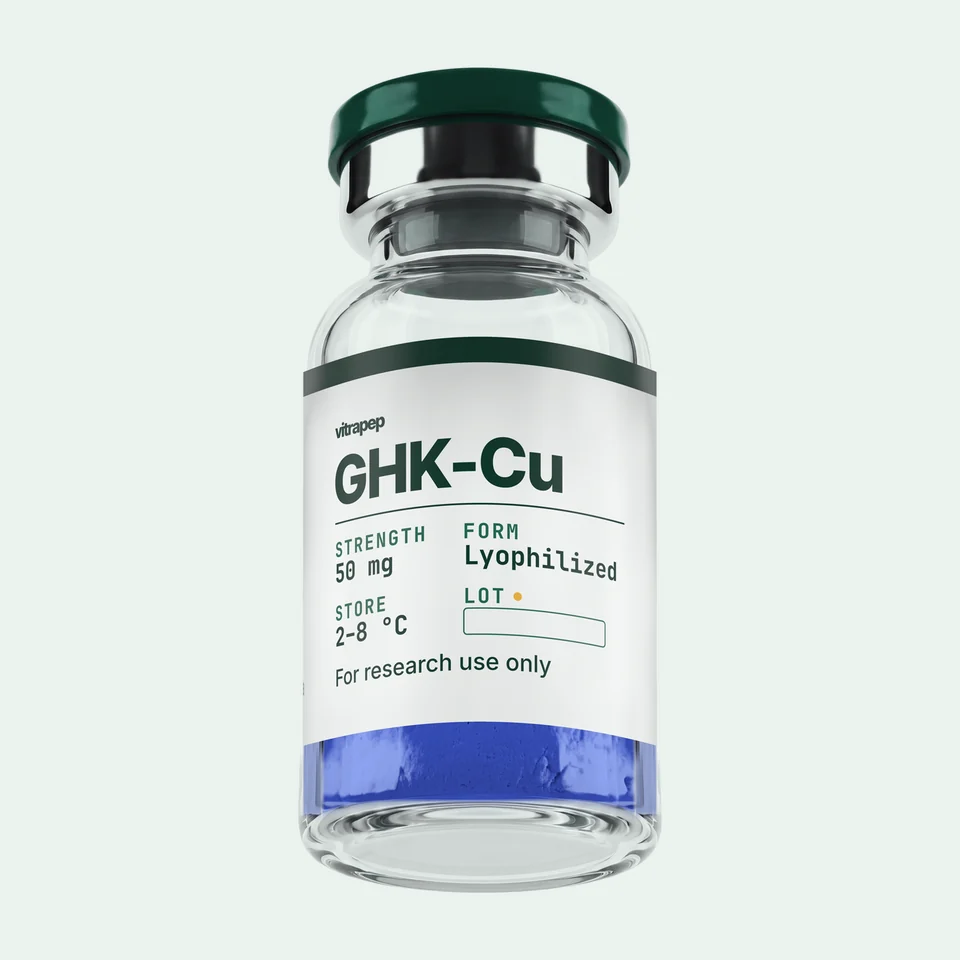
GHK-Cu
Specifications and the current lot’s test documentation for the GHK-Cu sold for laboratory research.
Frequently asked questions about GHK-Cu price
How much does GHK-Cu cost?
Research-grade GHK-Cu listed at $34.99 to $64.00 per 50 mg vial and $35.00 to $59.99 per 100 mg vial at the US suppliers we checked on November 17, 2026. That is $0.35 to $1.28 per mg.
Is GHK-Cu legal in the US?
As a cosmetic ingredient, copper tripeptide-1, it can be sold without FDA approval, like other cosmetic ingredients. It is not an FDA-approved drug, it is not a controlled substance, and its use in pharmacy compounding is still under FDA evaluation.
Is GHK-Cu FDA-approved?
No. We found no approved drug application for it in FDA’s Drugs@FDA data. Cosmetics do not go through FDA approval at all.
Is research-grade GHK-Cu the same as GHK-Cu in skincare?
The molecule is the same; the product is not. Skincare is a finished cosmetic formula. A research vial is the lyophilized peptide sold as a laboratory reagent, for laboratory research use only, not for human or veterinary use.
Why is a 100 mg vial cheaper per mg?
Filling, labeling and lot testing cost about the same per vial, so a larger vial spreads them over more milligrams. Every supplier in our check that sold both sizes priced 100 mg lower per mg.
What to know now
- Two categories. Copper tripeptide-1 in skincare is a cosmetic ingredient; research vials are laboratory reagents.
- 50 mg vials listed at $34.99–$64.00. Across sizes, $0.35 to $1.28 per mg on November 17, 2026.
- Legal status. Not an approved drug, not a controlled substance; compounding use is under FDA evaluation.
- Vitrapep lists 50 mg at $60.99. That is $1.22 per mg, near the top of the 50 mg listings.
- Check the lot. A lot-specific certificate that confirms the copper complex matters more than a discount.
What we’re watching
FDA says it intends to bring GHK-Cu, for non-injectable routes, to its Pharmacy Compounding Advisory Committee before the end of February 2027. We will update this page if FDA schedules that meeting or changes the category. We will also re-check supplier prices as promotions change.