NAD+ side effects depend on the product and study being discussed. Small studies of direct NAD+ exposure have reported different experiences, while larger bodies of research often examine precursors such as nicotinamide riboside (NR) or nicotinamide mononucleotide (NMN), not NAD+ itself. FDA has also warned about adverse reactions associated with certain compounded sterile NAD+ preparations.
Quick answer: Reported NAD+ side effects in direct human observations include a single report of minor dizziness in a randomized cardiac trial and gastrointestinal discomfort, nausea, vomiting, increased heart rate, throat symptoms and chest pressure during a small clinic-based chart review. FDA has separately received reports of severe chills, shaking, vomiting and fatigue after exposure to certain compounded sterile NAD+ preparations, with concerns about endotoxin contamination. Evidence from NR or NMN studies should not be presented as if those participants received NAD+ itself.
What is NAD+, and is it a peptide?
Nicotinamide adenine dinucleotide (NAD+) is a coenzyme found in cells. It participates in oxidation-reduction reactions and supports enzymes involved in energy metabolism, DNA repair and cellular signaling. NAD+ is not a peptide or protein. It is a dinucleotide made from two nucleotide units, and it has a central role in basic cell biology.
NAD+ has attracted attention in aging and metabolic research because cellular NAD+ levels and related pathways change in some experimental models and human conditions. That scientific interest has led to studies of direct NAD+ exposure and of compounds that cells can use to make NAD+, including NR and NMN. These are related but distinct interventions. A study of an NAD+ precursor is not a direct study of NAD+ itself.
The distinction matters for side-effect reporting. The compound administered, the formulation, the study population and the observation period all influence what can be concluded. This article therefore separates direct NAD+ reports from research on precursors.
What NAD+ side effects have been reported with direct exposure?
Direct human studies remain limited, but a randomized trial in a defined cardiac population now adds an important human safety dataset. Yu and colleagues published a single-center, randomized, placebo-controlled study of 180 adults with heart failure due to ischemic cardiomyopathy. The trial reported one case of minor dizziness in the NAD+ group, which subsided after about an hour; investigators discontinued the study product as a precaution. One participant in the placebo group reported chest discomfort. The paper reported no notable adverse effects on laboratory markers of liver, kidney function or glucose. These findings are encouraging within that specific hospital population, but do not establish general tolerability across other products or settings.
An earlier pilot by Grant and colleagues included eight healthy men in the NAD+ group and three controls. No adverse events were observed during the short monitored period. The sample cannot rule out uncommon or delayed effects.
A 2026 chart review by Reyna and colleagues examined six NAD+ recipients and eight NR recipients. Its abstract described moderate or severe gastrointestinal symptoms, increased heart rate and chest pressure during NAD+ sessions. The full text is internally inconsistent: one results subsection says no adverse events were documented, while the following summary reports symptoms in all six NAD+ recipients. Those symptoms were reported to resolve after the session. The study is retrospective and very small, so it cannot provide a reliable event rate. Its NR group is a separate comparator, not direct NAD+ exposure.
What NAD+ side effects have been reported with direct exposure
| Direct NAD+ evidence | Study population | Reported safety observation | Main limitation |
|---|---|---|---|
| Yu et al., 2025/2026 | 180 adults with ischemic cardiomyopathy and heart failure; randomized, placebo-controlled trial | One minor dizziness report in the NAD+ group; one chest-discomfort report in placebo; no notable lab safety changes reported | Single-center study in a defined cardiac population; does not establish general or long-term tolerability |
| Grant et al., 2019 | 11 healthy men: 8 in the NAD+ group and 3 controls | No adverse events observed during the six-hour study period | Very small pilot and short observation window |
| Reyna et al., 2026 | Clinic chart review: 6 NAD+ recipients and 8 NR recipients | All six NAD+ recipients had symptoms including gastrointestinal discomfort, nausea, vomiting, increased heart rate and chest or throat symptoms during the session | Retrospective, very small, non-randomized study |
| FDA safety communication | Reports involving certain compounded sterile NAD+ preparations | Severe chills, shaking, vomiting and fatigue were reported after exposure | Spontaneous reports do not establish incidence or prove every product has the same risk |
What has FDA warned about?
FDA has reminded compounders to use ingredients suitable for sterile compounding. The agency described reports of severe chills, shaking, vomiting and fatigue after people received compounded NAD+ products. FDA stated that some symptoms were consistent with excessive endotoxin exposure. The agency also explained that food-grade ingredients may not be suitable for sterile drug preparation without appropriate processing and controls.
This warning concerns product quality and contamination risks in certain compounded preparations. It should not be rewritten as proof that the NAD+ molecule itself causes every reported symptom. Nor should it be used to generalize the same risk to every preparation. The agency's central point is that the suitability and quality of ingredients for sterile compounding matter.
Spontaneous reports can identify potential problems, but they do not provide a denominator or establish event frequency. They also cannot prove causation. A safety review must distinguish a report from a confirmed causal relationship.
What do NR and NMN studies say about side effects?
NR and NMN are precursors in NAD+ biosynthesis, not NAD+ itself. Their clinical findings help explain the pathway but cannot establish direct NAD+ tolerability. A randomized trial by Conze and colleagues found NR generally well tolerated in healthy overweight adults. A separate short randomized study by Fukamizu and colleagues found no severe adverse events with NMN in healthy adults. These results apply to those precursors and study populations, not to direct NAD+ preparations.
A 2026 systematic review by Gallagher and Emmanuel assessed 113 studies of NAD-related interventions, including 33 human intervention studies and 80 rodent studies. Human evidence largely concerned oral NR and NMN, with heterogeneous outcomes. The review found no eligible outcome trials of direct NAD+ for anti-aging or wellness indications. A separate 2026 narrative review by Alangari and colleagues focused on wellness and translational use. It described that literature as low quality, mainly small uncontrolled studies, observational reports and case reports with limited follow-up. Its scope differs from the disease-specific cardiac trial by Yu and colleagues. The review also disclosed that one author was employed by a wellness company, a factor readers can consider when weighing its interpretation.
The research signal is that the NAD+ pathway remains biologically important and supports several active lines of investigation. The key scientific question is which intervention changes which biomarkers, in which population, and whether those changes affect meaningful outcomes. NAD+, NR and NMN should not be treated as interchangeable.
Why is the NAD+ safety picture still incomplete?
The direct NAD+ studies differ in design and population. A randomized study in 180 adults with ischemic cardiomyopathy reported one minor dizziness event, while an early pilot observed no adverse events over a short period. A later chart review described symptoms in all six NAD+ recipients. These findings should not be combined into a single risk percentage because the populations, products and methods of collecting events differed.
Product quality also matters. FDA focused on ingredient suitability for sterile compounding and reports consistent with excessive endotoxin exposure. A formulation-specific quality problem is not proof of a pharmacological adverse effect from NAD+ itself.
Long-term outcomes remain under study. Future research needs prospective designs, clear adverse-event reporting and well-characterized preparations. It should analyze NAD+, NR and NMN separately.
For more background, see Vitrapep's NAD+ complete guide, NAD+ and sirtuin mechanism article, and NAD+ research price page.
Vitrapep research material
Vitrapep sells NAD+ for laboratory research use only. It is not for human or veterinary use.
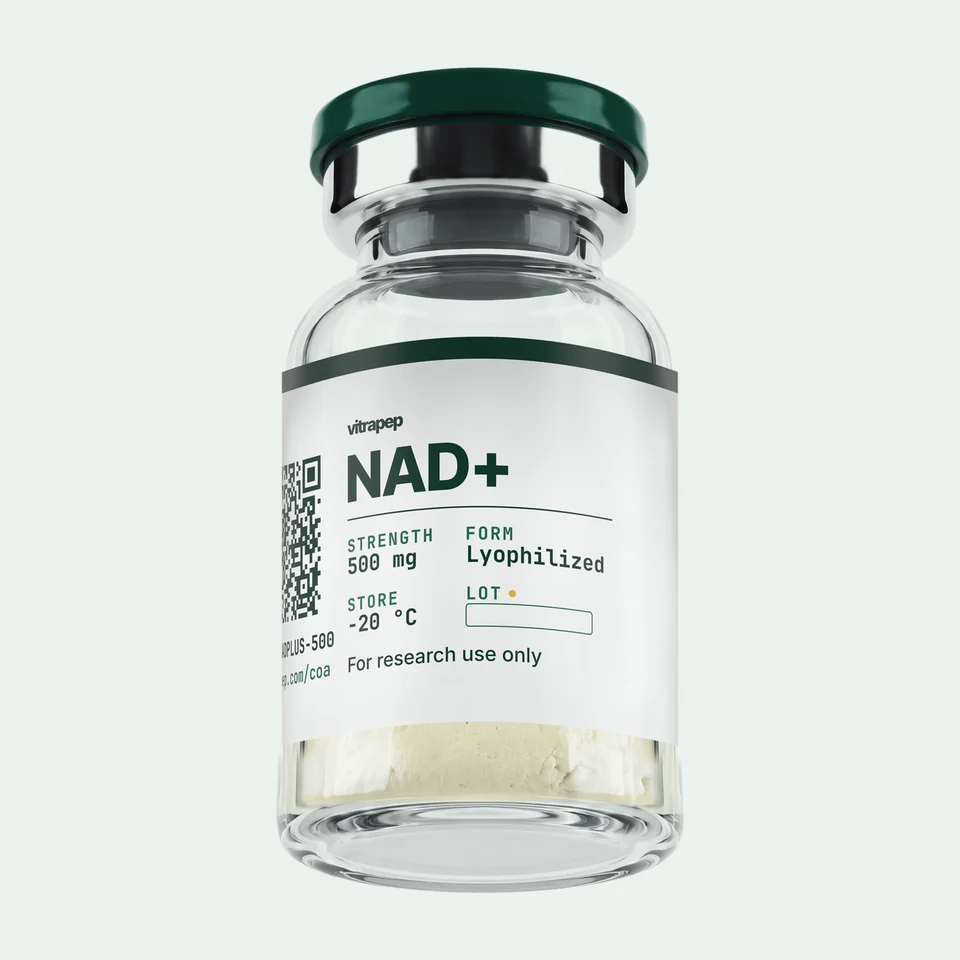
NAD+
Specifications for the NAD+ sold for laboratory research. COA available with each lot.
Frequently asked questions
Is NAD+ a peptide?
No. NAD+ is a dinucleotide coenzyme involved in cellular energy metabolism and redox reactions. It is included here because it is part of the Vitrapep research catalogue, not because it is a peptide.
What side effects have been reported with NAD+?
A small 2026 chart review described gastrointestinal symptoms, increased heart rate and throat or chest symptoms during NAD+ sessions. FDA separately described severe chills, shaking, vomiting and fatigue associated with certain compounded sterile NAD+ preparations.
Are NR and NMN the same as NAD+?
No. NR and NMN are precursors that cells can use to produce NAD+. Their clinical safety findings should not be treated as direct NAD+ safety findings.
Did a human NAD+ study report no side effects?
A small 2019 pilot involving eight NAD+ participants reported no adverse events during its short observation period. Its size and duration cannot establish broad or long-term safety.
What did FDA warn about in compounded NAD+ preparations?
FDA described reports of severe chills, shaking, vomiting and fatigue and raised concern about excessive endotoxin exposure in certain compounded sterile preparations. The warning emphasizes ingredient suitability and preparation quality.
What to know now
- NAD+ is a coenzyme, not a peptide, and direct NAD+ evidence is much smaller than the broader NR and NMN precursor literature.
- Small direct human studies have reported both no observed events in one pilot and multiple transient symptoms in a later clinic chart review.
- FDA has warned about adverse reactions associated with certain compounded sterile NAD+ preparations and concerns consistent with endotoxin exposure.
What we’re watching
- Larger prospective studies that evaluate direct NAD+ exposure with clear adverse-event definitions and follow-up.
- Further FDA communications about compounded sterile NAD+ preparations and ingredient suitability.
- Systematic reviews that separate direct NAD+ studies from NR and NMN precursor trials.