MOTS-c vs NAD+ comparisons often put the two on the same longevity shelf, but they are different kinds of molecules. MOTS-c is a 16-amino-acid peptide encoded in mitochondrial DNA. NAD+ is a coenzyme used by all living cells, and it is not a peptide.
Quick answer: MOTS-c and NAD+ cannot be ranked on current evidence. They belong to different chemical classes, were studied in different populations with different endpoints, and have never been tested against each other. MOTS-c human data are limited to measurements of the body's own peptide. NAD+ data come mostly from precursor trials, with mixed results.
What are MOTS-c and NAD+?
MOTS-c stands for mitochondrial open reading frame of the 12S rRNA type-c. Lee and colleagues at the University of Southern California reported it in 2015. They found a short gene inside the mitochondrial 12S rRNA region that codes for a 16-amino-acid peptide.
FDA's 2026 briefing document lists its sequence as Met-Arg-Trp-Gln-Glu-Met-Gly-Tyr-Ile-Phe-Tyr-Pro-Arg-Lys-Leu-Arg. It gives the free base formula as C101H152N28O22S2, with a molecular weight of 2174.6 g/mol. FDA also notes that MOTS-c circulates in human and rodent blood. The Vitrapep MOTS-c complete guide covers its biology in more depth.
NAD+ is nicotinamide adenine dinucleotide. PubChem indexes it as nadide, with the formula C21H27N7O14P2 and a molecular weight of 663.4 g/mol. It is built from two nucleotides joined through their phosphate groups. One carries adenine and the other carries nicotinamide. It contains no amino acids, so it is not a peptide (see what peptides are).
NAD+ was first identified in yeast extracts, according to a 2021 review by Covarrubias and colleagues. Cells make it from tryptophan and vitamin precursors and recycle it. See the NAD+ complete guide.
How do MOTS-c and NAD+ compare side by side?
How do MOTS-c and NAD+ compare side by side
| Feature | MOTS-c | NAD+ |
|---|---|---|
| Chemical class | Peptide of 16 amino acids | Dinucleotide coenzyme; not a peptide |
| Formula and weight | C101H152N28O22S2; 2174.6 g/mol (FDA) | C21H27N7O14P2; 663.4 g/mol (PubChem) |
| Origin | Encoded in the mitochondrial 12S rRNA region; reported in 2015 | Present in all cells; made from tryptophan and vitamin precursors |
| Mechanism studied | Folate cycle inhibition leading to AMPK activation, in cells and mice | Redox coenzyme and substrate for sirtuins, PARPs and CD38 |
| Human treatment evidence | None published; one Phase 2a trial recruiting | Many precursor trials; few trials of NAD+ itself |
| FDA status | Not approved; FDA proposed not adding it to the 503A bulks list | No approved drug found; NAD is "under evaluation" for 503A compounding |
| WADA 2026 status | Named under S4.4.1, prohibited at all times | Not named; the M2.2 infusion rule applies to any substance |
What mechanisms have researchers studied for each?
In the 2015 paper, skeletal muscle appeared to be the main target of MOTS-c in mice. In cells, it inhibited the folate cycle and linked purine synthesis. This led to activation of AMPK, an energy-sensing enzyme. Mice given MOTS-c were protected from diet-induced obesity and from age-related and diet-related insulin resistance.
FDA's 2026 summary of that study says treated mice on a high-fat diet weighed about 20% less than untreated mice after eight weeks. FDA cautioned that MOTS-c studies have been limited to rodents and that its molecular targets remain unknown.
NAD+ works differently. The Covarrubias review describes it as a coenzyme for redox reactions, which makes it central to energy metabolism. It is also used up by enzymes that regulate DNA repair, gene activity and immune function, including sirtuins, PARPs and CD38. The review reports that tissue NAD+ levels decline with age in rodents and humans.
Both are studied in metabolism and aging, but through different pathways. A PubMed search on November 18, 2026 found no study comparing MOTS-c with NAD+ or an NAD+ precursor.
What human evidence exists for MOTS-c?
No published trial has given MOTS-c to people. FDA's 2026 review searched PubMed, Embase, ClinicalTrials.gov and other sources. It found no clinical studies or human exposure data.
The human data that do exist measure the body's own MOTS-c. In a 2021 study by Reynolds and colleagues, 10 sedentary, healthy young men exercised on a stationary bicycle. Their muscle MOTS-c rose 11.9-fold after exercise. Blood levels rose 1.6-fold during exercise and returned to baseline after four hours of rest. The same paper reported improved physical performance in young, middle-aged and old mice given MOTS-c.
A Phase 2a trial (NCT07505745) is now testing MOTS-c in people. It is randomized, double-blind and placebo-controlled, and plans to enroll 120 adults aged 18 to 65 with prediabetes and overweight or obesity. The primary outcomes are insulin sensitivity at 12 weeks and adverse events through week 16. It was recruiting with no results posted as of November 18, 2026.
What human evidence exists for NAD+?
The NAD+ human literature is larger, but most of it does not test NAD+ itself. A 2026 systematic review by Gallagher and Emmanuel found 33 human intervention studies from 2010 to October 2025, 28 of them randomized. NR and NMN reliably raised NAD-related molecules in blood, but effects on function and metabolism were mixed and often null. It found no outcome trials of infused or injected NAD+ for anti-aging or wellness uses.
What human evidence exists for NAD+
| Study | Compound tested | Population and size | Design and duration | Main finding |
|---|---|---|---|---|
| Yoshino et al., 2021 | NMN (precursor) | 25 postmenopausal women with prediabetes and overweight or obesity | Randomized, double-blind, placebo-controlled; 10 weeks | Muscle insulin sensitivity rose with NMN, not with placebo |
| Brakedal et al., 2026 (NOPARK) | NR (precursor) | 410 adults with early Parkinson disease; 393 analyzed | Phase 3, placebo-controlled, 11 centers in Norway; 52 weeks | No clinical benefit; total symptom score was 2.72 points worse than placebo |
| Yu et al., 2026 | NAD+ | 180 adults with heart failure from ischemic cardiomyopathy | Single-center, randomized, placebo-controlled; 7 days of treatment, 6 months of follow-up | Ejection fraction at one month was 45.44% versus 42.44%; clinical events did not differ significantly |
| Reyna et al., 2026 | NAD+ and NR infusions | Records of 6 NAD+ clients and 8 NR clients | Retrospective chart review; 30-day follow-up | NAD+ clients reported moderate to severe symptoms that resolved when sessions ended |
The Yoshino trial measured insulin action directly with a clamp test.
NOPARK, published in JAMA on November 17, 2026, is the largest trial in the table. The total symptom score rose 2.45 points with NR and fell 0.27 points with placebo. Nonmotor symptoms also worsened more with NR. The authors concluded the findings do not support NR as a disease-modifying treatment.
The Yu trial tested NAD+ itself rather than a precursor. It met its primary endpoint, a gain in left ventricular ejection fraction at one month. The authors said it lacked power for clinical events and called for larger multicenter trials.
What side effects have been reported for each?
For MOTS-c, no human safety data exist. FDA's adverse event database searches through March 9, 2025 retrieved no reports, and FDA found no nonclinical toxicity studies. FDA stated that potential safety risks in humans are unknown. It also raised concern about immune reactions linked to aggregation and impurities. The MOTS-c side effects page reviews this further.
For NAD+ precursors, the Gallagher review found NR and NMN generally well tolerated over weeks to months. In the Yoshino trial, no adverse events were reported in either group. In NOPARK, serious adverse events occurred in 17 of 205 people on NR (8.3%) and 29 of 205 on placebo (14.1%).
For NAD+ itself, reports are smaller. The Yu trial recorded one case of minor dizziness in the NAD+ group, which resolved in about an hour. One placebo patient reported chest discomfort. In the Reyna review, NAD+ clients reported moderate to severe stomach symptoms, faster heart rate and chest pressure during infusions. All the authors were employed by the commercial wellness company where the records were collected.
FDA has also reminded compounders not to make sterile products from food-grade NAD+. The agency received reports of severe chills, shaking, vomiting and fatigue after use of NAD+ injectable drugs, some needing medical treatment. FDA said these reactions are consistent with excessive endotoxin levels. The NAD+ side effects page covers these reports in detail.
What is the FDA and anti-doping status of each?
MOTS-c is not a component of any FDA-approved drug, according to FDA's briefing. FDA reviewed MOTS-c free base and acetate for pharmacy compounding under section 503A. It proposed not adding either to the 503A bulks list, citing poor characterization and no human safety or effectiveness data. Its advisory committee discussed MOTS-c on July 23, 2026.
A Drugs@FDA search through openFDA on November 18, 2026 found no approved drug with NAD+ (nadide) as an active ingredient. FDA's 503A nominations list was updated May 14, 2026. It places NAD in Category 1, "Bulk Drug Substances Under Evaluation," which is not an approval.
The 2026 WADA Prohibited List names MOTS-c under S4.4.1 as an AMPK activator. Class S4 is prohibited at all times, in and out of competition. NAD+ is not named on the list. However, WADA's method rule M2.2 limits large intravenous infusions or injections of any substance outside hospital and clinical settings. See peptides on the WADA list.
A research-use-only label does not make either compound legal or approved for use in people.
Why can't MOTS-c and NAD+ be ranked against each other?
No trial has compared them. Without a head-to-head study in the same population, any ranking would be a guess.
Their evidence also uses different measures. The human MOTS-c data describe the body's own peptide during exercise. The NAD+ trials measured blood metabolites, insulin action, heart function and Parkinson disease scores.
A larger literature is also not the same as a proven benefit. The NAD+ precursor trials produced positive, null and negative results, including the negative NOPARK result. Most NAD+ trials also tested NR or NMN, so their findings do not transfer automatically to NAD+ itself.
Finally, results from trial materials do not describe other products sold under the same names.
What is still unknown?
For MOTS-c, the basic human pharmacology is missing. FDA identified no human pharmacokinetic studies. A laboratory study found that MOTS-c breaks down quickly in human blood. FDA said it remains to be determined whether supplied MOTS-c can reach active levels in people.
For NAD+, precursor trials show blood NAD+ markers rise, but markers are not clinical outcomes. Trials of NAD+ itself remain few and short.
For both, long-term human safety has not been established. The Vitrapep page on research peptides and human use risks explains why these gaps matter.
Vitrapep research material
Vitrapep sells MOTS-c for laboratory research use only. It is not for human or veterinary use.
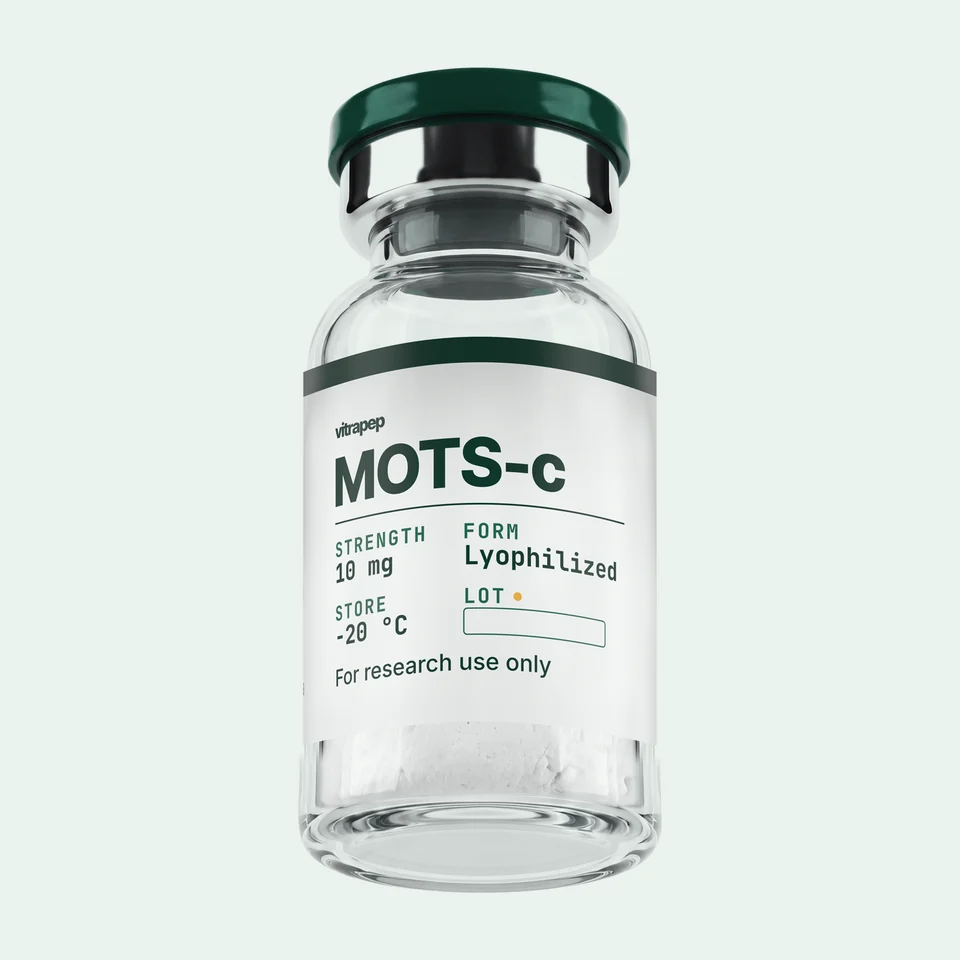
MOTS-c
Specifications for the MOTS-c sold for laboratory research. COA available with each lot.
Frequently asked questions
Is NAD+ a peptide like MOTS-c?
No. NAD+ is a dinucleotide coenzyme made of two nucleotides. MOTS-c is a peptide of 16 amino acids encoded in mitochondrial DNA.
Has any study compared MOTS-c with NAD+?
No. A PubMed search on November 18, 2026 found no study comparing MOTS-c with NAD+ or with the precursors NMN or NR.
Has MOTS-c been tested in people?
No results have been published. A placebo-controlled Phase 2a trial (NCT07505745) is recruiting adults with prediabetes and overweight or obesity.
Are MOTS-c or NAD+ FDA-approved?
No. MOTS-c is not part of any approved drug, and we found no approved drug containing NAD+. FDA lists NAD as under evaluation for compounding, which is not approval.
Are MOTS-c and NAD+ banned in sport?
MOTS-c is named on the 2026 WADA Prohibited List under S4.4.1 and is banned at all times. NAD+ is not named, but WADA's M2.2 rule limits large infusions of any substance.
Is there an approved dose for either compound?
No. Neither has an FDA-approved product, so no FDA-reviewed dose exists. See why research peptides have no dose.
What to know now
- MOTS-c is a 16-amino-acid mitochondrial peptide. NAD+ is a dinucleotide coenzyme, not a peptide.
- No published trial has given MOTS-c to people. The only human data measure the body's own MOTS-c, which rose during exercise in 10 men.
- NAD+ human trials mostly test the precursors NMN and NR, with mixed results, including a negative 2026 Phase 3 trial in Parkinson disease.
- Neither compound is FDA-approved. MOTS-c is on the 2026 WADA Prohibited List; NAD+ is not named.
What we’re watching
- Results from the MOTS-c Phase 2a trial NCT07505745, the first registered trial to report on MOTS-c in people.
- FDA's final decision on MOTS-c and the 503A bulks list after the July 2026 advisory committee meeting.
- FDA's ongoing evaluation of NAD in Category 1 of the 503A nominations list.
- Larger multicenter trials of NAD+ itself with clinical endpoints, as the Yu trial authors proposed.