MOTS-c side effects are difficult to quantify because published research has mainly examined cells, animals and naturally occurring blood levels, rather than administering synthetic MOTS-c to people. Early studies have generated interest in its role in metabolic signaling and exercise biology, but they do not establish a human safety profile.
Quick answer: No reliable human side-effect rate has been established for MOTS-c. Most published findings come from laboratory and animal research, while human studies have measured naturally occurring MOTS-c rather than testing administered MOTS-c. The absence of reported human adverse events is not evidence that the compound is safe.
What is known about MOTS-c side effects?
There is currently no established clinical side-effect profile for administered MOTS-c. The original and follow-up research largely examined cell systems and animal models. A human observational study measured circulating MOTS-c in people but did not administer the peptide as a treatment. FDA's July 2026 briefing stated that it had not identified human exposure data for MOTS-c and that its potential human safety risks were unknown.
MOTS-c is described as a mitochondrial-derived peptide encoded within mitochondrial DNA. The discovery literature identified a short peptide associated with metabolic regulation. This has made MOTS-c an interesting subject in research on energy balance, muscle physiology and age-related metabolic changes. These mechanisms are scientifically promising, but a proposed biological role does not establish clinical benefit or safety.
The distinction between naturally occurring MOTS-c and an externally administered research product is especially important. Detecting a peptide in blood does not show how people respond to a manufactured preparation, what exposure levels may occur, or whether adverse events develop after administration. Those questions require controlled human studies.
What have cell and animal studies found?
The foundational 2015 paper by Lee and colleagues described MOTS-c as a mitochondrial-derived peptide involved in metabolic homeostasis. In cell experiments, the researchers linked MOTS-c to folate-cycle and de novo purine-biosynthesis pathways, with downstream activation of AMP-activated protein kinase (AMPK). In mouse experiments, the study reported protection against age-associated and diet-induced insulin resistance. These are preclinical findings, not evidence of a treatment effect or side-effect rate in people.
A 2016 review by Lee, Kim and Cohen discussed MOTS-c research on muscle and fat metabolism. Later animal research explored related questions. A 2019 mouse study by Kim and colleagues examined plasma metabolites and insulin sensitivity. Other animal research has examined exercise-related physiology and responses to metabolic stress. These models help researchers generate hypotheses about how mitochondrial signaling may influence whole-body metabolism. They cannot determine the safety of an administered peptide in humans because species differ in physiology, exposure and immune response.
What have cell and animal studies found
| Evidence source | Model | What it reported | What it does not establish |
|---|---|---|---|
| Lee et al., 2015 | Cell experiments and mice | MOTS-c affected metabolic pathways and AMPK signaling; mouse models showed improved insulin-resistance measures | Human side effects, efficacy or a safe exposure range |
| Lee et al., 2016 | Review of published research | Summarized emerging research on MOTS-c and muscle and fat metabolism | New experimental results or human tolerability |
| Kim et al., 2019 | Mouse models | Investigated metabolic and insulin-sensitivity outcomes in aged and diet-induced obese mice | Safety in people or a clinically useful effect size |
| Knoop et al., 2019 | Analytical method development | Described mass-spectrometry detection of MOTS-c | Clinical safety or effectiveness |
The preclinical findings are a meaningful reason for continued scientific interest. They help define pathways and research questions. But the next step is not to assume that mouse results translate directly to people. It is to establish exposure, pharmacology, tolerability and clinically relevant outcomes in carefully designed human studies.
Have human studies reported side effects?
The key human evidence identified in the literature is observational. A 2022 study titled “The Effect of Chronic Endurance Exercise on Serum Levels of MOTS-c and Humanin in Professional Athletes” compared circulating MOTS-c levels in 75 professional athletes and 30 non-athlete controls. Researchers measured naturally occurring MOTS-c in blood and examined associations with athletic status and related variables. The participants were not given synthetic MOTS-c as an experimental treatment. The study therefore cannot establish adverse effects from administered MOTS-c.
Other human work has examined genetic variation or naturally occurring peptide levels in relation to health and longevity. Such studies can contribute to understanding the biology of MOTS-c, but they are not controlled exposure studies. A person having a naturally occurring peptide in the body is not equivalent to receiving a manufactured peptide preparation.
FDA's 2026 Pharmacy Compounding Advisory Committee briefing is particularly relevant to the current safety question. The agency stated that it had not identified human exposure data for MOTS-c and had not identified clinical trials establishing human safety. It also noted that the lack of adverse-event reports does not prove safety. The agency's review discussed general concerns relevant to peptide preparations, including potential immunogenicity and aggregation. Those are potential issues for evaluation, not proof that a particular MOTS-c product has caused a specific reaction.
What does the FDA review say about MOTS-c?
MOTS-c is not an FDA-approved drug. FDA's 2026 briefing reviewed information submitted in connection with a proposed bulk drug substance for compounding. The briefing described a limited nonclinical package and stated that the agency had not identified human exposure data. It also noted the absence of clinical studies capable of characterizing human safety.
A Pharmacy Compounding Advisory Committee briefing is a scientific and regulatory review document. It should not be presented as a drug approval, proof of safety or a finding that every possible preparation carries the same risk. The most supportable conclusion is narrower: the available human evidence is inadequate to establish the safety of administered MOTS-c, and it is not an FDA-approved medicine.
The FDA review also described gaps in pharmacokinetic and toxicology information. Without adequate information about how a substance is absorbed, distributed, metabolized and cleared, researchers cannot reliably characterize exposure. Without suitable toxicology and human studies, the nature and frequency of potential adverse events remain uncertain.
Why is the safety evidence still limited?
The first limitation is the lack of direct human exposure studies. Cell and mouse findings can point toward biological pathways, but they cannot identify how frequently a human adverse event occurs. The observational measurement of naturally circulating MOTS-c does not solve this gap.
The second limitation is analytical and formulation-related. A research peptide's identity, purity, aggregation profile and other characteristics can influence what is being studied. FDA's briefing discussed peptide-related immunogenicity and aggregation as considerations. These general concerns explain why a human development program would need careful analytical characterization and safety monitoring.
The third limitation is the lack of long-term follow-up. Even if a small initial study found no serious event, it would not be able to rule out uncommon or delayed risks. A more complete safety assessment would need to examine tolerability, immune responses, laboratory findings and adverse events over a defined period.
These gaps do not erase the scientific interest in MOTS-c. They define what research should answer next. The early work on mitochondrial signaling, AMPK and metabolic regulation provides a rationale for further investigation. A careful evidence standard protects that research interest by separating promising mechanisms from established human outcomes.
For additional context, see Vitrapep's MOTS-c complete guide, MOTS-c research summary, and MOTS-c AMPK mechanism article.
Vitrapep research material
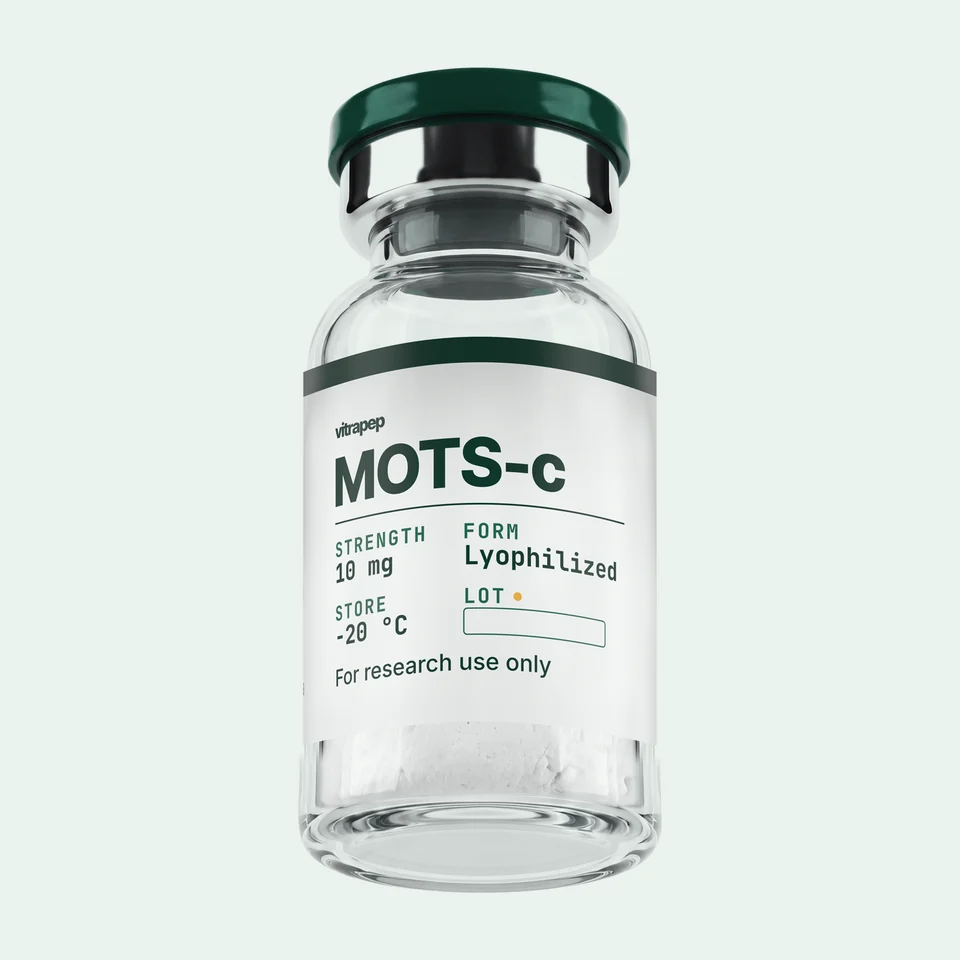
Vitrapep sells MOTS-c for laboratory research use only. It is not for human or veterinary use.
MOTS-c
Specifications for the MOTS-c sold for laboratory research. COA available with each lot.
Frequently asked questions
Does MOTS-c have known side effects in humans?
A reliable human side-effect profile has not been established. FDA's 2026 review stated that it had not identified human exposure data for administered MOTS-c.
Have researchers studied MOTS-c in humans?
Some human studies have measured naturally occurring MOTS-c or examined genetic associations. These are not trials in which participants received synthetic MOTS-c as a treatment.
What do animal studies suggest about MOTS-c?
Cell and animal studies suggest links to metabolic regulation, AMPK signaling and insulin sensitivity. These findings are early research signals and do not establish human benefits or safety.
Is MOTS-c FDA-approved?
No. MOTS-c is not an FDA-approved drug. FDA reviewed the limited evidence in a 2026 compounding advisory context and reported that human safety data were not identified.
Does the absence of adverse-event reports mean MOTS-c is safe?
No. When human exposure is absent or very limited, there may be few or no reports to assess. Lack of reports cannot establish safety.
What to know now
- MOTS-c is a mitochondrial-derived peptide with intriguing preclinical research involving metabolic pathways and AMPK signaling.
- Published human observational findings do not establish the effects or safety of administered MOTS-c.
- FDA's 2026 review stated that it had not identified human exposure data, leaving human safety unknown.
What we’re watching
- Publication of the first well-controlled human pharmacology and safety studies, if initiated.
- Results from the Phase 2 trial now registered on ClinicalTrials.gov (NCT07505745).
- Further FDA updates concerning MOTS-c and peptide bulk drug substances proposed for compounding.
- Research that clarifies how MOTS-c's cellular and animal findings translate, or do not translate, to human biology.