SS-31 price searches lead to two very different products. Forzinity, whose active ingredient is elamipretide, is an FDA-approved prescription medicine. Research-grade SS-31 is a lyophilized peptide sold for laboratory research use only. This page sets out what US research suppliers listed on November 17, 2026, per vial and per mg, what moves the price, and which listings deserve a closer look.
Quick answer: Research-grade SS-31 listed at $49.99–$70.00 per 10 mg vial at the other US suppliers we checked on November 17, 2026. Per mg, prices ran from $1.60 to $7.00, with the lowest figures on 50 mg vials. Vitrapep lists 10 mg at $90.99, or $9.10 per mg. For sourcing questions, see where to buy SS-31.
What research-grade SS-31 is
SS-31 is a research name for elamipretide, a four-residue peptide with the sequence D-Arg-2,6-dimethyl-Tyr-Lys-Phe-NH2. In Forzinity it is supplied as a hydrochloride salt, with the formula C32H49N9O5·3HCl and a molecular weight of 749.2 (DailyMed, 2025). Research suppliers sell it as a freeze-dried powder, most often in 10 mg or 50 mg vials. For the published research, see our SS-31 research guide.
On September 19, 2025, FDA granted accelerated approval to Forzinity as the first treatment for Barth syndrome, in patients weighing at least 30 kg. The approval rests on improved strength of the knee extensor muscle, and FDA requires a confirmatory randomized, placebo-controlled trial (FDA, 2025; Drugs@FDA, NDA 215244). Our article on the Forzinity approval covers it in detail.
Research-grade SS-31 is not Forzinity. It is a reagent for laboratory work, FDA has not reviewed it as a drug, and it is not a substitute for any prescription medicine. It is for laboratory research use only, not for human or veterinary use. Our explainer on research use only labeling covers what that label means.
What US research suppliers list in November 2026
We checked supplier product pages on November 17, 2026, and recorded the listed single-vial price for each size the page showed. Prices exclude shipping, codes and multi-vial discounts.
Research-grade SS-31 prices at US suppliers, checked November 17, 2026
| Supplier | Vial size | Listed price | Price per mg |
|---|---|---|---|
| Peptide Giants | 10 mg | $49.99 | $5.00 |
| Peptide Giants | 50 mg | $149.99 | $3.00 |
| PS Peptides | 10 mg | $64.99 | $6.50 |
| PS Peptides | 50 mg | $179.99 | $3.60 |
| American Peptides | 10 mg | $70.00 | $7.00 |
| MyPurePeptide (listed as SS-31 Elamipretide) | 50 mg | $80.00 | $1.60 |
| Vitrapep | 10 mg | $90.99 | $9.10 |
Sources: supplier product pages listed in the references, read November 17, 2026. Price per mg is the listed price divided by the vial size. Peptide Giants shows one price, $49.99, on its page; the per-size prices are from the store’s own data, which gave regular prices of $71.43 and $214.30. PS Peptides shows a $64.99–$179.99 range; its store data showed the 50 mg size out of stock. American Peptides showed no price for its 30 mg and 50 mg sizes and lists the synonyms elamipretide and MTP-131. All of these products are sold for laboratory research use only.
Three patterns stand out. First, 10 mg vials at other suppliers ran from $49.99 to $70.00. Second, the 50 mg vials were much cheaper per mg, from $1.60 to $3.60. Third, Vitrapep’s $90.99 is the highest 10 mg price in the table, and its $9.10 per mg is the highest per-mg figure.
What drives the price spread
Several costs sit behind every vial, and suppliers carry them differently. Our peptide prices explainer covers them across the whole catalog.
- Unusual building blocks. At four residues, SS-31 is short. In a study of over 500 solid-phase syntheses, coupling efficiencies fell as peptides got longer (Young et al., 1990). But its sequence includes a D-amino acid and a dimethylated tyrosine, which are not standard building blocks.
- Salt or free base. The hydrochloride salt weighs more than the free base. Using the 749.2 molecular weight on the Forzinity label and the free-base weight of about 639.8 that suppliers list, 10 mg of the salt holds about 8.5 mg of free base. A label that does not say which form it means is hard to compare.
- Purity and third-party testing. Raising HPLC purity means discarding more of each batch. Identity by mass spectrometry and purity by HPLC at an outside laboratory is a cost paid on every lot.
- Vial size. Filling, capping, labeling and testing a vial cost about the same at 10 mg or 50 mg. Spread over more milligrams, those fixed costs shrink per mg.
- Promotions. Sale prices and quantity discounts change the effective price from week to week. PS Peptides took 3% to 9% off two or more vials of the same size.
Red flags in very cheap listings
A low price is not proof of a problem. The lowest 10 mg listing we found, $49.99, gave no sequence, CAS number or molecular weight on its product page, though it reported an identity test as passed. What matters is what the seller documents. These signs deserve a closer look:
- No identity data. A listing should give the sequence, the molecular formula and whether the weight refers to the salt or the free base. Without them, the identity of the material cannot be checked against the label.
- Conflicting identifiers. One listing in our check gave two different CAS numbers on the same page. Identifiers on a listing should agree with each other and with the certificate.
- No lot-specific certificate. A credible certificate names the lot, the laboratory, the test date, HPLC purity and a mass spectrometry identity result. Our guide to reading a certificate of analysis walks through each field.
- Claims of equivalence to Forzinity. A research reagent is not the approved medicine. A listing that suggests otherwise, or carries human-use language, is a warning sign. In a June 2023 warning letter to an online seller of peptides, FDA wrote that despite “research purpose only” and “not for human consumption” labels, evidence from the seller’s website showed the products were intended as drugs for human use (FDA, 2023).
What Vitrapep charges for SS-31
Vitrapep lists SS-31 as a 10 mg lyophilized vial at $90.99, which works out to $9.10 per mg. Store prices may still change before launch. The product page lists the sequence and the free-base molecular formula. It is a research reagent, sold for laboratory research use only and not for human or veterinary use. It is not Forzinity and not a substitute for any prescription medicine. For sourcing questions, see where to buy SS-31, and for prices across the catalog, our peptide price list.
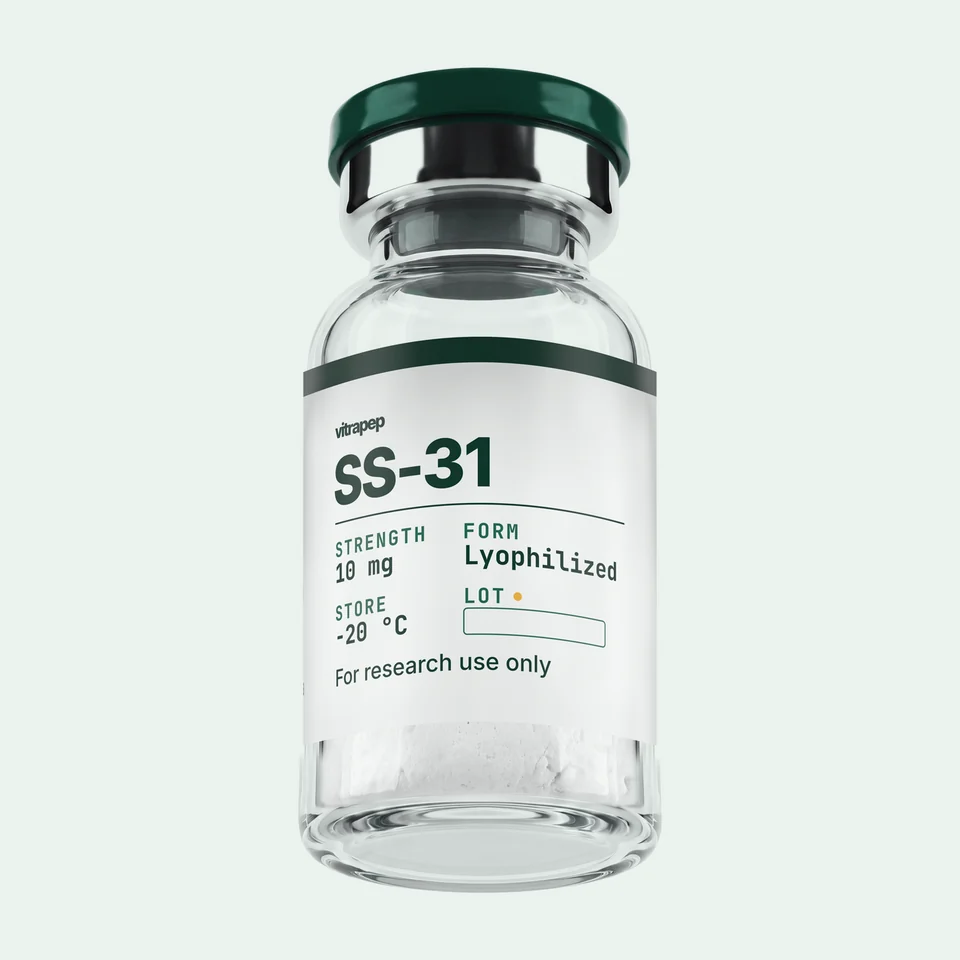
SS-31
Specifications and the current lot’s test documentation for the SS-31 sold for laboratory research.
Frequently asked questions about SS-31 price
How much does SS-31 cost?
Research-grade SS-31 listed at $49.99 to $70.00 per 10 mg vial at the US suppliers we checked on November 17, 2026. Across 10 mg and 50 mg vials, prices ran from $1.60 to $7.00 per mg. Forzinity, the prescription medicine, is a separate product and is not priced here.
Is SS-31 FDA-approved?
Elamipretide is approved as Forzinity, which received accelerated approval on September 19, 2025, for Barth syndrome in patients weighing at least 30 kg. Research-grade SS-31 is a different product category that FDA has not reviewed as a drug.
Is research-grade SS-31 the same as Forzinity?
No. Forzinity is a prescription medicine, manufactured and tested under drug rules and dispensed by a pharmacy. Research-grade SS-31 is a laboratory reagent. It is for laboratory research use only, not for human or veterinary use, and it is not a substitute for any prescription medicine.
Why is a 50 mg vial cheaper per mg than a 10 mg vial?
Much of the cost of a vial is fixed: filling, sealing, labeling and lot testing. Those costs are about the same at 10 mg or 50 mg, so they are spread over more milligrams in the larger size. Peptide Giants, for example, came to $5.00 per mg at 10 mg and $3.00 per mg at 50 mg.
Is a cheap SS-31 listing a bad sign?
Not by itself. Price differences between suppliers are normal and reflect testing, purity, vial size and overhead. Missing identity data, an unstated salt form and no lot-specific certificate are the signals worth checking.
What to know now
- Forzinity is the approved medicine. FDA granted it accelerated approval for Barth syndrome on September 19, 2025.
- Research-grade 10 mg vials listed at $49.99–$70.00. That was the range at the other US research suppliers we checked on November 17, 2026.
- Per mg, $1.60 to $7.00. The 50 mg vials were the cheapest per mg.
- Vitrapep lists 10 mg at $90.99. At $9.10 per mg, it is the highest per-mg price in our table.
- Check identity and form before price. The sequence, the salt form and a lot-specific certificate matter more than a discount.
What we’re watching
First, the confirmatory trial FDA requires for Forzinity’s accelerated approval. Second, supplier pricing and stock, since 50 mg vials were out of stock at one supplier on the day we checked. We will re-check these listings as they change.