Bacteriostatic water is sterile water with a preservative added, most often 0.9% benzyl alcohol. The preservative is there to hold back bacterial growth in a vial that is opened more than once. This guide sets out what the US standard and the approved label say, how the product differs from sterile water and from bacteriostatic saline, and what to check when you buy it for laboratory work.
Quick answer: Bacteriostatic water is sterile water with a preservative, usually 0.9% benzyl alcohol, packed in a multiple-dose vial. In the US, the FDA-approved product is a prescription drug. Its label says “Rx only” and warns that it is not for use in newborns. Bacteriostatic water sold for laboratory research is a reagent, labeled not for human or veterinary use. When you buy it for the lab, look for a sealed vial, a printed lot number and expiry date, a USP composition statement and a certificate that matches the lot.
What is bacteriostatic water?
The United States Pharmacopeia (USP) publishes the public standard for this product under the name Bacteriostatic Water for Injection. The USP monograph defines it as Water for Injection that is sterilized and suitably packaged and that contains one or more suitable antimicrobial agents. The monograph does not name a single preservative. Each manufacturer states its agent and amount on the label.
In practice the agent is usually benzyl alcohol. Hospira’s label on DailyMed describes a sterile, nonpyrogenic preparation of water for injection with benzyl alcohol “added as a bacteriostatic preservative.” It lists two strengths: 0.9% (9 mg/mL) in a 30 mL plastic vial and 1.1% (11 mg/mL) in a 20 mL glass vial. The stated pH is 5.7, with a range of 4.5 to 7.0.
“Bacteriostatic” describes the job of the preservative: it holds back the growth of bacteria. That is why the label calls the product a multiple-dose container. The water is the same water for injection used in plain sterile water. The differences are the preservative and the container type.
Bacteriostatic water vs sterile water vs bacteriostatic saline
The three products are easy to mix up because the names overlap. Three current Hospira labels on DailyMed show the differences side by side.
Three diluent products, as their labels describe them
| Attribute | Bacteriostatic Water for Injection, USP | Sterile Water for Injection, USP | Bacteriostatic 0.9% Sodium Chloride Injection, USP |
|---|---|---|---|
| Base | Water for injection | Water for injection | Water for injection with 9 mg/mL sodium chloride |
| Preservative | Benzyl alcohol, 0.9% (9 mg/mL) or 1.1% (11 mg/mL) | None. “Contains no bacteriostat, antimicrobial agent or added buffer.” | Benzyl alcohol, 0.9% (9 mg/mL) |
| Container | Multiple-dose vial | Single-dose vial only | Multiple-dose vial |
| pH on label | 5.7 (4.5 to 7.0) | Not stated | 5.0 (4.5 to 7.0) |
| Newborn warning | “NOT FOR USE IN NEONATES” | No benzyl alcohol warning | “NOT FOR USE IN NEONATES” |
| Label storage | 20 to 25 °C | 20 to 25 °C | 20 to 25 °C |
| US status | Rx only (NDA 018802) | Rx only (NDA 018801) | Rx only (NDA 018800) |
Sterile Water for Injection has no preservative. Its label says it is supplied only in single-dose containers and that any unused portion is discarded. Bacteriostatic 0.9% Sodium Chloride Injection is a third product: sodium chloride at 9 mg/mL plus 0.9% benzyl alcohol, described on its label as isotonic. “Bacteriostatic water” and “bacteriostatic saline” are not two names for the same thing.
Storage and the discard period on the label
The Hospira bacteriostatic water label gives one storage condition: store at 20 to 25 °C (68 to 77 °F), with a pointer to USP Controlled Room Temperature. It does not call for refrigeration of the sealed vial. Each vial label carries a lot number and an expiry date.
The label does not give a number of days after which an opened multiple-dose vial must be discarded. It does say not to use the product unless the solution is clear and the seal is intact. For clinical settings, the CDC’s injection-safety guidance says an opened multi-dose vial should be dated and discarded within 28 days unless the manufacturer states another date. An unopened vial follows the manufacturer’s expiration date.
The benzyl alcohol warning for newborns
Both benzyl alcohol products in Table 1 carry the same warning on their packaging: “NOT FOR USE IN NEONATES.” The Warnings section of the bacteriostatic water label states that benzyl alcohol has been associated with toxicity in neonates. It also says data are unavailable on the toxicity of other preservatives in this age group.
The warning has a long history. A 1982 paper in the New England Journal of Medicine was titled “The gasping syndrome and benzyl alcohol poisoning.” A 1986 study in mice opens by noting that benzyl alcohol had been implicated as the agent responsible for the gasping syndrome in premature neonates.
Regulatory status in the US
On DailyMed, the Hospira product is filed as a human prescription drug label under NDA 018802, and the vial trays read “Rx only.” Under 21 U.S.C. § 353(b)(4)(A), a prescription drug is misbranded if its label does not bear, at a minimum, the symbol “Rx only.” Hospira’s sterile water and bacteriostatic saline carry the same marking.
Bacteriostatic water sold for laboratory research is a different category of product. It is a lab reagent, sold for in-vitro work and labeled not for human or veterinary use. It is not the FDA-approved drug, even where the composition matches. Our research-use-only explainer covers what that label means, and this guide covers the wider US framework for research compounds.
Where to buy bacteriostatic water for lab use
For research work, buy from a laboratory supplier that sells it as a reagent and documents each lot. Whoever the supplier is, these are the points to check before you order and again when the box arrives.
- A sealed multiple-dose vial. An intact stopper and a tamper-evident seal. The approved label itself says not to use the product unless the solution is clear and the seal is intact.
- A stated composition. The preservative and its strength, for example 0.9% benzyl alcohol, printed on the label, as the approved label does.
- A lot number and an expiry date. Both are printed on the approved vial label. The lot number is what ties a vial to its test results.
- USP grade. A statement that the product conforms to the USP monograph for Bacteriostatic Water for Injection.
- A certificate of analysis. A certificate for the same lot as the vial, from a third-party lab, listing the tests run and the results. Our guide to reading a COA covers what a complete one looks like.
- Research-use labeling. A product sold for the lab should say it is for laboratory research use only, not for human or veterinary use.
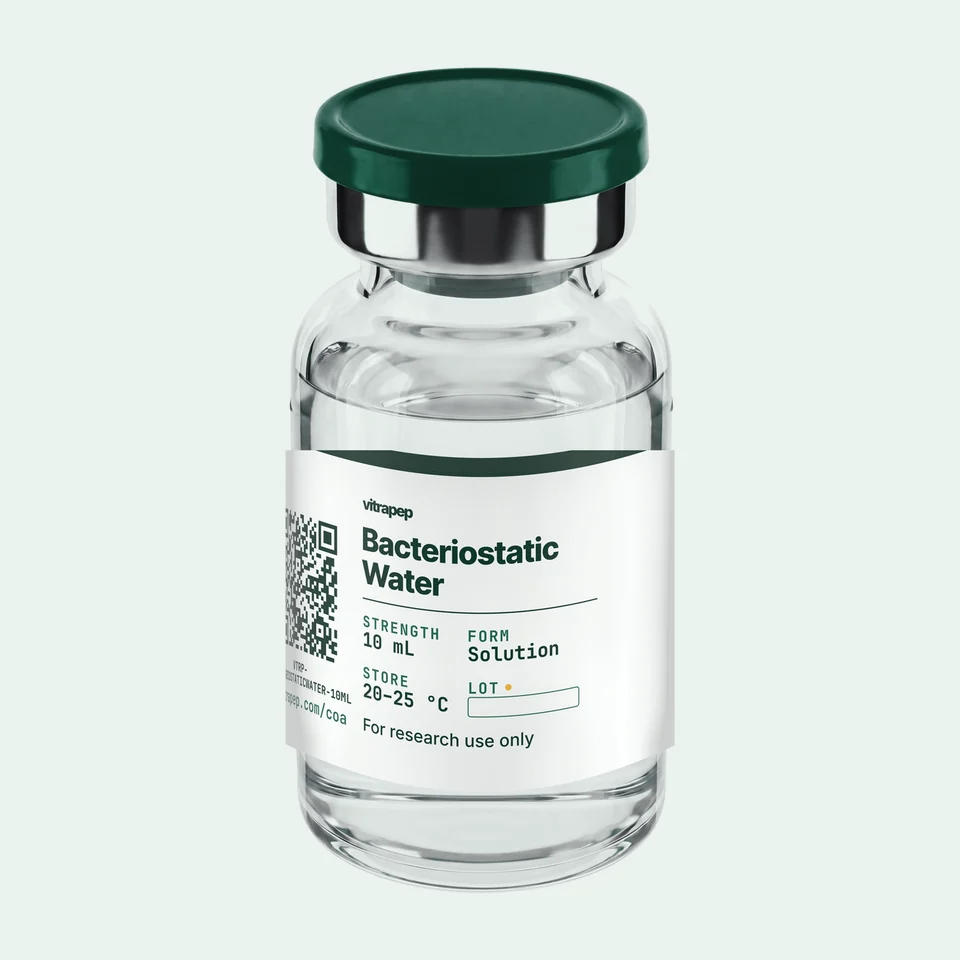
Bacteriostatic Water
Sterile water with 0.9% w/v benzyl alcohol in a sealed Type I borosilicate glass vial. Third-party certificate for every lot. For laboratory research use only, not for human or veterinary use.
Vitrapep’s Bacteriostatic Water
Vitrapep lists Bacteriostatic Water at $24.99 for a 10 mL vial. The product page describes sterile water with 0.9% w/v benzyl alcohol in a Type I borosilicate glass vial with a rubber stopper and a tamper-evident seal. The listed pH is 5.0 to 7.0. Listed storage is 20 to 25 °C for sealed vials and 2 to 8 °C for up to 28 days once opened.
Each lot ships with a third-party certificate of analysis. The Bacteriostatic Water certificate includes a microbial screen by PCR, a test Vitrapep’s peptide certificates do not carry. Like everything in the Vitrapep catalog, it is for laboratory research use only and is not for human or veterinary use. Check the product page for the current price and stock.
Frequently asked questions
What is bacteriostatic water made of?
Sterilized Water for Injection plus a preservative. The USP monograph allows one or more suitable antimicrobial agents. The Hospira label lists benzyl alcohol at 0.9% (9 mg/mL) or 1.1% (11 mg/mL).
Is bacteriostatic water the same as sterile water?
No. Sterile Water for Injection has no preservative and is supplied in single-dose containers. Bacteriostatic water contains a preservative and is supplied in multiple-dose vials.
Does bacteriostatic water need to be refrigerated?
Not according to the approved label, which says to store it at 20 to 25 °C. Lab products may list their own conditions for opened vials. Vitrapep lists 2 to 8 °C for up to 28 days after opening.
How long does bacteriostatic water last once opened?
The Hospira label gives no day count. CDC injection-safety guidance for clinical settings says an opened multi-dose vial should be discarded within 28 days unless the manufacturer states another date. For a lab product, go by the supplier’s specification.
Do you need a prescription for bacteriostatic water?
The FDA-approved product is labeled “Rx only,” the marking federal law requires on prescription drugs. Laboratory-grade bacteriostatic water is a research reagent, sold for laboratory research use only and not for human or veterinary use.
What to know now
- Definition: sterilized Water for Injection with one or more antimicrobial agents, per the USP monograph.
- Usual preservative: benzyl alcohol, 0.9% (9 mg/mL) on the common Hospira vial; a 1.1% version also exists.
- Not sterile water or saline: sterile water has no preservative; bacteriostatic saline adds sodium chloride.
- Label storage: 20 to 25 °C, with no opened-vial day count on the approved label.
- Newborn warning: “NOT FOR USE IN NEONATES,” because of benzyl alcohol.
- US status: the approved product is “Rx only.” Lab-grade product is a research reagent, not for human or veterinary use.
- Buying checklist: sealed vial, stated composition, lot number, expiry date, USP statement, lot-matched certificate.
What we’re watching
The USP monograph is under revision. A Pharmacopeial Forum proposal would add the bacterial endotoxins test using recombinant reagents (USP chapter <86>) as an alternative to the current test (chapter <85>). The proposal states that the endotoxin limit itself is unchanged. A change in test method would not change what a passing lot has to meet.