Peptide testing is how a lab checks that a vial holds the right molecule, at the stated purity and amount, without contaminants that would skew an experiment. For research peptides, the record of that testing is the certificate of analysis for each lot. This hub covers what a third-party lab checks, why independence matters, how to verify a certificate, and the red flags.
Quick answer: Third-party peptide testing means an independent lab, not the seller, tests a sample from each lot and issues a certificate. The core tests are identity by LC-MS, purity by HPLC, net content and endotoxin. To verify a certificate, check the lab’s name, a lot number that matches your vial, the test date, the method and result for each test, and a signature. Red flags include no chromatogram or numbers, one certificate reused across lots, and a purity figure with no method.
What a third-party lab checks on each lot
Each test answers a different question. These four matter most, and each has its own explainer:
- Identity. Liquid chromatography–mass spectrometry measures the mass of the main component and compares it with the mass calculated for the labeled sequence. LC-MS and peptide identity explains how.
- Purity. HPLC with UV detection reports the main peak as a share of all detected peak area. HPLC purity, explained covers how that figure is read.
- Net content. The amount of material actually measured in the vial, in milligrams, compared with the amount on the label.
- Endotoxin. A Limulus amebocyte lysate (LAL) test for lipopolysaccharide from Gram-negative bacteria, which can skew cell experiments. Endotoxin testing, explained covers the methods and how to read a Pass.
Identity and purity are a pair. The international specifications guideline ICH Q6A says identification by a single chromatographic retention time is not regarded as specific, and names HPLC/MS as an acceptable combined test. A high purity figure without a mass result says the sample is mostly one thing, not which thing.
The 11 tests on each Vitrapep lot
| Test | Question it answers | Certificate |
|---|---|---|
| Identity (LC-MS) | Is this the molecule on the label? | Freedom Diagnostics (published) |
| Purity (HPLC-UV) | What share of the detected material is the target peptide? | Both |
| Net content | How much material is in the vial, in mg? | Both |
| Endotoxin (LAL, USP <85>) | Did the sample pass the bacterial endotoxins test? | Freedom Diagnostics (published) |
| Appearance | Does the powder match its description? | Production lab (on file) |
| Solubility | Does the material dissolve as specified? | Production lab (on file) |
| pH | Is the pH of a test solution within its range? | Production lab (on file) |
| Moisture | How much water does the powder hold? | Production lab (on file) |
| Impurities | What else shows up on the chromatogram, and how much? | Production lab (on file) |
| Residual solvents | Are leftover manufacturing solvents within limits? | Production lab (on file) |
| Heavy metals | Are lead, cadmium, mercury and arsenic within limits? | Production lab (on file) |
The production lab’s panel
The second certificate covers what else sits in the vial besides the peptide. Two of its tests have counterparts in international drug-quality guidelines. ICH Q3C(R8) defines residual solvents as organic volatile chemicals used or produced in manufacture that are not completely removed by practical manufacturing techniques. ICH Q3D(R2) puts arsenic, cadmium, mercury and lead in its Class 1: toxic elements with limited or no use in manufacture, which usually enter through materials such as mined excipients.
Moisture matters because peptides take up water. Bachem’s handling guide says peptides tend to be hygroscopic and that moisture absorbed from the air reduces the overall peptide content and may decrease stability. Our guide on how to store peptides covers what that means once a vial arrives.
Why independent testing matters
A seller’s own certificate puts one party in charge of both the material and the only document that describes it. Regulated drug manufacturing does not accept that arrangement on trust. Under 21 CFR 211.84(d), a manufacturer may accept a supplier’s report of analysis only if it runs at least one specific identity test itself and establishes the reliability of the supplier’s analyses by validating them at appropriate intervals. The GMP guideline for active ingredients, ICH Q7, adds that the reliability of certificates of analysis should be checked at regular intervals.
Outside regulated channels, test results can be far from the label. In a 2024 study in the Journal of Medical Internet Research, researchers test-bought semaglutide from online sellers that did not require a prescription. The three vials that arrived measured 7.7% to 14.37% purity, and endotoxin was detected in all of them. The lesson is not about one compound: a label is a claim, and a lot test by a separate lab is how you check it.
How to verify a certificate
ICH Q7 sets out what an authentic certificate should carry, and its points work as a checklist for any lab material:
- The lab’s name and contact details. ICH Q7 asks certificates to show the name, address and telephone number of the original manufacturer and, where another party issues a new certificate, of the lab that performed the analysis. A lab name you can look up is the minimum.
- A lot number that matches your vial. Under 21 CFR 210.3, a lot number is the code from which a lot’s complete manufacturing and distribution history can be traced. A certificate for a different lot tells you little about your vial.
- A date. ICH Q7 says certificates should be dated. Look for the test or report date.
- Each test with its method, limit and result. ICH Q7 asks for each test performed, its acceptance limits and the numerical results where results are numerical.
- A signature. ICH Q7 says certificates should be signed by authorized personnel of the quality unit.
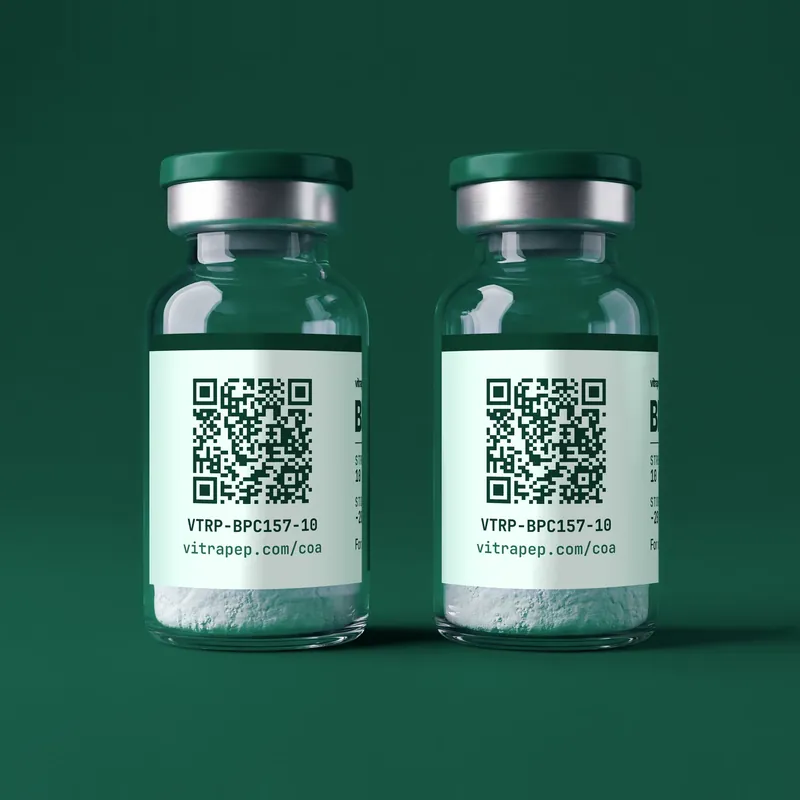
- A QR code or lookup that resolves to the record. Scan any QR code and confirm it opens a record with the same lot number and results as the paper in hand.
Our full walkthrough of a certificate is in how to read a COA.
Red flags on a peptide COA
- No chromatogram and no numbers. A purity line that says only “pass” or “>98%” with no trace behind it cannot be checked.
- Purity with no method. A percentage means little without the technique behind it, usually HPLC area-%.
- Identity with no masses. “Confirmed” alone is weaker than an observed mass set against a theoretical mass.
- One certificate for every lot. Identical dates, values or sample numbers across different lots suggest a generic document, not a lot test.
- No lab named, or the seller as the only lab. Nothing to check independently.
- A lot number that does not match the vial. The certificate describes some other material.
Look up a certificate
Enter the lot number printed on the vial, or scan its QR code, to open that lot’s certificate. No account is needed. All Vitrapep products are for laboratory research use only, not for human or veterinary use.
How Vitrapep tests each lot
Every Vitrapep lot is tested twice before it goes on sale. The production lab tests the batch and issues a certificate that Vitrapep keeps on file. When the lot arrives, a sample goes to Freedom Diagnostics, an independent laboratory, for identity by LC-MS, purity by HPLC-UV, net content, and endotoxin by LAL under USP <85>. A lot is released only when both certificates are on file: 11 distinct tests in all.
The Freedom Diagnostics certificate is the one Vitrapep publishes. Each one carries its lot’s number, test date and results. Find it on the certificate lookup page by lot number. The quality page and why we test twice explain the process in more detail. Everything in the catalog is for laboratory research use only and is not for human or veterinary use.
Frequently asked questions
What is third-party peptide testing?
Testing by a lab that is separate from the seller. The lab tests a sample from a specific lot and issues its own certificate with its name, the methods and the results.
What does peptide purity testing measure?
Usually the HPLC area-%: the main peak’s share of all detected peak area at the detection wavelength. It shows how much of the sample is one component, not which component it is.
How can I tell whether a COA is genuine?
Match the lot number to your vial, check that the lab is named and reachable, look for a date, methods, limits, results and a signature, and confirm any QR code or lookup opens the same record.
Does a COA prove a peptide is safe?
No. A certificate reports the measurements printed on it for one lot. It is not evidence of safety, effectiveness or approval for any use.
What to know now
- Core tests: identity by LC-MS, purity by HPLC, net content, endotoxin by LAL.
- Extra panel: appearance, solubility, pH, moisture, impurities, residual solvents, heavy metals.
- Pairing: purity without identity says how much, not what.
- Independence: regulated makers verify supplier certificates; lab buyers should expect a separate lab.
- Verify: lab name, lot match, date, method, limits, results, signature, working lookup.
- Red flags: no numbers, no method, no masses, one certificate for all lots.
What we’re watching
The FDA reissued its pyrogen and endotoxins testing Q&A as Edition 2 in March 2026, replacing the 2012 version. It still points to USP <85> and says the USP gel-clot method decides when results disagree, unless a monograph says otherwise. It does not mention recombinant Factor C, which USP now covers in chapter <86> as an alternative test. Our endotoxin guide tracks how that plays out.