Endotoxin testing checks a material for lipopolysaccharide, a molecule from the outer membrane of Gram-negative bacteria. It is invisible, it survives heat, and small amounts can change how cells behave in culture. That is why a research peptide’s certificate carries an endotoxin line. This guide explains what endotoxins are, how the LAL and recombinant Factor C tests work, what USP <85> and <86> cover, what EU/mL means, and how to read a “Pass.”
Quick answer: Endotoxin testing, also called the bacterial endotoxins test, detects lipopolysaccharide from Gram-negative bacteria. Most labs use the LAL assay described in USP <85>, in one of three forms: gel-clot, turbidimetric or chromogenic. A recombinant Factor C method under USP <86> is an alternative that uses no horseshoe crab blood. For lab materials, endotoxin matters because it can trigger responses in cells and animals that look like an effect of the compound under study.
What are endotoxins?
Endotoxins come from the outer membrane of Gram-negative bacteria. Raetz and Whitfield’s review of lipopolysaccharide endotoxins describes the molecule in three parts: a hydrophobic domain called lipid A, or endotoxin, a core oligosaccharide, and an outer polysaccharide called the O-antigen.
Charles River, a maker of endotoxin test reagents, describes endotoxins in its product sheet as extremely potent, heat stable and ubiquitous in nature. Because they are heat stable, heating that kills bacteria does not necessarily destroy their endotoxin. A material can carry endotoxin even when nothing in it is alive.
Why endotoxin matters in lab research
Immune cells in culture respond to endotoxin. If it rides along in a test material, the response can be credited to that material. The literature has clear examples:
- A protein effect that was really LPS. Gao and Tsan studied a recombinant heat shock protein preparation that appeared to make mouse macrophages release TNF-alpha. They concluded in the Journal of Biological Chemistry that the protein did not cause the release and that the activity was entirely due to contaminating LPS.
- Residual levels can still matter. Schwarz and colleagues found that residual endotoxin in recombinant proteins was enough to activate human dendritic cells in culture. Their PLoS One paper warns that with LPS-sensitive cells, even low endotoxin contamination may generate erroneous data, and recommends screening proteins with the LAL test.
- A recurring problem. A 2006 review in Immunology Letters, “Dirty little secrets,” urges considerable caution about endotoxin in bacterially derived recombinant proteins.
These studies concern recombinant proteins made in bacteria, but the lesson applies to any material added to cells: without an endotoxin result, a reaction in the dish cannot be cleanly credited to the compound. In animals, endotoxin is a pyrogen: it can induce fever. An LAL Update article from Associates of Cape Cod notes that this potency varies widely between bacteria, and the classic pyrogen test measured it in rabbits.
How the LAL test works
LAL is an aqueous extract of blood cells (amebocytes) from the horseshoe crab Limulus polyphemus, according to Charles River. The National Cancer Institute’s Nanotechnology Characterization Laboratory explains the principle in its gel-clot method: endotoxin reacts with an enzyme in the lysate, which sets off a chain of protein-cutting steps that ends in clotting.
The FDA’s pyrogen and endotoxins Q&A, revised as Edition 2 in March 2026, says the agency has accepted the LAL test in place of the rabbit pyrogen test for more than 30 years. It also notes that endotoxin assays are subject to interferences from the sample’s physical and chemical properties, which is why a valid run includes controls. The NCL method lists three steps: confirm the lysate’s labeled sensitivity, test the sample for interfering factors, then assess it for endotoxin.
Gel-clot, turbidimetric and chromogenic methods
The FDA Q&A says USP <85> describes gel clot, photometric and kinetic test methods. Charles River’s sheet names three techniques: gel-clot, based on gel formation; turbidimetric, based on turbidity; and chromogenic, based on color released when a synthetic peptide-chromogen complex is cleaved. It runs the last two as kinetic methods, read as the reaction proceeds, plus an end-point chromogenic method. It describes gel-clot as qualitative and its kinetic reagents as quantitative.
Endotoxin test methods at a glance
| Method | What is read | Type of result | Reagent source | USP chapter |
|---|---|---|---|---|
| Gel-clot LAL | Whether a firm gel forms | Qualitative limit test, or semi-quantitative by dilution series | Horseshoe crab amebocyte lysate | <85> |
| Turbidimetric LAL | Increase in cloudiness | Quantitative (kinetic) | Horseshoe crab amebocyte lysate | <85> |
| Chromogenic LAL | Color from a cleaved synthetic substrate | Quantitative (kinetic or end point) | Horseshoe crab amebocyte lysate | <85> |
| Recombinant Factor C | Signal from the recombinant reagent | Detects or quantifies | Recombinant proteins, no crab blood | <86> (alternative test) |
When methods disagree, the FDA Q&A says the final decision rests on the USP compendial gel-clot method unless the product’s monograph says otherwise.
Recombinant Factor C and USP <86>
USP chapter <86>, Bacterial Endotoxins Test Using Recombinant Reagents, adds techniques that use nonanimal-derived reagents. The test uses recombinant Factor C (rFC), or a recombinant cascade reagent containing recombinant Factor C, Factor B and proclotting enzyme. The reagents are built from the gene sequences of the horseshoe crab’s own clotting factors and detect endotoxins from Gram-negative bacteria.
Its status matters. USP states that <86> is not currently an “applicable” chapter and that, unless a monograph says otherwise, its tests are alternative tests. The FDA Q&A says alternatives should be validated and shown to give equivalent or better results. Lonza, which sells an rFC assay, states on its rFC page that its assay contains no horseshoe crab blood components and does not react with glucans, which reduces false positives. Lonza also lists European Pharmacopoeia chapter 2.6.32 as recognizing rFC.
EU/mL in plain terms
Endotoxin is measured in endotoxin units (EU), not nanograms. The reason, as the Associates of Cape Cod article explains, is that the biological activity of endotoxins varies greatly between bacterial species and even between strains. A nanogram of one preparation can have a very different potency from a nanogram of another. To fix this, the FDA standardized the test on a reference endotoxin preparation, and the endotoxin unit was defined against it as a measure of activity in the LAL assay. A result states activity equivalent to the standard, not a mass of endotoxin.
EU/mL is endotoxin activity per milliliter of the solution tested. Reagents are sold by sensitivity in the same unit: Charles River lists cartridges at 0.005 to 0.1 EU/mL. Sensitivity describes the assay, not the material. The NCL method notes that when a sample is diluted, the sensitivity must be multiplied by the dilution factor before it says anything about the sample.
What “Pass” on a COA means
Some certificates give an endotoxin number; others give a verdict. A Pass is the lab’s verdict that the sample met the method’s criteria. Read it with the method named next to it: the assay, the USP chapter and the lab.
Three cautions apply. A sensitivity figure printed beside a Pass belongs to the assay; it is not the result or the specification. An EU/mL figure cannot be turned into EU/mg without a measured concentration and the exact amount of material per milliliter tested, and a Pass gives neither. And an endotoxin test is not a sterility test: it looks for one bacterial molecule, not living organisms. See reading a COA and the peptide testing hub for the other lines.
Look up a certificate
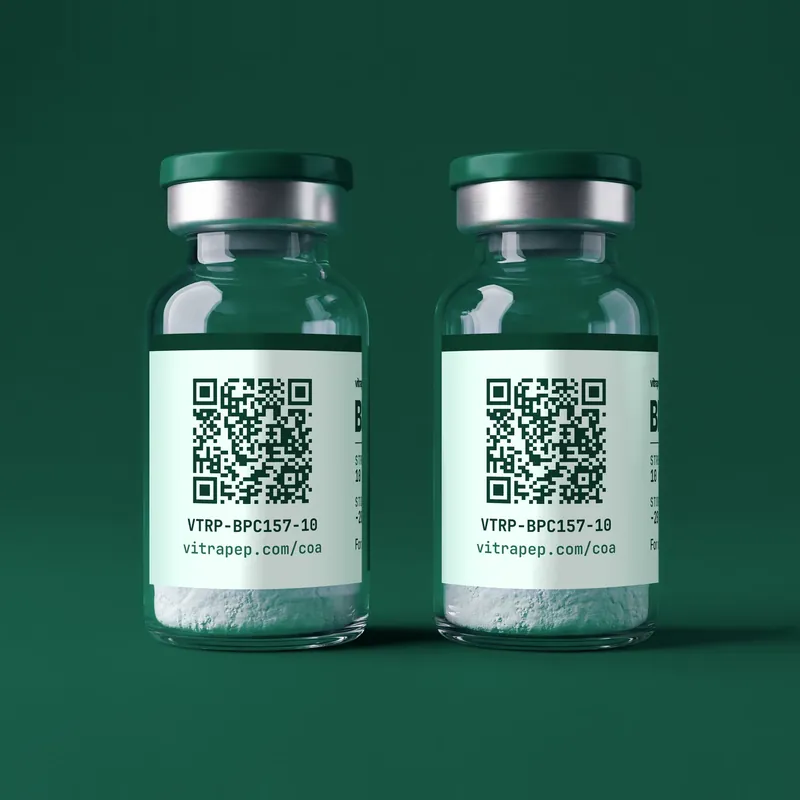
Enter the lot number printed on the vial to open that lot’s certificate from Freedom Diagnostics, including its endotoxin result. All Vitrapep products are for laboratory research use only, not for human or veterinary use.
How Vitrapep reports endotoxin
Freedom Diagnostics, the independent lab that tests each Vitrapep lot, runs the LAL assay under USP <85>, in duplicate. The certificate reports the endotoxin result as Pass, with no number. It also prints 0.05 EU/mL. That figure is the assay’s detection sensitivity. It is not a result, not a specification and not a ceiling, and it should never be converted into EU/mg.
Each lot’s certificate carries its lot number and test date; open it on the certificate lookup page. Vitrapep’s lyophilized vials are not sterile-filled, and no sterility claim is made. A PCR microbial screen is run on the Bacteriostatic Water certificate only. The quality page lists all 11 tests per lot. Everything in the catalog is for laboratory research use only and is not for human or veterinary use.
Frequently asked questions
Why do research peptides get an endotoxin test?
Because endotoxin can trigger responses in cells and animals that may be mistaken for an effect of the compound. An endotoxin result lets a researcher rule that out.
What does 0.05 EU/mL mean on a Vitrapep certificate?
It is the detection sensitivity of the assay. The result is the Pass beside it. The 0.05 figure is not a measured value or a limit for the lot.
What to know now
- What it is: lipopolysaccharide from Gram-negative bacteria; lipid A is the endotoxin part.
- Why it matters: it can cause responses in cells that get credited to the test compound.
- Main test: LAL under USP <85>, as gel-clot, turbidimetric or chromogenic assays.
- Alternative: recombinant Factor C under USP <86>, with no horseshoe crab blood.
- Units: EU, a measure of activity against a reference standard; EU/mL per milliliter tested.
- On a Vitrapep COA: Pass is the result; 0.05 EU/mL is the assay’s sensitivity.
What we’re watching
USP is moving recombinant reagents into monographs. A Pharmacopeial Forum proposal for Bacteriostatic Water for Injection would add <86> as an option next to <85>, with the endotoxin limit unchanged. Until a monograph names <86>, it remains an alternative test.