How to store peptides comes down to three things: temperature, moisture and light. Freeze-dried (lyophilized) research peptides hold up far better than peptides in solution, but they still change slowly over time. This guide sets out what peptide manufacturers and the stability literature say about storing the dry powder, what breaks peptides down, and what the dates on a certificate mean.
Quick answer: Do peptides need to be refrigerated? In lyophilized form, not during a short trip: manufacturers ship them at room temperature. For storage, yes. Manufacturer guidance puts short-term storage in a refrigerator (about 4 °C) and long-term storage in a freezer (−20 °C or colder), in a sealed vial kept dry and away from direct light.
Why lyophilized peptides are stable
Lyophilization is freeze-drying. The peptide is frozen and then dried, leaving a solid cake or powder in the vial. The reason to do it is shelf life. Wang’s review of solid protein pharmaceuticals notes that proteins often have to be made into solid forms to reach an acceptable shelf life, and that lyophilization is the most common way to do it.
Several of the reactions that break peptides down, such as hydrolysis, use water directly. Lai and Topp’s review of solid-state stability lists moisture content and temperature among the main factors that control how fast those reactions run. Removing the water slows them down.
Dry does not mean inert. The same review lists the reactions that still occur in solid peptides and proteins: deamidation, peptide bond cleavage, oxidation, the Maillard reaction, beta-elimination, and dimerization or aggregation. Wang adds that even a well-made lyophilized product may still have limited long-term storage stability. Storage conditions are what keep those reactions slow.
Recommended storage temperatures
Manufacturer guidance agrees on the outline, with small differences in the numbers.
Storage of lyophilized peptides, by stage
| Stage | Temperature | What the sources say |
|---|---|---|
| In transit | Room temperature | Bachem: peptides “may be shipped at room temperature” and are “typically shipped at ambient temperature.” |
| Short term | Refrigerator, about 4 °C | Bachem: for short-term use, peptides may be stored in a refrigerator at 4 °C. ICH’s refrigerator test condition is 5 °C ± 3 °C, which is 2 to 8 °C. |
| Long term | Freezer, −20 °C or colder | Bachem: below −15 °C, for example −50 °C or lower for long-term storage. Thermo Fisher: store at −20 °C on receipt. ICH’s freezer test condition is −20 °C ± 5 °C. |
| Every stage | Sealed, dry, dark | Bachem: a tightly closed container. Thermo Fisher: many peptides are light-sensitive and should be kept from direct light. |
The ICH figures come from ICH Q1A(R2), the international stability guideline used in drug registration. It sets the long-term test condition for drug substances meant for a refrigerator at 5 °C ± 3 °C, and for those meant for a freezer at −20 °C ± 5 °C. These are stability-test conditions, not handling advice. They show what “refrigerated” and “frozen” mean in regulatory stability work.
Do peptides need to be refrigerated?
For lyophilized peptides the answer is: not in transit, yes in storage. Bachem’s guide says products are typically shipped at ambient temperature. Once the vial arrives, the guidance moves it into the cold. Thermo Fisher’s handling sheet says to store the product at −20 °C immediately on receipt. Bachem allows a refrigerator for short-term use and asks for below −15 °C for longer storage. Cold slows the chemistry described below; it does not stop it.
This page covers the dry powder only. Peptides in solution are a separate case: Bachem notes that they may slowly undergo chemical degradation and does not recommend storing peptides in solution long term.
Moisture, and why a vial should warm up before it is opened
Peptides tend to be hygroscopic, which means they take up water from the air. Bachem’s guide says that because of this, the container should be allowed to reach ambient temperature in a desiccator before it is opened. It adds that moisture absorbed from the atmosphere reduces the overall peptide content and may also decrease stability. Thermo Fisher gives the same instruction: let the peptide warm to room temperature, preferably in a desiccator.
The point is to avoid exposing a cold, dry powder to room air while it is still cold. A desiccator keeps the air around the vial dry while it warms.
Freeze-thaw cycles
Thermo Fisher’s handling sheet says repeated thawing and freezing must be avoided, and it suggests preparing single-use aliquots on receipt where needed. For dry vials, each trip out of the freezer is also a chance for moist air to get in. Keeping stock in vials sized to be opened once, and leaving the rest sealed in the freezer, keeps the number of cycles low.
What degrades peptides
Stability reviews describe several chemical routes by which peptides and proteins degrade. Manning, Patel and Borchardt list proteolysis, deamidation, oxidation, racemization and beta-elimination. Bachem links shelf life to sequence: peptides containing Asn, Gln, Met, Cys and/or Trp have limited shelf lives. That residue list maps onto two of those routes, and a third applies to every sequence.
- Oxidation (Met, Cys, Trp). Li, Schöneich and Borchardt name methionine, cysteine, histidine, tryptophan and tyrosine as the residues most susceptible to oxidation. They note that oxidation can be catalyzed by transition metal ions and induced by light. Thermo Fisher describes peptides containing cysteine, methionine or tryptophan as rapidly susceptible to oxidation.
- Deamidation (Asn, Gln). Asparagine and glutamine side chains can lose their amide group, a reaction called deamidation. The rate depends strongly on the neighboring residues. In one model hexapeptide studied in solution, an Asn followed by Gly deamidated with a half-life of 1.4 days at 37 °C and pH 7.4. Replacing that Gly with a bulkier Leu or Pro slowed degradation 33- to 50-fold.
- Hydrolysis. Water can cut the peptide bond itself. Lai and Topp list peptide bond cleavage among the reactions that still occur in the solid state, with moisture content as one of the controlling factors.
None of these reactions change the label on the vial. Their products can show up as extra peaks on an HPLC trace and as a lower main-peak purity. Our guide to HPLC purity explains how those peaks are read.
Shelf-life language on a COA
Two terms show up on certificates and labels. Both come from ICH Q1A(R2):
- Re-test date. The date after which a drug substance should be examined again to confirm that it still meets its specification.
- Expiration date. The date before which a batch is expected to stay within its shelf-life specification if stored under defined conditions, and after which it must not be used.
Both definitions carry a condition: storage. A re-test or expiry date on a peptide certificate assumes the lot was kept under the conditions on its label. A vial left warm and open has not been tested against that date. Our guide to reading a COA covers where these dates sit on the page, and what are peptides covers the chemistry behind them.
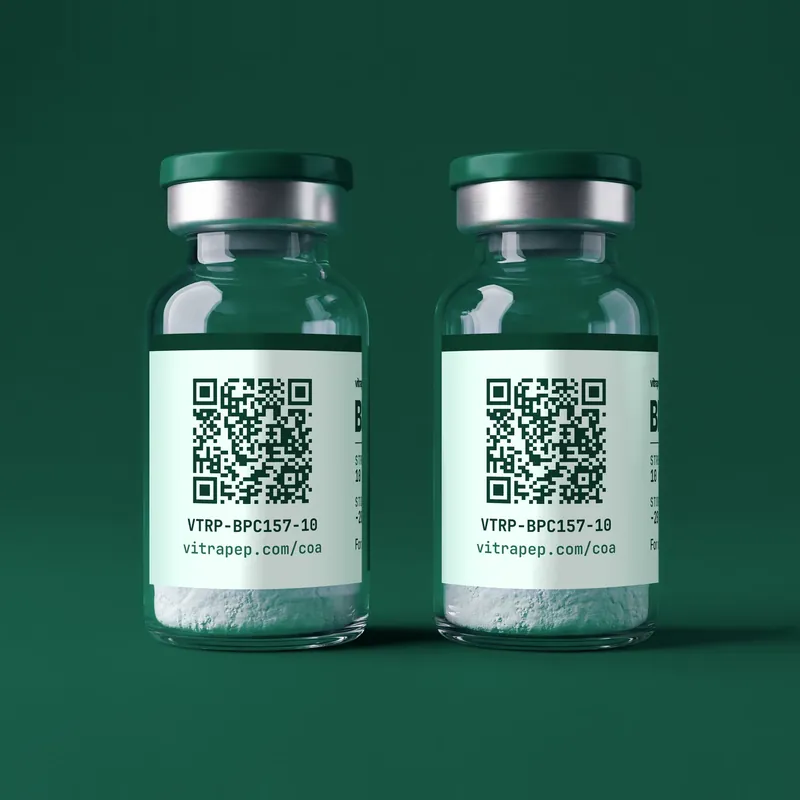
Vitrapep Research Catalog
Lyophilized research peptides in sealed vials, each lot with a third-party certificate of analysis and its storage conditions listed on the product page. For laboratory research use only, not for human or veterinary use.
How Vitrapep ships and lists storage
Vitrapep ships lyophilized vials by FedEx 2-Day from a cold-chain fulfillment center in California. The vials travel in their dry form, the same form manufacturers ship at room temperature, and Vitrapep’s product pages state that lyophilized vials are stable at room temperature in transit.
Each product page lists its own storage conditions and shelf life. Many lyophilized vials in the catalog list a 24-month shelf life, with −20 °C for long-term storage and 2 to 8 °C for shorter periods. The shipping policy asks buyers to move each order into the storage conditions on its labels as soon as it arrives. All Vitrapep products are for laboratory research use only and are not for human or veterinary use.
Frequently asked questions
Do peptides need to be refrigerated?
Lyophilized peptides do not need refrigeration during a short shipment; manufacturers ship them at room temperature. For storage, manufacturer guidance uses a refrigerator (about 4 °C) for the short term and a freezer (−20 °C or colder) for the long term.
How long do lyophilized peptides last?
It depends on the sequence and on storage. Sequences containing Asn, Gln, Met, Cys or Trp have shorter shelf lives. The answer for a given lot is the re-test or expiry date on its certificate, under the storage conditions on its label.
Why should a vial warm to room temperature before opening?
Peptides are hygroscopic. Opening a cold vial lets the powder take up moisture, which Bachem says reduces peptide content and may decrease stability.
Does light damage peptides?
It can. Thermo Fisher says many peptides are light-sensitive, and oxidation can be induced by light. Store vials in the dark.
What to know now
- Form matters: lyophilized (freeze-dried) peptides are far more stable than peptides in solution.
- Temperatures: room temperature in transit, about 4 °C short term, −20 °C or colder long term.
- Moisture: peptides are hygroscopic; let a cold vial reach room temperature, ideally in a desiccator, before opening.
- Light and freeze-thaw: keep vials dark and limit trips out of the freezer.
- Weak points: Met, Cys and Trp oxidize; Asn and Gln deamidate; peptide bonds can hydrolyze.
- Dates: a re-test or expiry date holds only under the storage conditions on the label.
What we’re watching
ICH is consolidating its stability guidelines. In June 2025 the FDA published a draft guidance, Q1 Stability Testing of Drug Substances and Drug Products, described as a consolidated revision of Q1A(R2), Q1B, Q1C, Q1D, Q1E and Q5C. The FDA page still lists it as a draft, marked not for implementation. The re-test and expiry definitions above are quoted from Q1A(R2).