CJC-1295 ipamorelin side effects are often discussed as if the combination has been tested in clinical trials. The available evidence does not support that assumption. Human findings for each compound separately cannot establish the safety of a combined product.
Quick answer: A reliable human side-effect profile for a CJC-1295 and ipamorelin blend has not been established. Separate evidence includes injection-site and cardiovascular events with CJC-1295, plus nausea and blood-pressure changes in an ipamorelin study. Combination-specific risks remain unknown.
Has a CJC-1295 and ipamorelin blend been studied in humans?
The available sources reviewed for this article do not establish a controlled human trial of a combined CJC-1295 and ipamorelin product.
This is an important evidence gap. A combination can have effects that differ from those of its individual components. Separate studies cannot determine whether adverse events become more frequent or whether new risks emerge when compounds are combined.
A recent orthopaedic review discusses CJC-1295 and ipamorelin together in a mouse model of glucocorticoid-induced muscle loss. That is preclinical evidence, not a human safety trial. Read the review abstract.
What side effects have been reported with CJC-1295?
The available controlled human study of CJC-1295 examined the long-acting DAC form. The study reported no serious adverse reactions. However, FDA's review describes events reported across the available clinical evidence.
These events include injection-site reactions, headache, flushing, diarrhea, nausea, abdominal pain, dizziness and hypotension. FDA also identified serious adverse events involving increased heart rate and systemic vasodilatory reactions.
The data are limited and do not establish the safety of all CJC-1295 forms. Read the FDA briefing.
What side effects have been reported with ipamorelin?
FDA reviewed a clinical study of ipamorelin in patients undergoing bowel surgery. Its briefing describes adverse events in both the ipamorelin and placebo groups.
Three participants in the ipamorelin group discontinued the study drug because of nausea, hypertension or hypotension. The FDA document also discusses serious adverse events, including infections, anastomotic leaks and readmissions.
Two deaths occurred among participants treated with ipamorelin. FDA noted uncertainty about whether those deaths were related to ipamorelin. The clinical setting and postoperative complications make causal interpretation difficult.
These findings should be reported with their study context. They do not prove that ipamorelin caused every event described. Read the FDA briefing document.
What human studies exist for each compound separately?
Four published human studies carry most of this evidence, each on one compound and each small.
Gobburu and colleagues examined ipamorelin in healthy male volunteers using a dose-escalation design. Forty-eight subjects were enrolled, with placebo subjects in every group. FDA’s review notes that the publication did not state that any adverse events occurred. A study that never discusses adverse events has not shown their absence. Read the volunteer study record.
Beck and colleagues reported the only published clinical trial in patients. It was a phase 2, randomized, double-blind, placebo-controlled study in adults having bowel resection, with 117 patients enrolled and 114 in the safety population. Treatment-emergent adverse events were reported in 87.5% of the ipamorelin group and 94.8% of the placebo group. FDA’s review lists hypokalemia at 12.5% versus 3.4%, insomnia at 10.7% versus 5.2%, and hyperglycemia at discharge at 14.3% versus 8.6%. Read the trial record.
Raun and colleagues first described ipamorelin’s selectivity, using rat pituitary cells, anesthetized rats and conscious swine. In swine, the peptide did not change FSH, LH, prolactin or TSH levels. It also did not raise ACTH or cortisol, as two comparison peptides did. That is cell and animal evidence, not a human safety result. Read the selectivity paper.
On the CJC-1295 side, Teichman and colleagues ran two randomized, placebo-controlled, ascending-dose trials. Both enrolled healthy adults aged 21 to 61, and ran 28 and 49 days. Ionescu and Frohman later measured growth hormone pulsatility overnight in 12 healthy men. FDA’s review records no serious adverse events in that second study, alongside a heart rate increase and transient injection-site redness and tenderness. Read the CJC-1295 trial report and the pulsatility study.
Across the published CJC-1295 studies, FDA counted 63 healthy adults. Men made up 87%, and 73% had only one exposure.
What each evidence source can and cannot show
| Evidence source | Compound | Population and size | Reported adverse events | What it cannot tell us about a blend |
|---|---|---|---|---|
| Gobburu et al., 1999 | Ipamorelin | 48 healthy male volunteers; dose-escalation pharmacology study | None stated in the publication, per FDA’s review | Short exposure in healthy men; no CJC-1295 group |
| Beck et al., 2014 | Ipamorelin | 117 adults enrolled after bowel resection; phase 2, placebo-controlled | Hypokalemia, insomnia and hyperglycemia above placebo; serious events in both groups; two deaths among treated patients | Surgical illness clouds attribution; no participant received CJC-1295 |
| Raun et al., 1998 | Ipamorelin | Rat pituitary cells, anesthetized rats and conscious swine | No change in FSH, LH, prolactin or TSH; no significant ACTH or cortisol rise | Cell and animal work; no human event rates |
| Teichman et al., 2006 | CJC-1295 DAC | Healthy adults; two randomized, placebo-controlled trials, 28 and 49 days | Injection-site reactions, headache, diarrhea, flushing and transient hypotension, per FDA’s review | Healthy volunteers only, short duration, no ipamorelin group |
| Ionescu and Frohman, 2006 | CJC-1295 DAC | 12 healthy men studied overnight | No serious events; heart rate increase; injection-site redness and tenderness | One session; nothing about repeated or combined exposure |
Could combining the compounds change the risk profile?
It is not known. Combining two compounds that influence the growth hormone pathway does not mean their effects or risks can be predicted by adding separate trial results.
Potential interactions, combined hormone effects and formulation-related risks have not been adequately characterized in human studies of the blend. There is also no established clinical evidence that a blend has the same composition or exposure characteristics across products.
A responsible evidence summary should therefore distinguish documented events from unanswered questions. Combination-specific adverse events are not established.
Why is there no direct evidence for the combination?
No one has registered the study that would answer the question. A ClinicalTrials.gov search on November 18, 2026 for trials listing both compounds as interventions returned no records.
The registered studies cover each compound alone. Ipamorelin has two completed phase 2 trials: a study in 117 adults and a larger dose-finding study in 320 patients. Results were never posted for the second. CJC-1295 appears in one phase 2 study in people with HIV-associated visceral obesity, which is listed as terminated.
Mechanism is the second reason. FDA’s review describes CJC-1295 as an analogue of growth hormone releasing hormone that acts at GHRH receptors on pituitary somatotroph cells. Ipamorelin instead acts at the ghrelin receptor, GHS-R1a, a receptor first cloned and described in 1996. See how ipamorelin acts at GHS-R for that pathway in detail.
Two receptors mean combined effects cannot be inferred by addition. Earlier work in 18 healthy men found that a growth hormone releasing peptide and GHRH together raised growth hormone synergistically. Those were different compounds, so the result does not describe this blend. It does show that the two pathways can interact, which is a reason to measure a combination rather than assume it. Read the 1990 report.
Adverse event reporting carries the same problem. FDA reviewed a report on a compounded product that held ipamorelin and a second peptide. The agency wrote that it could not assess a relationship between ipamorelin specifically and the event.
What does FDA say about the safety of these compounds?
FDA has identified CJC-1295-related concerns involving immunogenicity, peptide impurities and characterization. It has also identified serious adverse events involving increased heart rate and systemic vasodilatory reactions.
FDA's ipamorelin briefing discusses clinical safety data from a surgical population. It notes adverse events and deaths in treated participants, while acknowledging uncertainty about causation.
FDA review documents assess safety concerns. They do not constitute approval of either compound or a combined product.
How do regulators classify these two compounds?
FDA publishes a list of bulk drug substances that may present significant safety risks, called category 2 under its interim compounding policies. Both compounds appear there, on a page current as of April 22, 2026.
The CJC-1295 entry cites immunogenicity risk for certain routes, plus complexity around peptide-related impurities and ingredient characterization. It also cites serious adverse events, including increased heart rate and systemic vasodilatory reaction, and limited clinical data. Read the FDA category 2 list.
The ipamorelin acetate entry cites the same immunogenicity and characterization concerns. It notes that the peptide contains unnatural amino acids. It also refers to serious adverse events including death in the published hospital study. FDA added it to category 2 on September 29, 2023.
Both 2024 review memos reached the same proposal. Each recommended against adding the substance to the section 503A bulk drug substances list. For CJC-1295, FDA cited characterization gaps, an unclear history in compounding, nonclinical safety signals and missing clinical data. The advisory committee meeting held on July 23 and 24, 2026 reviewed a different set of peptides and did not revisit either compound.
The WADA 2026 Prohibited List took force on January 1, 2026. It names CJC-1295 among GHRH analogues and ipamorelin among growth hormone secretagogues, both in section S2.2.4. Both are prohibited at all times, in and out of competition. Read the 2026 list. Neither classification establishes a human safety profile for a blend.
Why is the evidence for blends especially limited?
A blend introduces additional questions about identity, composition, stability and consistency. Without a well-characterized product and controlled human study, researchers cannot reliably attribute an event to one ingredient or the combination.
The evidence also depends on the exact CJC-1295 form. DAC and non-DAC substances are not interchangeable evidence categories.
For these reasons, a side-effect list for the individual compounds should not be presented as a proven side-effect list for the blend.
For more background, see Vitrapep’s CJC-1295 side effects, ipamorelin side effects, CJC-1295 vs ipamorelin comparison and CJC-1295 complete guide. For why there is no approved dose, see why research peptides have no dose.
Vitrapep research material
Vitrapep sells CJC-1295 / ipamorelin blend for laboratory research use only. It is not for human or veterinary use.
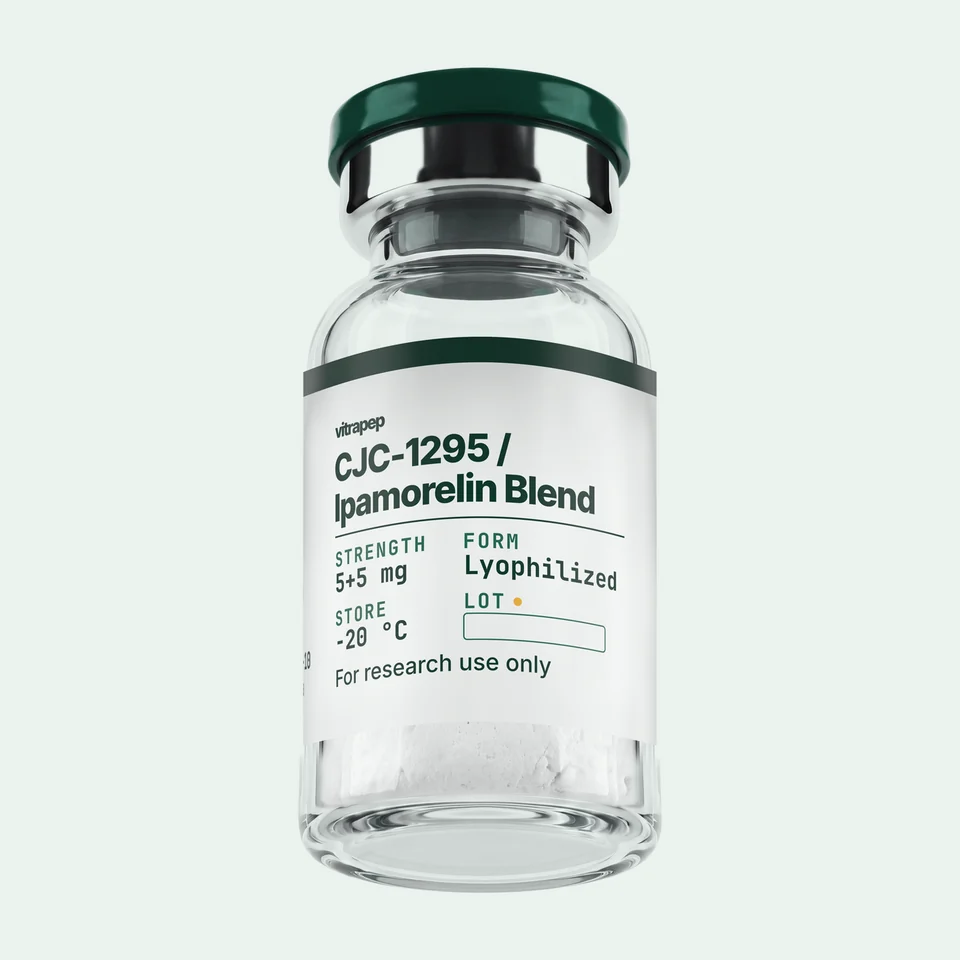
CJC-1295 / Ipamorelin Blend
Specifications for the CJC-1295 / ipamorelin blend sold for laboratory research. COA available with each lot.
Frequently asked questions
Are CJC-1295 and ipamorelin proven safe together?
No. The available sources do not establish a controlled human safety profile for the combination.
What are the known CJC-1295 side effects?
FDA materials describe injection-site reactions, headache, flushing, gastrointestinal symptoms, dizziness, hypotension and increased heart rate.
What are the known ipamorelin side effects?
An FDA-reviewed surgical study reported nausea and blood-pressure changes among reasons for discontinuation. The FDA document also describes serious postoperative events and notes uncertainty about causation.
Have deaths been reported in an ipamorelin study?
Yes. FDA's review describes two deaths among ipamorelin-treated participants in a surgical study. It states that the relationship between treatment and those deaths is unclear.
Does animal research prove the blend works or is safe in people?
No. Animal findings can inform research questions. They cannot establish human efficacy or safety.
Is there a registered trial of the two compounds together?
No. A ClinicalTrials.gov search on November 18, 2026 for studies listing both compounds returned no records.
Do CJC-1295 and ipamorelin act on the same receptor?
No. FDA reviews describe CJC-1295 as a GHRH analogue acting at GHRH receptors, while ipamorelin acts at the ghrelin receptor GHS-R1a.
Are both compounds prohibited in sport?
Yes. The WADA 2026 Prohibited List names both in section S2.2.4, which is prohibited at all times. That classification concerns sport, not laboratory safety.
What to know now
- Combination-specific human safety data for CJC-1295 plus ipamorelin are not established.
- Separate FDA reviews describe adverse events for each compound, but in different research contexts.
- Animal combination findings do not establish human safety or effectiveness.
What we’re watching
- Any registered, controlled human trial that evaluates the actual combination.
- New FDA safety reviews for CJC-1295 and ipamorelin.
- Research that identifies the exact CJC-1295 form and blend composition.
- Whether a future FDA advisory committee briefing revisits either substance.