Ipamorelin side effects have not been characterized through a broad clinical development program. The main human safety evidence comes from a randomized study in adults recovering from bowel surgery, while an FDA review highlighted both reported events and substantial gaps in what is known.
Quick answer: Ipamorelin side effects reported in the limited human trial evidence include gastrointestinal symptoms, hypokalemia, insomnia and hyperglycemia. The study population was recovering from major surgery, so the findings cannot be assumed to represent risks in other settings. Ipamorelin is not FDA-approved, and long-term human safety remains uncertain.
What is known about ipamorelin side effects?
The published human evidence is too limited to calculate reliable side-effect rates across general populations. The main published safety dataset evaluated ipamorelin in adults undergoing bowel resection, where postoperative complications and normal recovery symptoms can overlap with treatment-emergent events. A separate early pharmacokinetic study in healthy male volunteers examined ipamorelin exposure and growth-hormone responses, but it was not a long-term safety trial. The FDA's 2024 Pharmacy Compounding Advisory Committee briefing summarized these data and emphasized the narrow context of the safety database.
Ipamorelin is a growth hormone secretagogue. Early pharmacology research by Raun and colleagues described its action through the growth hormone secretagogue receptor, also called GHSR1a or the ghrelin receptor. That mechanism helps explain why researchers investigated it, but receptor selectivity does not by itself establish safety in humans. A compound's side-effect profile requires clinical observations across adequate numbers of participants and different populations.
What did the human ipamorelin trial report?
Beck and colleagues published a randomized, double-blind, placebo-controlled Phase 2 proof-of-concept study in 2014. The study enrolled 117 adults undergoing bowel resection and evaluated ipamorelin for postoperative ileus. The trial's main question concerned recovery of gastrointestinal function after surgery, not general wellness, exercise performance or long-term growth-hormone outcomes.
The clinical-trial record is also available on ClinicalTrials.gov under NCT00672074. The study reported treatment-emergent adverse events in both groups. The FDA briefing summarized the overall proportion as 87.5% in ipamorelin-treated participants and 94.8% in placebo participants. The high rates reflect the surgical setting and should not be read as ordinary background rates for healthy adults. Many recorded events were mild or moderate and could also be related to surgery or the underlying condition.
The FDA review highlighted some event categories that were numerically more common in the ipamorelin group. These included hypokalemia, insomnia and hyperglycemia at discharge. The briefing also summarized discontinuations and serious adverse events. A numerical difference in a small study does not prove that ipamorelin caused an event, but it is relevant to the safety assessment and should not be omitted.
What did the human ipamorelin trial report
| Reported event or outcome | Ipamorelin group | Placebo group | Context |
|---|---|---|---|
| Any treatment-emergent adverse event | 87.5% | 94.8% | Postoperative study; many events could relate to surgery or illness |
| Hypokalemia | 12.5% | 3.4% | Highlighted in FDA's review; small study, causality not established |
| Insomnia | 10.7% | 5.2% | Numerical difference in the postoperative trial |
| Hyperglycemia at discharge | 14.3% | 8.6% | Postoperative discharge measurement |
| Serious adverse events | 17.9% | 15.5% | FDA review summary; not proof of drug causation |
The FDA briefing also described discontinuations in the ipamorelin group associated with nausea, hypertension and hypotension. Several placebo participants also discontinued because of events including electrolyte disturbance, vomiting, nausea or abdominal distention. Two deaths occurred among ipamorelin-treated participants following bowel resection and postoperative complications. FDA stated that a causal relationship between ipamorelin and those deaths was unclear. The deaths should therefore be disclosed as part of the trial record, but not described as proven drug-related fatalities.
Which symptoms were reported most often?
Nausea, vomiting and abdominal distention were among the events discussed in the FDA briefing. They occurred in a population recovering from abdominal surgery, so it is difficult to separate a possible pharmacologic contribution from normal postoperative symptoms. The trial did not create a general profile of common ipamorelin side effects in healthy people.
The same caution applies to hypokalemia, insomnia and hyperglycemia. FDA noted numerical imbalances between groups, but the trial was small and not designed to provide precise risk estimates for every event. These observations are signals for further study, not a complete list of established adverse reactions.
The study also cannot answer whether adverse-event patterns would differ in longer-term exposure or in other populations. Safety findings are shaped by who was studied, what condition they had, the duration of observation and how events were collected. A small clinical trial is valuable because it provides direct human data, but it cannot replace larger and longer studies.
What does FDA say about ipamorelin safety?
Ipamorelin is not an FDA-approved drug. In 2024, FDA staff reviewed ipamorelin-related bulk drug substances in the context of the Pharmacy Compounding Advisory Committee's consideration of substances proposed for compounding. The briefing described the limited clinical data and identified uncertainties relevant to safety. The committee process and staff assessment are not equivalent to FDA drug approval.
FDA's review noted that only one clinical safety study was available in the evidence package, involving patients after bowel surgery. The agency also discussed the limited information available for proposed formulations and administration contexts. The absence of additional clinical data does not mean that a product is safe; it means that the risk profile is not well established.
It is also important not to treat studies of other growth-hormone secretagogues as if they directly measured ipamorelin. Related compounds can differ in receptor activity, pharmacokinetics and clinical effects. Safety conclusions should be tied to the molecule that was actually studied.
For additional context, see Vitrapep's ipamorelin complete guide, ipamorelin research summary, and ipamorelin mechanism article. The tesamorelin vs ipamorelin comparison explains why evidence from the two compounds should not be mixed.
Vitrapep research material
Vitrapep sells ipamorelin for laboratory research use only. It is not for human or veterinary use.
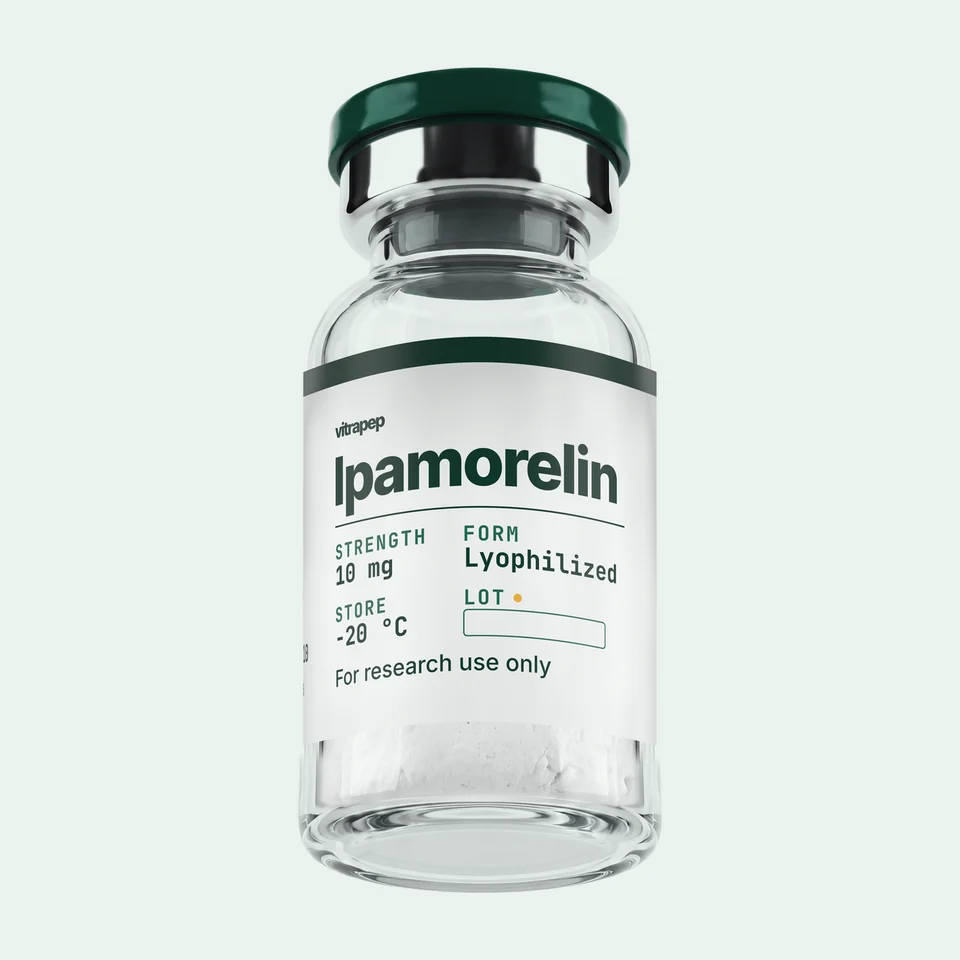
Ipamorelin
Specifications for the ipamorelin sold for laboratory research. COA available with each lot.
What are the main evidence limitations?
The most important limitation is sample size and study setting. One postoperative trial cannot establish a reliable event rate for healthy volunteers or for other research populations. The underlying surgery and hospitalization can themselves cause nausea, vomiting, electrolyte disturbances, sleep disruption and changes in blood glucose.
A second limitation is duration. A short study cannot establish long-term safety. It also cannot reliably detect uncommon adverse events. Larger and longer controlled studies would be needed to characterize event frequency, identify less common risks and determine whether findings differ across populations.
A third limitation is that ipamorelin's intended uses in commercial research discussions may exceed the human evidence. The available postoperative study does not validate claims about body composition, recovery, healthy aging or athletic performance. Those topics require their own appropriately designed clinical studies.
Frequently asked questions
What are the most commonly reported ipamorelin side effects?
The limited human trial reported gastrointestinal events such as nausea, vomiting and abdominal distention. FDA's review also highlighted hypokalemia, insomnia and hyperglycemia in the postoperative study.
Did the ipamorelin trial prove that ipamorelin caused these events?
No. Participants were recovering from bowel surgery, and many events could also be related to the procedure or underlying illness. The study provides observations, not definitive causation for each event.
Is ipamorelin FDA-approved?
No. Ipamorelin is not an FDA-approved drug. FDA has reviewed limited evidence in the context of proposed bulk drug substances for compounding.
Are there long-term safety studies of ipamorelin?
The human evidence reviewed by FDA was very limited. The available trial does not establish long-term safety across different populations.
Did deaths occur in the ipamorelin study?
The FDA briefing reported two deaths among ipamorelin-treated participants after bowel resection and postoperative complications. FDA stated that the relationship to ipamorelin was unclear, so the deaths cannot be attributed to the compound on the available evidence.
What to know now
- The main human safety dataset is a small postoperative bowel-surgery trial, not a broad study in healthy adults.
- Reported events included gastrointestinal symptoms, hypokalemia, insomnia and hyperglycemia, but causal relationships are not established for every event.
- Ipamorelin is not FDA-approved, and long-term human safety remains insufficiently characterized.
What we’re watching
- Publication of larger controlled human studies with clearly defined adverse-event collection.
- Further FDA evaluation of ipamorelin-related bulk drug substances and proposed formulations.
- Independent studies that assess safety outside the postoperative setting.