Tesamorelin vs ipamorelin is a useful research comparison because the compounds stimulate the growth-hormone axis through distinct pathways. Tesamorelin has randomized clinical-trial evidence and a narrowly defined FDA-approved indication, while ipamorelin has a smaller human evidence base centered on a postoperative bowel-surgery study.
Quick answer: Tesamorelin and ipamorelin are not interchangeable. Tesamorelin has Phase 3 evidence and an FDA-approved prescription product for a specific HIV-associated indication. Ipamorelin remains investigational and has limited human safety and efficacy data.
What does the tesamorelin vs ipamorelin research show?
Tesamorelin and ipamorelin influence growth-hormone signaling through different receptors. Tesamorelin is a synthetic GHRH analog. It activates the GHRH receptor in the pituitary and stimulates the body's own growth-hormone release. Ipamorelin is a growth hormone secretagogue that activates the growth hormone secretagogue receptor, also known as GHSR1a or the ghrelin receptor.
The distinction matters because these pathways are related but not identical. GHRH is a natural hypothalamic signal that promotes growth-hormone secretion. Ghrelin and related secretagogues signal through a separate receptor system. Early pharmacology work by Raun and colleagues described ipamorelin as a relatively selective growth hormone secretagogue, with less activity on some other pituitary hormones than older secretagogues. That selectivity is a mechanistic observation, not proof of long-term clinical safety.
Tesamorelin's mechanism and clinical use are described in the current FDA prescribing information for Egrifta WR. The label states that it is a GHRH analog and that it increases endogenous growth-hormone secretion and insulin-like growth factor 1 (IGF-1). The product's FDA indication is reduction of excess abdominal fat in adults with HIV-associated lipodystrophy. It is not indicated for general weight-loss management.
Ipamorelin's receptor pharmacology was characterized in preclinical research by Raun and colleagues. The compound stimulated growth-hormone release through the secretagogue receptor. Its human development has been much more limited than tesamorelin's. The distinction between a well-described biological mechanism and a proven clinical outcome is important throughout this comparison.
What did clinical studies report for tesamorelin?
Randomized trials found that tesamorelin reduced visceral abdominal fat in adults with HIV-associated lipodystrophy. In a 26-week randomized, double-blind trial published by Falutz and colleagues in the New England Journal of Medicine in 2007, 412 adults with HIV and excess abdominal fat received tesamorelin or placebo. The tesamorelin group had a 15.2% reduction in visceral adipose tissue, while the placebo group had a 5.0% increase. The groups also differed in triglyceride and IGF-1 changes. These findings support the specific indication studied, not a general claim about weight loss in other populations.
A longer follow-up study by Falutz and colleagues in 2010 examined continued treatment and safety in adults with HIV-associated abdominal fat accumulation. These trials contributed to the evidence base for the FDA-approved product. The current Egrifta WR prescribing information continues to restrict the indication to adults with HIV-associated lipodystrophy and explicitly says the product is not indicated for weight-loss management.
What did clinical studies report for tesamorelin
| Tesamorelin evidence | Population and design | Main finding | Interpretation |
|---|---|---|---|
| Falutz et al., 2007 | 412 adults with HIV and excess abdominal fat; randomized, placebo-controlled, 26 weeks | Visceral adipose tissue changed by -15.2% with tesamorelin and +5.0% with placebo | Direct human evidence for the studied HIV-associated indication |
| Long-term follow-up, 2010 | Adults with HIV-associated abdominal fat; randomized study with extension | Evaluated maintenance of effects and longer-term safety | Adds follow-up context, but does not broaden the approved indication |
| FDA prescribing information | Regulatory review of clinical trials | Defines a narrow indication and important warnings | The label, not promotional wording, determines approved use |
What did human studies report for ipamorelin?
Ipamorelin has one particularly important published human safety and efficacy study in postoperative ileus, a temporary slowing of bowel function after surgery. A separate early pharmacokinetic and pharmacodynamic study in healthy volunteers examined the compound and growth-hormone response, but it did not establish a broad long-term safety profile. Beck and colleagues reported a randomized, double-blind, placebo-controlled study involving 117 adults undergoing bowel resection. The trial evaluated whether ipamorelin could improve gastrointestinal recovery after surgery.
The primary efficacy outcomes did not establish a statistically significant benefit. The median time to first tolerated meal was 25.3 hours in the ipamorelin group and 32.6 hours in the placebo group, with a reported p value of 0.15. The trial therefore did not demonstrate a statistically significant difference on that measure. It remains a useful human pharmacology and safety data point, but it does not provide evidence that ipamorelin has the same clinical effects as tesamorelin.
The FDA's 2024 Pharmacy Compounding Advisory Committee briefing reviewed this limited evidence. It summarized the postoperative study and noted that most treatment-emergent adverse events were mild or moderate, often in the setting of surgery and underlying illness. The briefing also highlighted safety uncertainties and the lack of adequate evidence for other proposed uses and routes. A committee briefing is a regulatory scientific review, not an FDA approval of ipamorelin.
How do the safety findings compare?
The compounds have different safety evidence because they have been studied in different settings. Tesamorelin's prescribing information identifies clinically relevant concerns, including increased IGF-1, fluid retention, glucose intolerance or diabetes, and hypersensitivity. In the combined clinical-trial data presented in the label, injection-site reactions were reported more often with tesamorelin than placebo. The label also reports a higher proportion of participants reaching the specified hemoglobin A1c threshold in the tesamorelin group. These findings should be read within the trial populations and the product's approved indication.
Ipamorelin's safety database is much smaller. In the postoperative trial reviewed by FDA, common events included nausea, vomiting and abdominal distention, which occurred in a population already recovering from major surgery. The FDA briefing reported hypokalemia and insomnia more often in the ipamorelin group than in placebo, and described several discontinuations. Two deaths occurred among ipamorelin-treated participants after bowel resection and postoperative complications; FDA stated that a causal relationship to ipamorelin was unclear. The study cannot establish that ipamorelin caused those deaths.
How do the safety findings compare
| Safety question | Tesamorelin | Ipamorelin |
|---|---|---|
| Evidence base | Multiple clinical trials and an FDA-reviewed prescription label | Limited human evidence, including one postoperative trial |
| Important reported concerns | Injection-site reactions, fluid retention, elevated IGF-1, glucose changes and hypersensitivity warnings | Trial events included nausea, vomiting, abdominal symptoms, hypokalemia and insomnia; causality can be difficult to separate from surgery |
| Regulatory status | FDA-approved for a specific HIV-associated lipodystrophy indication | Not FDA-approved as a drug |
| Main uncertainty | Safety and effectiveness outside the labeled population | Long-term safety and effectiveness across proposed research and clinical contexts |
Is tesamorelin better than ipamorelin?
The available evidence does not support a universal ranking. Tesamorelin has stronger clinical evidence for one narrow, defined indication: reduction of excess abdominal fat in adults with HIV-associated lipodystrophy. Ipamorelin has a different mechanism and a much smaller clinical evidence base. No direct head-to-head trial has established that tesamorelin is better than ipamorelin for a shared clinical outcome.
A scientifically sound comparison asks which compound was studied, in which population, against what comparator and for which endpoint. The tesamorelin studies cannot be used to infer an ipamorelin effect. Likewise, the postoperative ipamorelin trial cannot establish that it has the same effects as a GHRH analog. Research buyers and readers should also distinguish FDA-approved prescription labeling from investigational research.
For more background, see Vitrapep's tesamorelin complete guide, tesamorelin side-effects article, ipamorelin complete guide, and ipamorelin research summary.
Vitrapep research material
Vitrapep sells tesamorelin for laboratory research use only. It is not for human or veterinary use. Vitrapep sells ipamorelin for laboratory research use only. It is not for human or veterinary use.
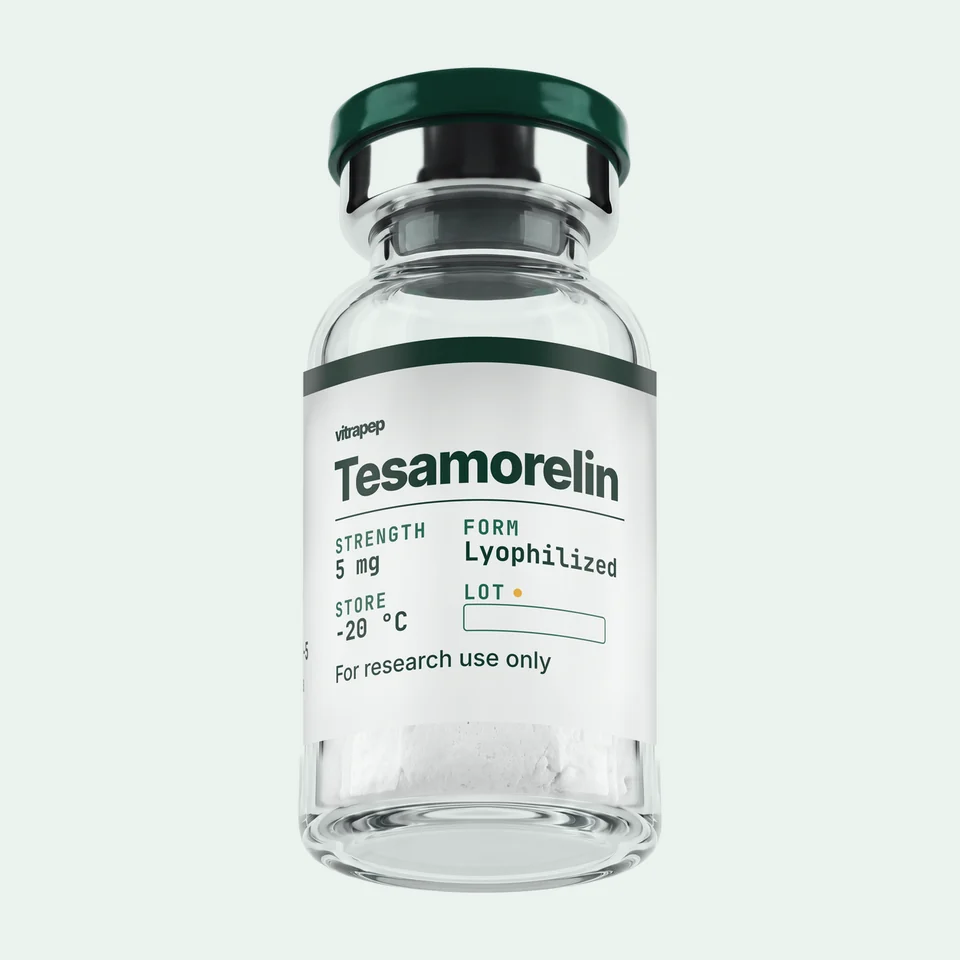
Tesamorelin
Specifications for the tesamorelin sold for laboratory research. COA available with each lot.
Frequently asked questions
Are tesamorelin and ipamorelin the same type of peptide?
No. Tesamorelin is a GHRH analog, while ipamorelin is a growth hormone secretagogue that acts through the ghrelin receptor. Both influence growth-hormone signaling, but they use different receptors.
Is tesamorelin FDA-approved?
Yes. The FDA-approved Egrifta WR product is indicated to reduce excess abdominal fat in adults with HIV-associated lipodystrophy. The label says it is not indicated for weight-loss management.
Is ipamorelin FDA-approved?
No. Ipamorelin is not an FDA-approved drug. FDA has reviewed a limited evidence package in the context of bulk drug substances proposed for compounding.
Is there a direct tesamorelin vs ipamorelin clinical trial?
No head-to-head clinical trial establishing comparative superiority was identified in the sources reviewed. Their clinical evidence comes from different populations and research questions.
Which compound has more human research?
Tesamorelin has the more developed human evidence base, including randomized trials supporting its narrow FDA-approved indication. Ipamorelin's human evidence is much more limited.
What to know now
- Tesamorelin and ipamorelin activate different receptors within growth-hormone signaling.
- Tesamorelin has randomized human evidence and a narrow FDA-approved indication for HIV-associated lipodystrophy.
- Ipamorelin remains investigational, with limited human evidence and unresolved long-term safety questions.
What we’re watching
- Further FDA updates concerning ipamorelin and bulk drug substances proposed for compounding.
- Additional peer-reviewed human studies that clarify ipamorelin's pharmacology, safety and clinical endpoints.
- Updated tesamorelin label revisions or trials that may clarify longer-term outcomes within the approved population.