Selank side effects are difficult to summarize because the published human literature is limited and does not provide a comprehensive safety profile. FDA has highlighted potential immunogenicity concerns and gaps in human safety information for selank acetate.
Quick answer: A definitive list of Selank side effects cannot be established from the available evidence. FDA has raised concerns about possible immune reactions and product-related impurities. Limited published reports should not be interpreted as proof that Selank has no adverse effects.
What side effects have been reported in Selank research?
Published reports do not provide a comprehensive, consistently reported adverse-event profile. Study designs, reporting standards and product descriptions vary across the literature.
This means readers should be cautious about online lists that present specific symptoms as established Selank side effects. If a study does not discuss adverse events, that does not mean no adverse events occurred.
The evidence also differs by product form. FDA's safety assessment specifically discusses selank acetate, also identified as TP-7.
What did human studies of Selank record about adverse events?
Most human data come from a few small Russian studies in adults with anxiety-related disorders. They compared Selank with benzodiazepines, a common class of anti-anxiety drugs, not with placebo. The papers are in Russian, with English abstracts on PubMed.
Zozulia and colleagues (2008) studied 62 patients with generalized anxiety disorder or neurasthenia. Thirty received Selank and 32 received medazepam, a benzodiazepine. PubMed classifies the study as a randomized controlled trial. The abstract reports similar anti-anxiety effects in both groups but does not describe adverse events.
Medvedev and colleagues (2014) ran an open-label study in 60 adults aged 18 to 55 with mild to moderate anxiety-related disorders. Patients were randomly assigned to Selank or phenazepam, another benzodiazepine, for 14 days. Safety was judged from spontaneous complaints, a standard side-effect rating scale (UKU) and physical exams.
In the full Russian text, nasal dryness was the most notable complaint with Selank, recorded in 7% of that group at day 21. At day 14, the Selank group also had longer sleep in 13%, memory impairment in 10% and impaired concentration in 7%. No sedation was recorded with Selank. In the phenazepam group, sedation was recorded in every patient by day 14. Anxiety subscale scores also fell more with phenazepam by day 14, 55% versus 26.3%.
A 2015 study by the same group randomly assigned 70 adults to phenazepam alone or to Selank plus phenazepam. The combination group had fewer benzodiazepine-type events, such as sedation in 68% versus 100% at day 14. Nasal dryness appeared only in the combination group, in 7.5% of patients at day 14. Because every patient took phenazepam, this design cannot isolate Selank’s own adverse events.
The 2015 phenazepam-only group matches the 2014 phenazepam group in size, demographics and adverse-event percentages. That suggests the two papers share one comparator group, so they are not fully independent. Both papers acknowledge support from a Russian company and a state research grant. Both also include an author from the institute that developed Selank.
A 2020 brain-imaging study scanned 52 healthy participants before and shortly after Selank, Semax or placebo. Its abstract does not discuss adverse events.
What did human studies of Selank record about adverse events
| Study | Population and size | Comparator and design | Reported adverse events | Main limitation |
|---|---|---|---|---|
| Zozulia et al., 2008 | 62 adults with generalized anxiety disorder or neurasthenia | Medazepam; classified by PubMed as randomized | Not discussed in the PubMed abstract | No placebo group; safety data not in the abstract |
| Medvedev et al., 2014 | 60 adults aged 18 to 55 with anxiety-related disorders | Phenazepam; open-label, randomly assigned, 14 days plus one week of follow-up | Selank group: nasal dryness, longer sleep, memory and concentration complaints; no sedation recorded | Small, open-label, developer-linked authors |
| Medvedev et al., 2015 | 70 adults aged 18 to 55 with anxiety-related disorders | Phenazepam alone vs Selank plus phenazepam; open-label | Fewer benzodiazepine-type events with the combination; nasal dryness only in the combination group | Everyone took phenazepam; comparator group appears shared with the 2014 paper |
| Panikratova et al., 2020 | 52 healthy participants | Placebo and Semax; brain-imaging study over minutes | Not discussed in the abstract | Not designed to measure safety |
Together, these four reports include fewer than 250 participants, and the Selank groups were smaller still. The reports that state a duration followed patients for three weeks or less. A search of ClinicalTrials.gov on November 18, 2026 found no registered trial testing Selank.
What does the FDA say about Selank safety?
FDA states that compounded drugs containing selank acetate may pose a risk of immunogenicity for certain routes of administration. The agency identifies potential aggregation and peptide-related impurities as relevant concerns.
FDA also says it lacks important information about safety issues raised by selank acetate when administered to humans. This is a statement about insufficient evidence, not a finding that harm is certain.
The FDA lists selank acetate on its page covering bulk drug substances that may present significant safety risks. Read the FDA safety summary.
Selank was not on the agenda of FDA’s July 23-24, 2026 Pharmacy Compounding Advisory Committee meeting. The Federal Register notice listed seven substance groups for discussion, including Semax, BPC-157 and TB-500. Selank was not among them, and we found no FDA advisory committee briefing document specific to Selank.
What is immunogenicity, and why does it matter?
Immunogenicity is the ability of a substance to trigger an immune response. For peptide products, the immune system may recognize the peptide or related material as foreign.
An immune response can vary in significance. Some responses may be detectable only through laboratory testing. Others can affect how a biological product behaves.
FDA's concern includes the possibility of aggregation and peptide-related impurities. These factors can influence immune recognition. The agency has not established the full extent of risk for selank acetate.
Are Selank and selank acetate the same?
The names are related, but the exact chemical form matters when evaluating research. FDA's safety summary specifically refers to selank acetate, also called TP-7.
A study of one preparation should not automatically be treated as evidence for every formulation or product sold under a similar name. Chemical identity, purity and product quality all affect how closely a research result applies.
In 2017 and 2018, a Belgian public health laboratory analyzed two unknown seized preparations and found Selank and Semax. The authors developed a mass spectrometry method so control laboratories can identify such peptides. They also found these peptides freely available online.
Where was Selank developed, and where is it registered?
Selank is a synthetic heptapeptide, a chain of seven amino acids: Thr-Lys-Pro-Arg-Pro-Gly-Pro. Its first four amino acids match tuftsin, a natural fragment of the human immunoglobulin G heavy chain. Pro-Gly-Pro was added to the end to improve metabolic stability, according to Volkova and colleagues (2016).
Selank was designed at the Institute of Molecular Genetics, Russian Academy of Sciences, with the Zakusov Research Institute of Pharmacology. Nearly all studies cited on this page come from Russian groups, several linked to these institutes. We found no published clinical trial of Selank run outside Russia.
Selank is registered as a medicine in Russia. A 2022 review of Russian peptide drugs lists it among 14 peptide products registered in the Russian Federation, classed as an anxiolytic. The 2014 Medvedev paper also states that Selank is permitted for treating anxiety disorders in Russia.
Is Selank FDA-approved?
The FDA materials cited here do not identify Selank or selank acetate as an FDA-approved medicine. FDA's review of a substance for compounding safety is not an approval.
A product labeled for research use is not thereby approved for human use. Regulatory status must be evaluated separately from a seller's label or marketing description.
For broader context, see how to evaluate peptide research.
Why is it difficult to establish a reliable Selank safety profile?
A reliable safety profile requires well-designed human studies, clear product characterization and consistent adverse-event reporting. The available evidence does not meet that standard.
Published studies may focus on a particular population or research question. Small studies may also be unable to identify uncommon or delayed adverse events.
FDA's assessment highlights the lack of important safety information. Until better data are available, the safest scientific conclusion is that Selank's human safety profile remains uncertain.
What have animal and cell studies shown about how Selank acts?
Laboratory studies point to mechanisms that could relate to both intended and unwanted effects. None of them proves a benefit or rules out harm in people.
GABA is the brain’s main inhibitory chemical messenger, and benzodiazepines act on its receptors. In rats, Volkova and colleagues (2016) measured 84 neurotransmission genes in the frontal cortex. Selank changed the expression of a number of them, and its early pattern correlated with that of GABA itself. The authors proposed that Selank may modulate the GABA system.
Enkephalins are natural opioid-like peptides broken down by enzymes in the body. In a 2001 laboratory study, Selank slowed the enzyme breakdown of enkephalin in blood plasma. The same paper reported a shorter enkephalin half-life in blood from patients with generalized anxiety disorder.
BDNF is a growth factor involved in nerve cell plasticity. In rats given long-term alcohol, Selank prevented an alcohol-linked rise in BDNF in two brain regions (Kolik et al., 2019).
Safety-focused animal data are sparse. In anesthetized cats, Selank was followed by a brief fall in arterial blood pressure of about 32% (Gan’shina and Kozlovskii, 2005). The drop was seen in the first one to three minutes, and heart and breathing rates did not change. Whether this finding has any human relevance is unknown.
For more background, see Vitrapep’s Selank complete guide, Selank research summary, Selank vs Semax comparison and Semax side effects.
Vitrapep research material
Vitrapep sells Selank for laboratory research use only. It is not for human or veterinary use.
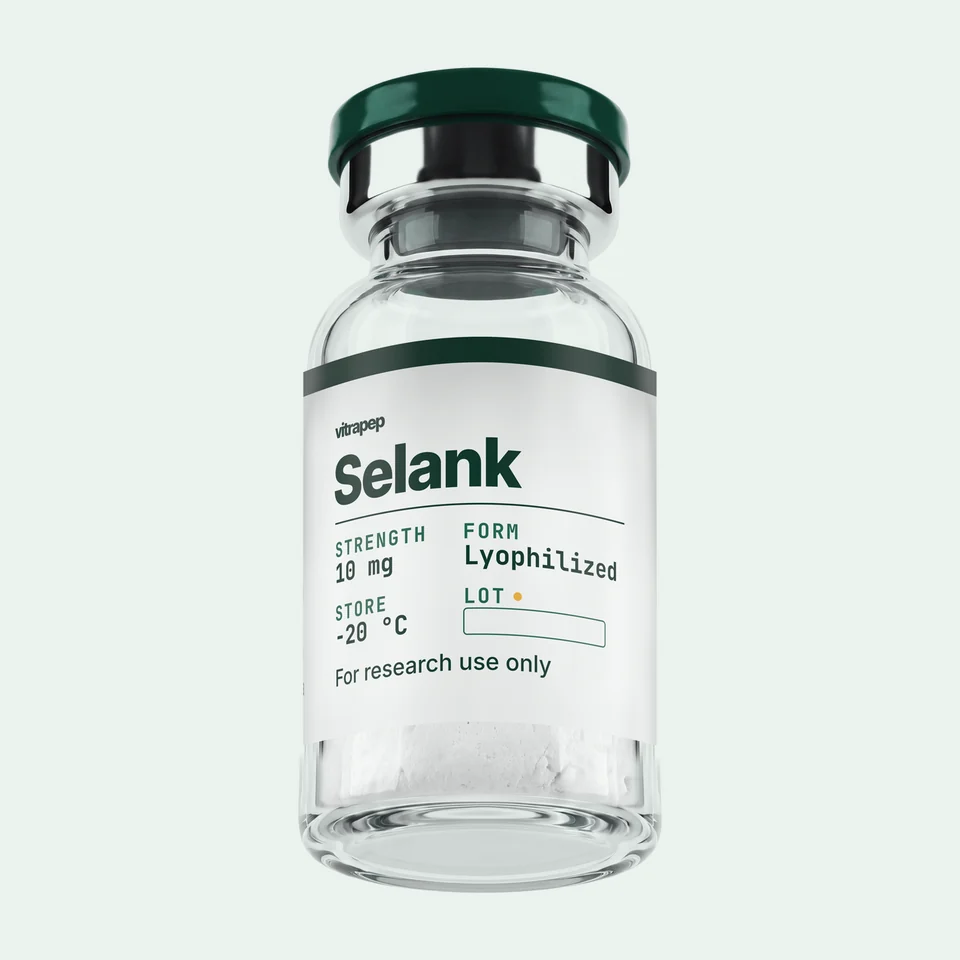
Selank
Specifications for the Selank sold for laboratory research. COA available with each lot.
Frequently asked questions
What are the most common Selank side effects?
The available evidence does not establish a reliable list of common side effects. FDA says important safety information about selank acetate is lacking.
Does Selank cause immune reactions?
FDA identifies potential immunogenicity concerns for selank acetate. It cites aggregation and peptide-related impurities as possible contributing factors.
Is Selank acetate FDA-approved?
The FDA materials cited here do not identify selank acetate as an FDA-approved medicine.
Does a lack of reported side effects mean Selank is safe?
No. If a study does not report adverse events, that is not evidence that no events occurred. Limited reporting cannot establish safety.
Is Selank the same as Semax?
No. They are different peptide substances. Their research findings and FDA safety assessments should be evaluated separately.
What adverse events did Russian Selank trials record?
In a 2014 open-label study, nasal dryness was the most notable complaint with Selank. Some patients also reported longer sleep or memory and concentration problems. The 2008 trial abstract does not describe adverse events. These small, short studies cannot establish a full side-effect list.
Where is Selank registered as a medicine?
Peer-reviewed sources by Russian researchers describe Selank as a registered anxiolytic in Russia. We found no source showing approval outside Russia.
Did FDA’s July 2026 advisory committee review Selank?
No. The Federal Register notice for the July 23-24, 2026 meeting listed seven substance groups, including Semax, but not Selank.
What to know now
- Selank's published human safety evidence is limited.
- FDA identifies potential immunogenicity risks related to aggregation and peptide impurities.
- FDA says important safety information about selank acetate in humans is lacking.
- Russian trials of Selank were small and short, used benzodiazepine comparators, and reported adverse events unevenly.
What we’re watching
- Better-characterized human studies with transparent adverse-event reporting.
- New FDA assessments of selank acetate and peptide-related impurities.
- Research that clarifies whether findings apply across different Selank forms and preparations.
- Whether Selank is placed on the agenda of a future FDA Pharmacy Compounding Advisory Committee meeting.