GHK-Cu vs BPC-157 comparisons often treat the two as interchangeable repair peptides, but the published record does not support that. GHK-Cu is a copper-bound tripeptide found in human serum, studied in small skin and wound trials. BPC-157 is a 15-amino-acid peptide from gastric juice research, with small, mostly uncontrolled human reports.
Quick answer: The two peptides cannot be ranked on current evidence. Their human studies measured different outcomes in different populations, and most were small. GHK-Cu human data come mainly from topical skin and wound studies. BPC-157 human data come from five small clinical reports that FDA judged too limited to characterize safety.
What are GHK-Cu and BPC-157?
GHK-Cu is the copper(II) complex of glycyl-L-histidyl-L-lysine, a peptide of three amino acids. Pickart and Thaler reported the tripeptide in human serum in 1973. In a 1988 cell study, Maquart and colleagues noted that the GHK sequence also occurs within type I collagen. They proposed that it might be released at wound sites.
PubChem lists GHK itself as C14H24N6O4, with a molecular weight of 340.38 g/mol. It indexes the copper complex as prezatide copper, also called copper tripeptide-1. A 2018 review by Pickart and Margolina reports that plasma GHK falls by more than half between age 20 and age 60. It also describes wide use of GHK-Cu in skin and hair products.
BPC-157 is a synthetic peptide of 15 amino acids: Gly-Glu-Pro-Pro-Pro-Gly-Lys-Pro-Ala-Asp-Asp-Ala-Gly-Leu-Val. Sikirić and colleagues at the University of Zagreb described it in 1993 as a fragment of a larger gastric juice protein named BPC. FDA's 2026 briefing document gives its formula as C62H98N16O22 and its molecular weight as 1419.5 g/mol. FDA also lists the names Bepecin and PL-14736, and notes that different salts and derivatives are sold as BPC-157.
For background, see the GHK-Cu complete guide and the BPC-157 complete guide.
How do GHK-Cu and BPC-157 compare side by side?
Table 1 summarizes both peptides from the primary sources cited here.
How do GHK-Cu and BPC-157 compare side by side
| Attribute | GHK-Cu | BPC-157 |
|---|---|---|
| Structure | Tripeptide Gly-His-Lys bound to a copper(II) ion; GHK alone is C14H24N6O4, 340.38 g/mol | Linear peptide of 15 amino acids; C62H98N16O22, 1419.5 g/mol |
| Origin | Reported in human serum in 1973; the GHK sequence also occurs in type I collagen | Described in 1993 as a fragment of a gastric juice protein |
| Class | Copper-binding peptide; cosmetic ingredient (copper tripeptide-1) | Investigational synthetic peptide (Bepecin, PL-14736) |
| Mechanisms studied | Collagen synthesis in fibroblast cultures; matrix and wound effects in animal models | Blood vessel growth linked to VEGFR2 signaling in cell and rat models; FDA says molecular targets are unidentified |
| Human evidence | Small topical trials, including a 1994 diabetic ulcer trial | Five small clinical studies identified by FDA; certainty rated very low in a 2026 review |
| FDA drug status | Not an approved drug | Not an approved drug; FDA found no approved product in any country |
| 503A compounding | Injectable routes: category 2 from 2023, nominations withdrawn. Other routes: category 1, under evaluation | Category 2 from 2023, nominations withdrawn; FDA reviewed it on its own initiative and proposed against listing in 2026 |
| WADA 2026 status | Not named; S0 covers unapproved substances in general | Named under S0; prohibited at all times |
What mechanisms have researchers studied?
For GHK-Cu, the clearest early data come from cell cultures, where Maquart and colleagues found that it stimulated fibroblast collagen synthesis. The 2018 review lists further reported actions, including blood vessel growth and glycosaminoglycan synthesis, mostly from cell and animal work.
For BPC-157, a 2017 study by Hsieh and colleagues examined blood vessel growth. BPC-157 increased vessel density in a chick embryo membrane assay and in cultured endothelial cells. In rats with hind limb ischemia, blood flow recovered faster. The authors linked these effects to VEGFR2 up-regulation and Akt-eNOS signaling.
FDA's 2026 review states that BPC-157's molecular targets have not been identified and its mechanisms remain poorly understood. For both peptides, these findings describe cells and animals, not people; see how to evaluate peptide research.
What human evidence exists for each peptide?
Table 2 lists the human studies we could verify. The BPC-157 rows follow the appendix of FDA's 2026 briefing.
What human evidence exists for each peptide
| Peptide | Study | Design | Population and size | Reported findings |
|---|---|---|---|---|
| GHK-Cu | Mulder et al., 1994 | Multicenter, randomized, evaluator-blinded, placebo-controlled | People with diabetic neuropathic ulcers; size not stated in the abstract | Median plantar ulcer closure 98.5% with GHK-Cu gel vs 60.8% with vehicle; fewer ulcer infections in one analysis |
| GHK-Cu | Miller et al., 2006 | Randomized, after laser skin resurfacing | 13 completers | No objective difference in redness or wrinkles; higher patient-rated skin quality with GHK-Cu |
| BPC-157 | Veljaca et al., 2002 and 2003 (meeting abstracts) | Placebo-controlled Phase 1 | 32 healthy volunteers randomized; 24 received BPC-157 | No significant adverse events attributed; headache and flatulence most frequent, similar to placebo |
| BPC-157 | Ruenzi et al., 2005 (meeting abstract) | Multicenter, randomized, double-blind, placebo-controlled; two weeks | 53 adults with mild to moderate ulcerative colitis; 46 completed | Disease activity change did not clearly differ from placebo |
| BPC-157 | Lee and Padgett, 2021 | Retrospective chart review with phone follow-up | 17 people with knee pain; 16 reached | 14 of 16 reported relief, some also given thymosin beta-4; no validated outcome tools |
| BPC-157 | Lee et al., 2024 | Single-arm pilot | 12 women with interstitial cystitis | 10 of 12 reported complete symptom resolution |
| BPC-157 | Lee and Burgess, 2025 | Single-arm safety pilot | 2 adults | No side effects reported; no notable changes in tested lab values |
For GHK-Cu, the 1994 ulcer trial is the largest controlled human dataset we found, but its abstract omits enrollment numbers. The 2006 laser study was very small. A 2026 systematic review by Mokhtar and colleagues included 20 studies of GHK-Cu in aesthetic medicine: 18 preclinical and 2 randomized trials. The authors cited methodological variability and few well-designed clinical trials.
Phase 2 trial NCT07437586 is recruiting an estimated 60 healthy adults to test a GHK-Cu gel against a vehicle gel on skin wounds.
For BPC-157, the two controlled studies exist only as meeting abstracts. FDA said the colitis abstract lacked key details, and its data were inadequate to support efficacy or safety. The other three are uncontrolled reports from clinics in Florida. A 2026 systematic review by Poolton and colleagues included those three, with 30 participants. It judged all three poor in quality and rated overall certainty very low.
Registered trials include NCT07437547, a recruiting placebo-controlled Phase 2 trial in acute hamstring strain. NCT07803250, a sham-controlled Phase 1 study after rotator cuff repair, is not yet recruiting. An earlier Phase 1 study, NCT02637284, has no posted results.
What side effects have been reported for each?
For GHK-Cu, the abstracts of the 1994 and 2006 trials do not describe adverse events, apart from infection rates in the ulcer trial. Not discussed is not the same as none. FDA says compounded injectable GHK-Cu "may pose risk for immunogenicity due to the potential for aggregation and peptide-related impurities." It adds that human data to inform safety are limited.
Immunogenicity is the potential to trigger an immune response. FDA's BPC-157 briefing says such responses range from antibodies with no clinical signs to life-threatening reactions.
For BPC-157, FDA wrote that no serious adverse events appear to have been reported in the five studies. It noted that they were short and small, with limited safety information. In the healthy-volunteer abstracts, headache and flatulence were most frequent, similar to placebo.
FDA also searched FAERS, its adverse event reporting database, through December 4, 2025. It found three reports, all involving injectable products. One described local redness and swelling in a person also using thymosin. Another described shortness of breath that led to an emergency room visit. The third described skin and gum darkening that recurred on re-exposure to a product containing BPC-157 and TB-500.
FDA said it is unclear whether BPC-157 caused these events. See GHK-Cu side effects and BPC-157 side effects.
How do FDA and WADA treat the two peptides?
Neither peptide is an FDA-approved drug. An openFDA search of Drugs@FDA on November 18, 2026 found no approved product listing GHK-Cu, prezatide copper or BPC-157. FDA's briefing says no BPC-157 product is approved in any country.
GHK-Cu is widely used as a cosmetic ingredient. FDA explains that cosmetic products and ingredients, other than color additives, do not need FDA approval before marketing. That status does not make GHK-Cu an approved drug for any condition.
Pharmacy compounding follows a separate track. FDA placed BPC-157 and injectable GHK-Cu in 503A category 2 on September 29, 2023, citing significant safety risks. Both nominations were later withdrawn, and FDA's compounding safety page now lists both as "nominated but withdrawn."
FDA's category list updated May 14, 2026 adds a second GHK-Cu track. Non-injectable GHK-Cu briefly left category 1 in April 2026, then returned after one nominator clarified its withdrawal. FDA intends to consult its Pharmacy Compounding Advisory Committee on GHK-Cu before the end of February 2027.
BPC-157 is further along. FDA evaluated BPC-157 free base and acetate on its own initiative, for ulcerative colitis. For the July 23, 2026 committee meeting, FDA's briefing concluded that the criteria weigh against adding either form to the 503A bulks list. We found no final FDA decision as of November 18, 2026; see is BPC-157 legal.
A research-use-only label does not make either compound approved or legal for use in people; see research peptides and human-use risks.
WADA's 2026 Prohibited List names BPC-157 under S0, non-approved substances, which are prohibited at all times. It does not name GHK-Cu. S0 covers any pharmacological substance not addressed elsewhere on the list and without current government approval for human therapeutic use. WADA's 2027 explanatory note warns that a peptide not named on the list may still be prohibited.
Why can't GHK-Cu and BPC-157 be ranked?
A ranking would need both peptides tested on the same outcome, population and design. That study does not exist. A PubMed search on November 18, 2026 for records naming both peptides returned eight results, all reviews or commentary.
Four differences stand out:
- Different outcomes. GHK-Cu human studies measured wound closure and skin appearance. BPC-157 reports measured colitis activity, knee pain, bladder symptoms and lab values.
- Different evidence quality. GHK-Cu has a few small randomized trials of topical products. BPC-157's controlled data exist only as meeting abstracts.
- Different molecules. A copper tripeptide and a peptide of 15 amino acids differ in size and chemistry. Results for one cannot be transferred to the other.
- Different regulatory questions. Cosmetic-ingredient status and compounding reviews answer separate questions. Neither establishes effectiveness for any disease.
Vitrapep research material
Vitrapep sells GHK-Cu for laboratory research use only. It is not for human or veterinary use.
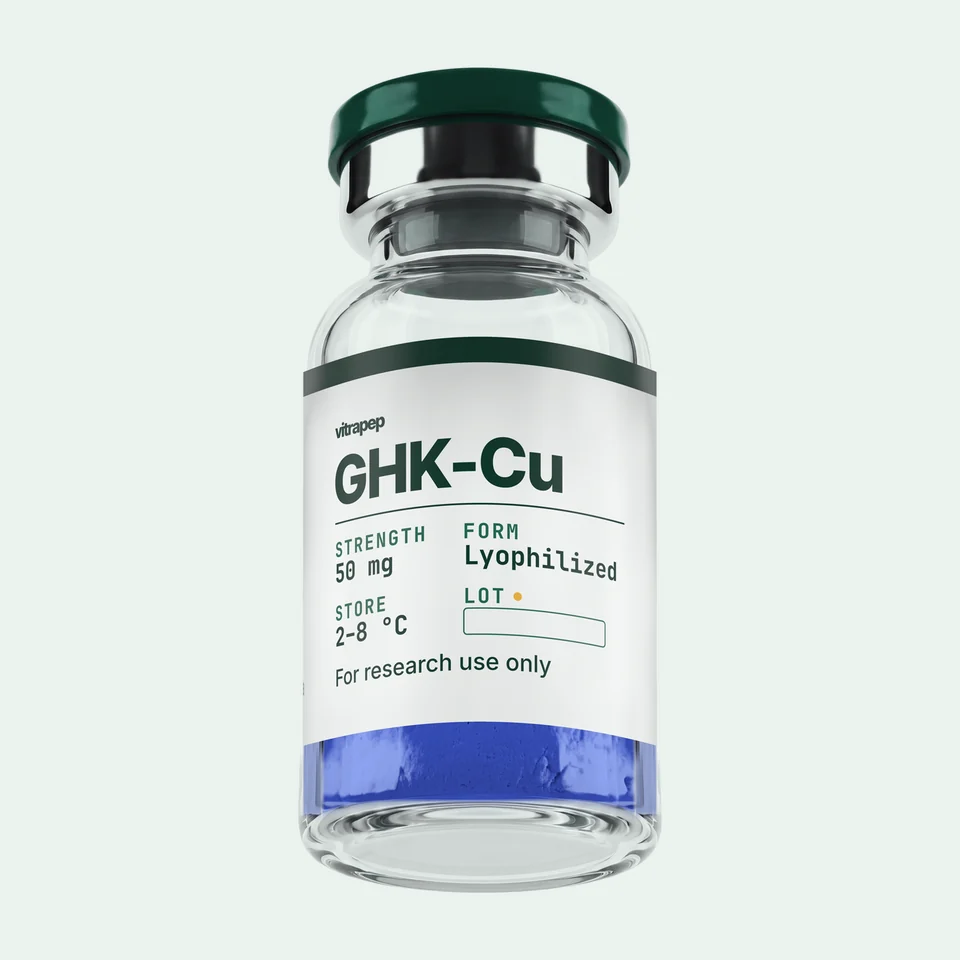
GHK-Cu
Specifications for the GHK-Cu sold for laboratory research. COA available with each lot.
Frequently asked questions
Is GHK-Cu the same as BPC-157?
No. GHK-Cu is a copper-bound tripeptide first reported in human serum. BPC-157 is a synthetic peptide of 15 amino acids, described as a fragment of a gastric juice protein.
Has any study compared GHK-Cu and BPC-157 directly?
We found none. A PubMed search on November 18, 2026 returned only reviews and commentary discussing both.
Is either peptide FDA-approved?
No. GHK-Cu is used as a cosmetic ingredient, and cosmetic ingredients other than color additives do not go through FDA approval.
What side effects have been reported?
FDA found no serious adverse events reported in five small BPC-157 studies, plus three FAERS reports of unclear cause. The GHK-Cu trial abstracts reviewed here report no adverse events beyond infection rates.
Is either peptide banned in sport?
WADA's 2026 list names BPC-157 under S0, prohibited at all times. GHK-Cu is not named, but S0 covers unapproved substances in general.
What is their pharmacy compounding status?
Neither is on FDA's 503A bulks list. Non-injectable GHK-Cu is under evaluation in category 1. FDA proposed in July 2026 not to add BPC-157.
Is there an approved dose for either peptide?
No. Neither has an FDA-reviewed dose for any use; see why research peptides have no dose.
What to know now
- GHK-Cu and BPC-157 differ in structure, origin and research history, and no head-to-head study exists.
- Human data for both are small: topical skin and wound trials for GHK-Cu, five clinical reports for BPC-157.
- Neither is an FDA-approved drug, and FDA flags immunogenicity concerns for compounded injectable forms of both.
- WADA names BPC-157 under S0; GHK-Cu is not named, but S0 is a general category.
What we’re watching
- Results from the GHK-Cu wound trial NCT07437586 and the BPC-157 trials NCT07437547 and NCT07803250.
- FDA's planned advisory committee consultation on GHK-Cu, due before the end of February 2027.
- A final FDA decision on BPC-157 and the 503A bulks list after the July 2026 meeting.
- How WADA's 2027 list, in effect January 1, 2027, treats unnamed peptides.