What is a polypeptide? It is a long chain of amino acids joined by peptide bonds. The word sits between “peptide” and “protein,” and the borders on both sides are blurry. This page sets out the definition, how a polypeptide differs from a peptide and from a protein, and some named examples.
Quick answer: A polypeptide is a chain of many amino-acid residues linked by peptide bonds. A peptide is the general term for any such chain, short or long. A protein is the finished working molecule, which can contain one polypeptide chain or several, and sometimes non-peptide parts such as heme.
The definition
IUPAC defines a peptide as any compound made by amide formation between a carboxyl group of one amino acid and an amino group of another. Those amide bonds may be called peptide bonds. When amino acids combine, the elements of water are removed, and what remains of each one is called an amino-acid residue. So every unit of a peptide chain is a residue.
A chain has two ends. IUPAC calls the residue with a free amino group N-terminal and the residue with a free carboxyl group C-terminal. It writes sequences with the N-terminal residue on the left. “Poly” means many: IUPAC says peptides with fewer than about 10 to 20 residues may be called oligopeptides, and those with more, polypeptides. Our page on types of peptides covers the other length words, and peptide bond formation covers the link itself.
Polypeptide vs peptide
Every polypeptide is a peptide. The word adds length, not a different chemistry. Where length begins is not fixed. IUPAC’s boundary is “about 10-20” residues.
US regulators use a different line for a different purpose. In a March 2020 guidance, FDA explains that a polymer of 40 or fewer amino acids is a “peptide” and that anything greater than 40 with a specific defined sequence is a “protein.” So a 30-residue chain is a polypeptide in IUPAC terms and a peptide in FDA’s.
Common names do not follow either rule. Vasoactive intestinal polypeptide (VIP) has 28 residues. Pancreatic polypeptide has 36. Glucose-dependent insulinotropic polypeptide (GIP), an incretin hormone covered in our GLP-1 class overview, has 42. All three carry “polypeptide” in their names. Two fall under FDA’s 40 line and one sits above it.
Polypeptide vs protein
Length is part of the answer. IUPAC says polypeptides of specific sequence with more than about 50 residues are usually known as proteins, and adds that authors differ greatly on where they start using the term. Our page on peptide vs protein covers that debate.
The other part is assembly. A polypeptide is one chain. A protein is the working molecule, and it can be built from more than one chain:
- Insulin. A 1993 review describes insulin as 51 amino acids in two peptide chains, A and B, linked by two disulfide bonds. The A chain has 21 residues and the B chain 30.
- Adult hemoglobin. A tetramer of two α and two β globin chains, each containing a prosthetic heme group. So hemoglobin is four polypeptides plus four non-peptide parts.
FDA’s rule allows for this. When two or more chains associate in nature, FDA counts the total number of amino acids across the chains. By that count, insulin’s 51 residues put it over the 40 line, even though neither chain alone is longer than 30.
A chain also takes on a three-dimensional shape, or conformation. IUPAC treats the conformation of polypeptide chains as a separate topic, and our page on polypeptide structure covers the levels of folding.
How cells make polypeptides
Ribosomes do the work. A 2017 review describes them as machines that polymerize polypeptide chains programmed by nucleotide sequences in messenger RNA, with catalysis of peptide bond formation among their jobs. The mRNA sequence sets the order of residues.
Many chains are edited after they are made:
- Signal sequences. Most secreted and many membrane proteins carry cleavable N-terminal signal sequences. These target the chain to the endoplasmic reticulum, or to the cytoplasmic membrane in bacteria.
- Precursor cutting. Insulin starts as proinsulin, which Steiner describes as a single polypeptide chain that begins with the B chain of insulin. A connecting peptide, the C-peptide, links the A and B chains. It is cut out at sites marked by pairs of basic residues, which leaves the two-chain hormone.
So one polypeptide can become a protein with two chains. Counting chains in the finished molecule does not always tell you how many were made.
How labs make polypeptides
Labs use two main routes. The first is chemical synthesis. Merrifield’s 1963 paper that introduced solid-phase peptide synthesis made a tetrapeptide. Our page on how peptides are made walks through it.
The second is recombinant expression in engineered cells. In one published process, recombinant human proinsulin was expressed in Escherichia coli, refolded, and then converted into mature insulin with two enzymes. For any defined sequence, the mass can be worked out from the residues; see our guide to peptide molecular weight and the upcoming peptide calculator.
Named polypeptides and proteins, by chain count and length
| Example | Chains | Residues | Where it is found | FDA 40-amino-acid line |
|---|---|---|---|---|
| Vasoactive intestinal polypeptide (VIP) | 1 | 28 | Widespread in internal organs; nerve fibers | Under (peptide) |
| Pancreatic polypeptide | 1 | 36 | Islet and acinar cells of the pancreas | Under (peptide) |
| Glucose-dependent insulinotropic polypeptide (GIP) | 1 | 42 | Enteroendocrine K cells of the gut | Over (protein) |
| Insulin | 2 (A and B), from one proinsulin chain | 51 (21 + 30) | Endocrine hormone; also made recombinantly | Over (chains counted together) |
| Adult hemoglobin | 4 (two α, two β) | Not given here | Each chain carries a heme group | Over |
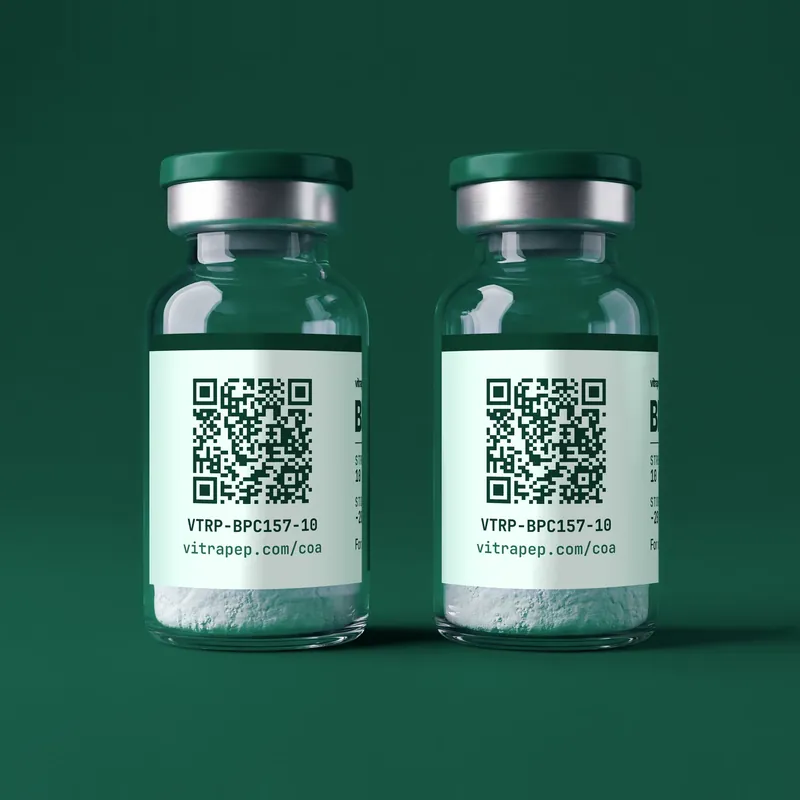
Vitrapep Research Catalog
Defined-sequence research peptides supplied as laboratory reference compounds, each lot with a third-party certificate of analysis. For laboratory research use only, not for human or veterinary use.
Frequently asked questions
Is a polypeptide the same as a protein?
Not exactly. A polypeptide is one chain of residues. A protein is the working molecule, which can be one chain or several, sometimes with non-peptide parts such as heme.
How many amino acids are in a polypeptide?
There is no fixed number. IUPAC uses “polypeptide” for chains longer than about 10 to 20 residues. FDA calls chains of 40 or fewer amino acids peptides for regulatory purposes.
What bond holds a polypeptide chain together?
The peptide bond, an amide bond between the carboxyl group of one amino acid and the amino group of the next. Some chains are also linked to each other by disulfide bonds, as in insulin.
Can one protein contain several polypeptides?
Yes. Insulin has two chains and adult hemoglobin has four.
What to know now
- Definition: a polypeptide is a long chain of amino-acid residues joined by peptide bonds.
- Vs peptide: every polypeptide is a peptide; IUPAC uses the word above about 10 to 20 residues.
- Vs protein: a protein is the working molecule and may hold several chains; IUPAC’s length line is about 50 residues, FDA’s is 40 amino acids.
- Names mislead: VIP (28), pancreatic polypeptide (36) and GIP (42) are all called polypeptides.
- Made and edited: ribosomes build chains from mRNA; signal sequences and precursor segments are often cut away.