Types of peptides can be sorted four ways: by length, by structure, by origin and by function. The schemes overlap. One molecule can be a nonapeptide, a cyclic peptide, a natural product and a hormone at the same time. This guide walks through each scheme with checked examples.
Quick answer: What are the main types of peptides? By length: dipeptides (2 residues), tripeptides (3), tetrapeptides (4), oligopeptides (up to about 10 to 20) and polypeptides (longer). By structure: linear, cyclic, stapled and branched. By origin: natural, synthetic and recombinant. By function: hormones, neuropeptides, antimicrobial peptides and signal peptides, among others.
Classification by length
IUPAC defines a peptide as any compound made by amide formation between a carboxyl group of one amino acid and an amino group of another. When amino acids combine, the elements of water are removed. What remains of each amino acid is called a residue, and peptides are counted in residues. Our primer on what peptides are covers the basics, and peptide bond formation covers the bond itself.
The name carries the count. Under IUPAC’s rule, a number prefix placed before “peptide” gives the total number of residues, as in hexapeptide. A dipeptide has two residues, a tripeptide three and a tetrapeptide four. IUPAC’s own dipeptide example is glycylalanine. Higher counts can be written as numerals, such as “a 22-peptide.” Beyond a handful of residues, broader words take over:
- Oligopeptide. IUPAC says peptides with fewer than about 10 to 20 residues may also be called oligopeptides.
- Polypeptide. Peptides with more residues than that may be called polypeptides. Our page on what a polypeptide is goes further.
- Protein. IUPAC says polypeptides of specific sequence with more than about 50 residues are usually known as proteins.
Where the cut-offs disagree
The length words are loose. IUPAC writes “about 10-20” for the oligopeptide boundary. For proteins, it adds that “authors differ greatly on where they start using this term.”
US regulators use a hard number instead. In a March 2020 guidance, FDA explains that it reads “protein” to mean any alpha amino acid polymer with a specific defined sequence greater than 40 amino acids. A polymer of 40 or fewer amino acids is a “peptide” for that purpose. When two or more chains associate in nature, FDA counts the total across all the chains. So a 45-residue chain is a protein to FDA but may still be a polypeptide under IUPAC’s “about 50.” See peptide vs protein for why the line matters.
Classification by structure
- Linear. A single open chain with two free ends. IUPAC writes the sequence with the N-terminal residue on the left and the C-terminal residue on the right. Carnosine and GHK are linear.
- Cyclic. IUPAC splits cyclic peptides into two kinds. In a homodetic cyclic peptide, the ring is made only of residues in normal peptide linkage; IUPAC’s example is gramicidin S. In a heterodetic cyclic peptide, one or more ring bonds is an isopeptide, disulfide, ester or other bond. Oxytocin is a cyclic nonapeptide closed by a disulfide bond between its Cys1 and Cys6 residues. The octreotide prescribing label describes it as a cyclic octapeptide with a 2→7 disulfide.
- Stapled. A synthetic class. In 2004, Walensky and colleagues used a strategy they called hydrocarbon stapling to make BH3 peptides, and reported that the stapled peptides were helical, protease-resistant and cell-permeable. Verdine and Hilinski describe these molecules as synthetic miniproteins locked into an alpha-helical fold by an all-hydrocarbon staple that acts as a chemical brace.
- Branched. Chains can branch. Tam’s 1988 multiple antigenic peptide system built peptides onto a core of a trifunctional amino acid; the model studied had three levels of lysine and eight amino ends. Glutathione shows a natural variation on the theme. IUPAC names it γ-glutamylcysteinylglycine: the glutamate joins through its side-chain (γ) carboxyl, a link of the kind IUPAC calls an isopeptide bond.
Classification by origin
Natural peptides are made by living things. Carnosine (β-alanyl-L-histidine) was discovered in 1900 as an abundant compound of meat, and a 2013 review notes that it is found in skeletal muscle and other excitable tissues. Pickart and Margolina describe GHK (glycyl-L-histidyl-L-lysine) as a human peptide. Not every natural peptide comes from a ribosome. Gramicidin S, secreted by Bacillus brevis, is a nonribosomally synthesized cyclic decapeptide, and its sequence includes ornithine and a D-amino acid. See are peptides natural? for more.
Synthetic peptides are built by chemical synthesis. Merrifield’s 1963 paper that introduced solid-phase peptide synthesis made a tetrapeptide. Synthesis can place residues in forms cells rarely use: octreotide’s chemical name on its label includes D-phenylalanyl and D-tryptophyl residues. See how peptides are made for the method.
Recombinant peptides are made by engineered cells. Human insulin, with 21 residues in its A chain and 30 in its B chain, has been produced from recombinant human proinsulin expressed in Escherichia coli and then converted to mature insulin with enzymes.
Classification by function
- Hormones. Signals carried in the blood to act elsewhere. A review of insulin calls it an endocrine hormone. Oxytocin is made mainly in hypothalamic neurons and released from the posterior pituitary into the systemic circulation. See peptide hormones.
- Neuropeptides. A 2017 overview counts over 100 known neuropeptides and probably many more among the over 1,000 peptides predicted to be encoded in the genome. They share processing after translation, release from vesicles and action on cell-surface receptors over a relatively large distance. Oxytocin crosses into this group too: oxytocin-producing neurons project widely through the central nervous system, and the peptide has central actions as well as hormonal ones.
- Antimicrobial peptides. Zasloff’s 2002 review describes potent, broad-spectrum antimicrobial peptides in both animals and plants, used against bacteria, fungi, viruses and protozoa. Gramicidin S, from a bacterium, is described as a powerful antimicrobial agent.
- Signal peptides. Short peptides at the N-terminal end of proteins that carry information for protein secretion. Most secreted and many membrane proteins carry cleavable N-terminal signal sequences that target them to and across the endoplasmic reticulum membrane, or the cytoplasmic membrane in bacteria. A signal peptide is a stretch of a longer protein chain, not a free-standing molecule.
Function labels describe what a peptide does, not what it is made of. See how peptides work for receptor binding.
Example peptides across the four schemes
| Example | Length | Structure | Origin | Function group |
|---|---|---|---|---|
| Carnosine | Dipeptide (2) | Linear | Natural (muscle and other excitable tissues) | Other |
| Glutathione | Tripeptide (3) | Linear, with a γ-glutamyl (isopeptide) link | Natural | Other |
| GHK | Tripeptide (3) | Linear | Natural (human peptide) | Other |
| Octreotide | Octapeptide (8) | Cyclic, disulfide (heterodetic) | Synthetic, includes D-amino acids | Prescription drug (per its label) |
| Oxytocin | Nonapeptide (9) | Cyclic, Cys1-Cys6 disulfide (heterodetic) | Natural | Hormone; also acts in the brain |
| Gramicidin S | Decapeptide (10) | Cyclic (homodetic) | Natural, bacterial, nonribosomal | Antimicrobial |
| Insulin | 51 residues in two chains (21 + 30) | Two chains linked by two disulfide bonds | Natural; also made recombinantly | Hormone |
| Stapled BH3 peptides | Varies by design | Stapled alpha helix | Synthetic | Research tool |
| Octa-branched MAP | Eight chains on a lysine core | Branched | Synthetic | Research tool (vaccine design) |
Insulin shows how the length schemes collide: its two chains total 51 residues, over FDA’s line of 40 and right at IUPAC’s “about 50.” For the mass of a sequence, see our guide to peptide molecular weight and the upcoming peptide calculator.
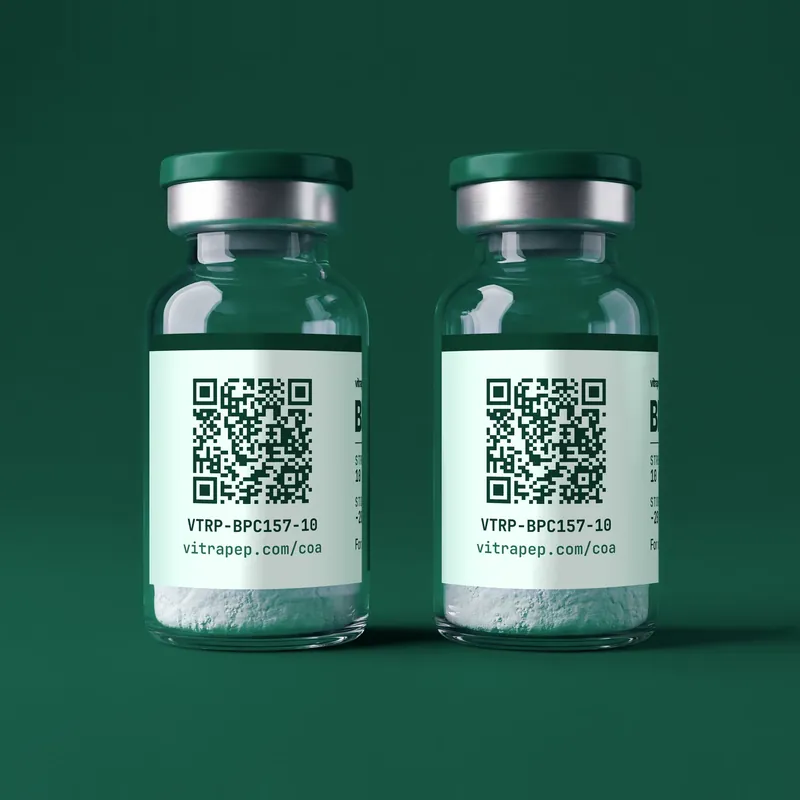
Vitrapep Research Catalog
Defined-sequence research peptides supplied as laboratory reference compounds, each lot with a third-party certificate of analysis. For laboratory research use only, not for human or veterinary use.
Frequently asked questions
How many amino acids are in an oligopeptide?
There is no fixed number. IUPAC says peptides with fewer than about 10 to 20 residues may be called oligopeptides.
When does a peptide become a protein?
It depends on the source. IUPAC says polypeptides of specific sequence with more than about 50 residues are usually called proteins, and that authors differ greatly. FDA’s regulatory line is more than 40 amino acids, counting all chains that associate in nature.
What is the difference between homodetic and heterodetic cyclic peptides?
In a homodetic cyclic peptide, the ring is closed only by normal peptide bonds, as in gramicidin S. In a heterodetic one, at least one ring bond is something else, such as the disulfide bond in oxytocin.
Can one peptide belong to several types?
Yes. Oxytocin is a nonapeptide, a heterodetic cyclic peptide and a natural product. It acts as a hormone and also has actions in the brain.
What to know now
- Length: prefixes give the residue count (di-, tri-, tetra-); oligopeptide means fewer than about 10 to 20 residues.
- Cut-offs differ: IUPAC says proteins start at about 50 residues, with authors differing; FDA’s line is more than 40 amino acids.
- Structure: linear, cyclic (homodetic or heterodetic), stapled and branched.
- Origin: natural, synthetic and recombinant; some natural peptides are made without ribosomes.
- Function: hormones, neuropeptides, antimicrobial peptides and signal peptides, with overlap between groups.