Does semaglutide expire? Yes. Federal rules require prescription drug products to carry an expiration date based on stability testing. This page sets out what the Ozempic, Wegovy and Rybelsus labels state and what laboratory research shows. It also covers what FDA has said about compounded and counterfeit versions.
Quick answer: Yes. Each approved semaglutide product has an expiration date on its label. The Ozempic label lists unused, refrigerated pens as good until that date and limits a pen to 56 days after first use. FDA says expired medicines can be less effective or risky. We found no published study that tested semaglutide medicines after their expiration date.
Does semaglutide expire?
Yes. Under 21 CFR 211.137, a drug product must carry an expiration date set by "appropriate stability testing" to assure identity, strength, quality and purity. The same rule says expiration dates "shall be related to any storage conditions stated on the labeling" of the product.
FDA says it began requiring expiration dates on prescription and over-the-counter medicines in 1979. Expired products "can be less effective or risky due to a change in chemical composition or a decrease in strength," according to FDA.
The Ozempic label lists refrigerated pens as good "until expiration date" before first use. After first use, its storage table gives a fixed 56-day period instead. The patient instructions say an in-use pen should be thrown away after 56 days, even if medicine remains.
What do the Ozempic, Wegovy and Rybelsus labels say about storage?
Each label has a section titled "How Supplied/Storage and Handling." Table 1 summarizes those sections, quoted or closely paraphrased from the current labels on DailyMed.
What do the Ozempic, Wegovy and Rybelsus labels say about storage
| Product and presentation | Before first use | Outside the refrigerator or in use | Other label statements |
|---|---|---|---|
| Ozempic multi-use pen | Refrigerator, 2°C to 8°C (36°F to 46°F), until the expiration date | After first use, 56 days at 15°C to 30°C (59°F to 86°F) or refrigerated | Do not freeze; protect from excessive heat and sunlight |
| Ozempic prefilled syringe | Refrigerator, 2°C to 8°C, until the expiration date | If needed, up to 28 days at 8°C to 30°C | Do not freeze; protect from light; original carton |
| Wegovy single-use pen or syringe | Refrigerator, 2°C to 8°C | If needed, before cap removal, up to 28 days at 8°C to 30°C | Do not freeze; protect from light; original carton |
| Wegovy FlexTouch multi-use pen | Refrigerator, 2°C to 8°C | After first use, 56 days at 15°C to 30°C or refrigerated | Protect from excessive heat and light |
| Rybelsus, Ozempic and Wegovy tablets | 20°C to 25°C (68°F to 77°F), excursions permitted to 15°C to 30°C | Not applicable | Original bottle, to protect from moisture |
The Wegovy label says not to use the product "if it has been frozen" and to protect it from light. Its 28-day allowance for single-use pens and syringes applies only before the cap is removed.
Tablets follow a different pattern. The Rybelsus and Ozempic tablets label calls for a dry place and the original bottle "to protect tablets from moisture" until use. The Wegovy tablet section uses the same wording.
Why do pen and tablet labels list different conditions?
The labels describe two different products. The pens and syringes hold "a sterile, aqueous, clear, colorless solution" with a pH of about 7.4. The multi-use pens list phenol and propylene glycol among their inactive ingredients, while single-use pens and syringes list sodium chloride.
The tablets are a solid product containing salcaprozate sodium (SNAC) and magnesium stearate. The tablet label describes semaglutide itself as "a white to almost white hygroscopic powder," meaning it takes up water from the air.
The labels do not explain the reasons behind these statements. Federal rules tie the dates and their storage conditions to stability studies, which the labels do not reproduce.
Why do peptides like semaglutide break down?
A classic review sorts peptide and protein degradation into chemical and physical instability (Manning et al., 1989). Chemical instability includes proteolysis, deamidation, oxidation, racemization and beta-elimination. Physical instability includes aggregation, precipitation, denaturation and adsorption to surfaces.
Chemical changes alter the molecule itself, for example by breaking a peptide bond. Physical changes alter its shape or state, for example when molecules clump together. A 2025 study notes that semaglutide degradation forms impurities that "may impact safety, efficacy, immunogenicity, and regulatory compliance" (Malgave et al., 2025).
Semaglutide's design addresses a different kind of stability. The labels say position 8 is modified "to provide stabilization against degradation by the enzyme dipeptidyl-peptidase 4 (DPP-4)" in the body. A C18 fatty di-acid at lysine 26 supports binding to albumin in the blood. These changes slow breakdown inside the body, which is not the same as shelf stability. The semaglutide complete guide covers that structure.
What have laboratory studies found about semaglutide stability?
Several recent laboratory studies have tested semaglutide under controlled conditions (Table 2). None involved patients, and none tested expired medicines.
Malgave and colleagues heated semaglutide solutions at temperatures up to 80 °C. They identified thirteen impurities and concluded that pH "was a key factor for the thermal degradation" of the peptide. Four impurities appeared only when plain water replaced a buffer as the solvent.
The same group then studied solid semaglutide (Akbar et al., 2026). The peptide kept its alpha-helical shape up to 60 °C, though helical content fell from 49.07% to 43.75%. At 80 °C it fell to 0.2%. Degradation and impurity formation rose with temperature.
Semaglutide molecules can also join together. Huang and colleagues found oligomers of up to 10 molecules within 24 hours. Low micromolar copper and zinc ions drove larger and more abundant oligomers, and albumin binding helped them come apart.
What have laboratory studies found about semaglutide stability
| Study | What was tested | Conditions | Main reported finding | Limits |
|---|---|---|---|---|
| Malgave et al., 2025 | Semaglutide in solution | 25, 40 and 60 °C for 28 days; 80 °C for 7 days; several pH values and buffers | Thirteen impurities; pH a key factor in heat degradation | Stress study; no finished products |
| Akbar et al., 2026 | Solid semaglutide | Heat stress up to 80 °C | Helical content fell at 60 °C and nearly vanished at 80 °C; impurities rose | Same group as Malgave |
| Huang et al., 2026 | Semaglutide with and without metal ions | Laboratory incubation | Oligomers of up to 10 molecules in 24 hours; copper and zinc increased them | Early aggregation only |
| Kopp et al., 2026 | Originator pens and two compounded vials | ICH Q1B light exposure | Originator concentration unchanged in its packaging; compounded vials lost strength | All authors current or former Novo Nordisk staff |
| Ashraf et al., 2024 | Three vials bought online without a prescription | Test purchases and analysis | Purity 7.7% to 14.37% against 99% claimed; endotoxin in all three | Very small sample |
The heat studies used stress conditions to speed up change. They show which factors matter, not how long any product lasts under its labeled conditions.
What has FDA said about compounded semaglutide storage and quality?
FDA states that "compounded drugs are not FDA approved" and that it does not review them for quality before marketing (FDA). The compounded semaglutide guide covers the legal background.
FDA has named storage problems directly. It has received complaints that some compounded GLP-1 drugs "have arrived warm or with inadequate ice packs," which it says can affect quality. For multiple-dose vials, FDA cites "an increased risk of contamination after 28 days" from first use. FDA applies that limit even where a compounder's instructions give a longer period.
The same page warns about salt forms, "including semaglutide sodium and semaglutide acetate," which FDA calls different active ingredients from the approved drugs. FDA also describes fraudulent compounded products naming pharmacies that did not make them.
Kopp and colleagues tested light sensitivity under the ICH Q1B guideline. The originator pen, in its packaging with the cap on, showed no change in semaglutide concentration. Two compounded vials from outsourcing facilities kept 95% and 86% of their starting strength. Their impurity totals rose from 1.3% to 5.1% and from 2.5% to 14.2%. All ten authors were current or former employees of Novo Nordisk, which makes Ozempic and Wegovy.
Labeling gaps add uncertainty. Belcourt and colleagues reviewed 33 compounded semaglutide or tirzepatide products marketed online in early 2025. Only 18% reported beyond-use date and storage information, and 28% reported storage conditions.
What has FDA said about counterfeit semaglutide?
FDA's counterfeit Ozempic page lists warnings from December 2023, April 2025 and December 2025. In 2023, FDA seized thousands of units labeled lot NAR0074 and found counterfeit needles, labels and cartons. In April 2025, it seized several hundred units labeled PAR0362. In December 2025, it seized dozens labeled PAR1229, which is also an authentic lot number.
The December 2025 warning centered on the expiration label itself. On the counterfeit pens, FDA said, the "EXP/LOT" text sat left of the date and lot number. Authentic pens print it above them. FDA said testing to determine the products' composition and safety risks was under way. The counterfeit GLP-1 medicines page covers each warning.
Online sellers are another source of unknown quality. Ashraf and colleagues made test purchases from six illegal online pharmacies (Ashraf et al., 2024). None of the three Ozempic pens ordered arrived. The three vials that did held lyophilized powder with semaglutide content above the labeled amount. Measured purity was 7.7% to 14.37%, against 99% claimed, and all three contained bacterial endotoxin.
Does research-grade semaglutide have an expiration date?
Research-grade semaglutide is a laboratory reagent, not an FDA-approved drug. It has no FDA-approved label and no FDA-reviewed expiration date. Any retest or expiry date comes from the supplier. The peptide storage and stability guide explains how those dates are defined, and the HPLC purity guide explains how degradation appears in testing.
The laboratory findings above apply to research material too. Solid semaglutide changed with heat, and lyophilized vials sold online fell far below their labeled purity.
A research-use-only label does not make a product legal or safe for people. FDA has warned companies that sold semaglutide "falsely labeled" for research directly to consumers with dosing instructions. See the risks of human use of research peptides and why research peptides have no dose.
Vitrapep research material
Vitrapep sells semaglutide for laboratory research use only. It is not for human or veterinary use.
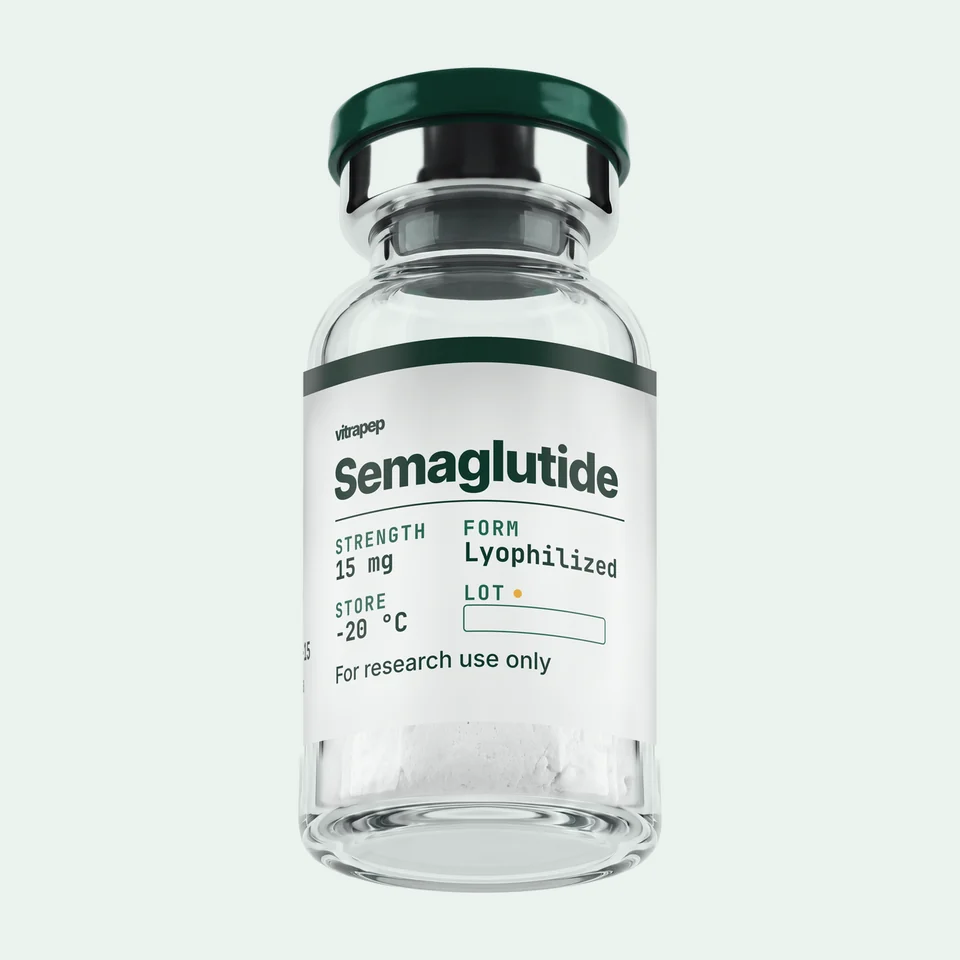
Semaglutide
Specifications for the semaglutide sold for laboratory research. COA available with each lot.
Frequently asked questions
Does semaglutide expire?
Yes. Every FDA-approved semaglutide product carries an expiration date set by stability testing and tied to the storage conditions on its label.
How long does the Ozempic label allow a pen after first use?
The label allows 56 days after first use, at 15°C to 30°C or refrigerated. The patient instructions say the pen should then be thrown away, even if medicine remains.
What does the Wegovy label say about room temperature?
Single-use Wegovy pens and syringes may be kept at 8°C to 30°C for up to 28 days if needed, before the cap is removed. The FlexTouch pen has a 56-day limit after first use.
Do semaglutide tablets need refrigeration?
The tablet labels do not call for refrigeration. They state 20°C to 25°C, with excursions permitted to 15°C to 30°C, in the original bottle.
Is expired semaglutide still effective?
We found no published study that tested this. FDA says expired medicines can be less effective or risky because their chemical composition or strength can change.
Does compounded semaglutide have the same expiration dating as Ozempic?
No. FDA does not review compounded drugs for quality before marketing. One 2026 study found that only 18% of compounded products reviewed reported beyond-use date and storage information.
Can heat or light damage semaglutide?
Laboratory studies show changes under stress. Heat reduced the helical structure of solid semaglutide, and light degraded two compounded products that lacked light protection.
What to know now
- Approved semaglutide products expire, and their dates depend on labeled storage conditions.
- Pen and syringe labels call for refrigeration before first use and set 28-day or 56-day limits otherwise.
- Tablet labels call for controlled room temperature in the original bottle.
- Laboratory studies link semaglutide degradation to heat, pH, light and metal ions.
- Compounded, counterfeit and research-grade products have no FDA-reviewed expiration dating.
What we’re watching
- FDA's test results on the counterfeit Ozempic it seized in late 2025.
- Independent stability studies of compounded semaglutide; the light data cited here come from Novo Nordisk authors.
- Updates to label storage sections as new semaglutide presentations reach the market.