This peptide glossary defines the terms you meet on research-peptide certificates, product pages and the articles on this site. Each entry is one or two plain sentences, with a link to the deeper guide where one exists. It covers testing, chemistry, handling and US regulation. It does not cover what individual compounds do.
Quick answer: The terms that matter most on a peptide certificate are identity (is it the right molecule, usually by LC-MS), purity (how much of the sample is the main peak, by HPLC), net content (how much is in the vial), endotoxin (a test for bacterial lipopolysaccharide, by LAL) and the lot number (which batch the results describe). Jump to any term below by its letter group, or link straight to an entry by its anchor.
Common abbreviations at a glance
Abbreviations on peptide certificates and pages
| Abbreviation | Stands for | Entry |
|---|---|---|
| COA | Certificate of analysis | Certificate of analysis |
| HPLC | High-performance liquid chromatography | HPLC |
| LC-MS | Liquid chromatography–mass spectrometry | LC-MS |
| m/z | Mass-to-charge ratio | m/z |
| LAL | Limulus amebocyte lysate | LAL |
| EU | Endotoxin unit | Endotoxin unit |
| rFC | Recombinant Factor C | Recombinant Factor C |
| TFA | Trifluoroacetic acid, or its salt, trifluoroacetate | TFA |
| SPPS | Solid-phase peptide synthesis | SPPS |
| RUO | Research use only | Research use only |
| USP | United States Pharmacopeia | USP |
| ICH | International Council for Harmonisation | Specification |
| NDA | New Drug Application | NDA |
| WADA | World Anti-Doping Agency | WADA |
A to C
- 503A
- Section 503A of the Federal Food, Drug, and Cosmetic Act sets the conditions under which compounded human drugs are exempt from parts of the Act. One condition, the FDA says, is a valid patient-specific prescription. See the 2023 FDA 503A peptide list.
- 503B
- Section 503B created outsourcing facilities, a voluntary category of compounders that, unlike 503A compounders, are subject to CGMP requirements. Vitrapep is neither a 503A compounder nor a 503B outsourcing facility.
- Acceptance criteria
- The numerical limits, ranges or other measures a test result must meet, in the words of ICH Q6A. On a certificate they appear as the limit beside each result. See specification.
- Acetate salt
- A peptide whose counter-ion is acetate. TFA left from synthesis can be exchanged for the ion of a weaker acid such as acetic acid, and Roux and colleagues compared ways of doing that exchange.
- Amino acid
- The NHGRI glossary calls it the building block of proteins and counts 20 different amino acids. Peptides are short chains of them. See what are peptides.
- Appearance
- A test that records what the material looks like. ICH Q6A calls it the description: a qualitative statement of the substance’s state and color.
- Area-% (area percent)
- The main peak’s share of all detected peak area on an HPLC chromatogram, the usual basis for a peptide purity figure. A USP and MHRA review reports chromatographic impurities on this basis. See HPLC purity, explained.
- Bacteriostatic water
- The USP monograph describes it as sterilized Water for Injection containing one or more suitable antimicrobial agents. See bacteriostatic water, explained.
- Certificate of analysis (COA)
- A lab report for one lot that lists each test, its acceptance limits and the results. ICH Q7 adds that it should be dated and signed. See how to read a COA and COA vs MSDS.
- Charge state
- The number of charges an ion carries. Electrospray often gives a peptide several, so one molecule shows up as a series of m/z peaks, and software combines them into one mass in a step Agilent’s LC/MS primer calls deconvolution. See LC-MS and peptide identity.
- Chromatogram
- The trace a chromatography detector draws as separated components leave the column: signal against time, with one peak per component. USP chapter <621> covers chromatography.
- Counter-ion
- An ion that balances a peptide’s charge in the solid. Bachem notes that a sample’s gross weight includes the peptide, its counter-ions, such as acetate or trifluoroacetate, and adhered water.
D to H
- D-amino acid
- The mirror-image form of an amino acid. ICH Q6A defines enantiomers as having the same formula but nonsuperimposable mirror-image arrangements, so a D-for-L swap leaves the mass unchanged and, as Verlander and Rode note, mass spectrometry alone cannot detect it.
- Deamidation
- Loss of the amide group from an asparagine (Asn) or glutamine (Gln) side chain, a reaction measured in peptides and proteins. It is one of the chemical routes by which peptides degrade. See how to store peptides.
- Deletion sequence
- An impurity missing one or more amino acids of the intended sequence. A review of peptide impurities links deletion and insertion impurities to inefficient Fmoc-deprotection and excess amino acid reagents during synthesis.
- Endotoxin
- The lipid A portion of lipopolysaccharide from Gram-negative bacteria, as Raetz and Whitfield describe it. It can trigger responses in cell experiments. See endotoxin testing, explained.
- Endotoxin unit (EU)
- A unit of endotoxin activity measured against a reference standard rather than by weight, because potency per nanogram varies between bacteria (Associates of Cape Cod). EU/mL is activity per milliliter of the solution tested.
- Excipient
- Any added ingredient other than the active compound. US drug rules call this an inactive ingredient: any component other than an active ingredient (21 CFR 210.3).
- Expiration date
- The date before which a batch is expected to stay within its shelf-life specification if stored under defined conditions, per ICH Q1A(R2). Compare re-test date.
- Gel-clot
- An LAL endotoxin method that reads whether a gel forms. Charles River describes it as a simple qualitative method.
- Gross weight
- The total weight of a peptide sample: the peptide, its counter-ions and adhered water, per Bachem. Compare net peptide content.
- Heavy metals
- Toxic elements tested as impurities. ICH Q3D(R2) puts arsenic, cadmium, mercury and lead in Class 1, the four elements Vitrapep’s production lab tests for.
- HPLC
- High-performance liquid chromatography: a column separates a sample into its components, and a detector, usually UV for peptides, records each as a peak. It is the usual basis for a purity figure. See HPLC purity, explained.
- Hygroscopic
- Prone to take up water from the air. Bachem says peptides tend to be hygroscopic, and that absorbed moisture reduces peptide content and may decrease stability.
I to L
- Identity
- Confirmation that a sample is the compound on the label. ICH Q6A says identification tests should be specific and that a single chromatographic retention time is not. See LC-MS and peptide identity.
- Impurity
- Any component that is not the defined chemical entity, in ICH Q6A’s definition. For peptides this includes deletion sequences, diastereomers and oxidized forms.
- In vitro
- In a test tube, plate or other lab vessel rather than in a living organism. Vitrapep supplies peptides for laboratory and in-vitro research.
- LAL
- Limulus amebocyte lysate: an extract of horseshoe crab blood cells that clots in the presence of endotoxin. It is the basis of the bacterial endotoxins test in USP <85>, run as gel-clot, turbidimetric or chromogenic assays.
- LC-MS
- Liquid chromatography–mass spectrometry: a chromatograph separates the sample and a mass spectrometer measures each component’s m/z. LC-MS/MS adds a fragmentation stage that Thermo Fisher says is commonly used to sequence proteins. See LC-MS and peptide identity.
- Lot (batch)
- A batch, or an identified part of one, with uniform character and quality within specified limits (21 CFR 210.3). A certificate speaks only for the lot it names.
- Lot number
- The code from which a lot’s full manufacturing and distribution history can be traced (21 CFR 210.3). On a Vitrapep vial it is printed on the label and opens that lot’s certificate on the COA lookup.
- Lyophilization
- Freeze-drying. The FDA’s inspection guide describes three stages, freezing, primary drying (sublimation) and secondary drying (desorption), and notes that products are made in lyophilized form because of their instability in solution. See how to store peptides.
M to O
- Mass spectrometry (MS)
- An analytical technique based on measuring the mass-to-charge ratio of ions related to the analyte, as USP chapter <736> defines it.
- m/z
- Mass-to-charge ratio, the quantity a mass spectrometer sorts ions by. Agilent’s LC/MS primer gives the arithmetic: a 100,000 u molecule with 10 charges appears at m/z 1,000.
- Moisture (residual moisture)
- The small amount of bound water left in a freeze-dried product, as Labconco’s freeze-drying guide defines it. The production lab reports it for each Vitrapep lot.
- Molecular weight
- The mass of a molecule, calculated from its formula. Agilent’s primer calls molecular weight determination a fundamental use of LC-MS and key to determining identity.
- Monoisotopic mass
- A mass calculated from a single isotope of each element; the IUPAC definition is based on the most abundant isotopes, as Attygalle and colleagues describe. Mass spectrometry is often used to determine a peptide’s monoisotopic mass.
- NDA
- New Drug Application: in the FDA’s words, the vehicle through which drug sponsors formally propose that the FDA approve a new pharmaceutical.
- Net content
- On a Vitrapep certificate, the amount of material measured in the vial, in milligrams, set against the label amount. Each lot’s figure is on its certificate.
- Net peptide content
- The fraction of peptidic material in a sample relative to counter-ions and residual water, per Bachem. It is not the same as purity, because it includes peptidic impurities.
- Orthogonal methods
- Tests based on different principles that check the same property, such as HPLC and mass spectrometry. The USP and MHRA review notes that multiple orthogonal techniques are typically used to verify a peptide’s structure.
- Oxidation
- A degradation reaction. Li, Schöneich and Borchardt name methionine, cysteine, histidine, tryptophan and tyrosine as the residues most susceptible.
P to R
- Peptide
- A short chain of amino acids, typically 2 to 50, linked by peptide bonds, per the NHGRI glossary. See what are peptides and peptide vs protein.
- pH
- A measure of how acidic or basic a solution is. Vitrapep’s production lab reports the pH of a test solution of each lot.
- Prescription drug
- Under 21 U.S.C. § 353(b)(1), a drug that may be dispensed only on a licensed practitioner’s prescription, because of its potential for harm or because its approved application limits its use.
- Purity
- For a peptide, usually the HPLC area-% of the main peak. It shows how much of the sample is one component, not which component. See HPLC purity, explained.
- Racemization
- Conversion of an amino acid toward its mirror-image form. The D’Hondt review notes it can occur during Fmoc-deprotection and gives diastereomeric impurities with the same mass as the target.
- Recombinant Factor C (rFC)
- An endotoxin test reagent built from the horseshoe crab’s gene sequences, so it is nonanimal-derived. USP chapter <86> covers it as an alternative to the LAL test.
- Re-test date
- The date after which a substance should be examined again to confirm it still meets its specification, per ICH Q1A(R2).
- Research use only (RUO)
- A label that limits a product to laboratory research. Every Vitrapep product is for laboratory research use only and is not for human or veterinary use. See what research use only means.
- Residual solvents
- Organic volatile chemicals used or produced in manufacture that practical techniques do not completely remove, as ICH Q3C(R8) defines them.
- Retention time
- The time a component takes to pass through a chromatography column to the detector. Matching it to a reference standard is one identity check, but ICH Q6A says retention time alone is not specific.
S to Z
- Sequence
- The order of amino acids in a peptide chain. It fixes the chemical formula, and so the theoretical mass a lab compares against in an identity test.
- Solubility
- Whether, and how readily, a material dissolves in a stated solvent. Vitrapep’s production lab reports it for each lot.
- Specification
- A list of tests, references to analytical procedures and acceptance criteria that a substance should conform to, as ICH Q6A defines it. ICH is the International Council for Harmonisation.
- SPPS
- Solid-phase peptide synthesis, building a peptide chain while it is anchored to a solid support, first reported by R. B. Merrifield in 1963. See how peptides are made.
- TFA
- Trifluoroacetic acid, a reversed-phase HPLC solvent, and trifluoroacetate, its salt. Cornish and colleagues note that HPLC-purified peptides are often TFA salts, and found TFA reduced cell numbers in bone-cell cultures at 10−8 to 10−7 M.
- Third-party testing
- Testing of a lot by a lab separate from the seller, which issues its own certificate. See the peptide testing hub.
- USP
- The United States Pharmacopeia, which publishes the USP–NF of public standards, including test chapters such as <85> (bacterial endotoxins), <621> (chromatography) and <736> (mass spectrometry).
- WADA
- The World Anti-Doping Agency. Its 2026 Prohibited List came into force on 1 January 2026 and is a mandatory standard for all signatories of the World Anti-Doping Code. See peptides on the 2026 WADA list.
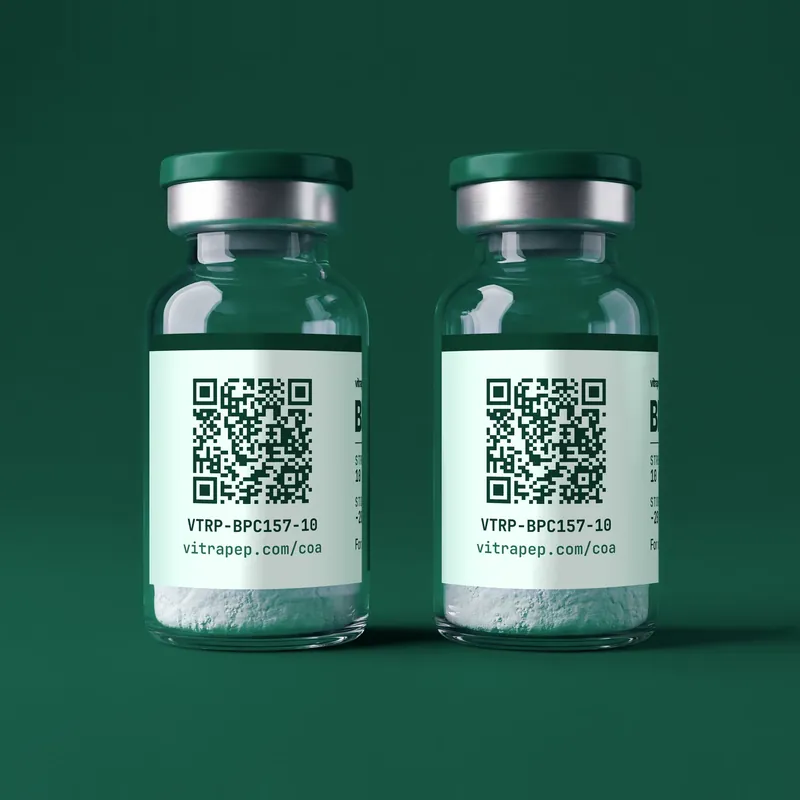
How Vitrapep tests each lot
Identity, purity, net content and endotoxin at Freedom Diagnostics, plus a production-lab panel, before any lot goes on sale. For laboratory research use only, not for human or veterinary use.
Where these terms appear on Vitrapep
Each Vitrapep lot has two certificates. Freedom Diagnostics, an independent lab, reports identity by LC-MS, purity by HPLC-UV, net content, and endotoxin by LAL under USP <85>. The production lab adds appearance, solubility, pH, moisture, impurities, residual solvents and heavy metals. The Freedom Diagnostics certificate is published, and each one carries its lot number and test date. Open it on the certificate lookup page. The quality page explains the process, and every product in the catalog is for laboratory research use only, not for human or veterinary use.
Frequently asked questions
What is the difference between purity and net peptide content?
Purity is the main peak’s share of HPLC peak area. Net peptide content is the peptide share of the powder once counter-ions and water are counted, and it includes peptidic impurities.
What is the difference between a lot and a batch?
Under 21 CFR 210.3 a lot is a batch, or an identified part of one, with uniform character and quality. In practice a certificate names one lot.
Why does TFA appear on peptide documents?
Because TFA is used in synthesis and HPLC purification, and HPLC-purified peptides are often TFA salts. Some are exchanged to acetate salts.
What does 0.05 EU/mL mean on a Vitrapep certificate?
It is the endotoxin assay’s detection sensitivity. The result is the Pass beside it. The figure is not a measured value or a limit and should not be converted to EU/mg.
What to know now
- Identity vs purity: a mass match says what; HPLC area-% says how much.
- Net peptide content: the peptide share of the powder, not purity.
- Lot: the unit a certificate speaks for; match it to the vial.
- Endotoxin: bacterial lipopolysaccharide, measured in EU against a standard.
- Counter-ions: TFA or acetate, part of the powder’s gross weight.
- Regulatory terms: 503A, 503B, NDA and prescription drug describe medicines, not research reagents.
What we’re watching
Definitions follow the guidance behind them. On July 28, 2026, the FDA withdrew its 2021 guidance on generic synthetic peptides and published 17 revised draft product-specific guidances covering impurity thresholds and related tests. We will update entries such as impurity and specification if the final versions change how those terms are used.